Which 3 seconds should you clone from? A learned audio selector cuts zero-shot TTS word errors by a third
Published November 2, 2026 · Built from the full paper (arXiv:2610.40372), read in full on November 2, 2026. All findings are the authors' (Arnon Turetzky and Yossi Adi, The Hebrew University of Jerusalem). We did not run the experiments.
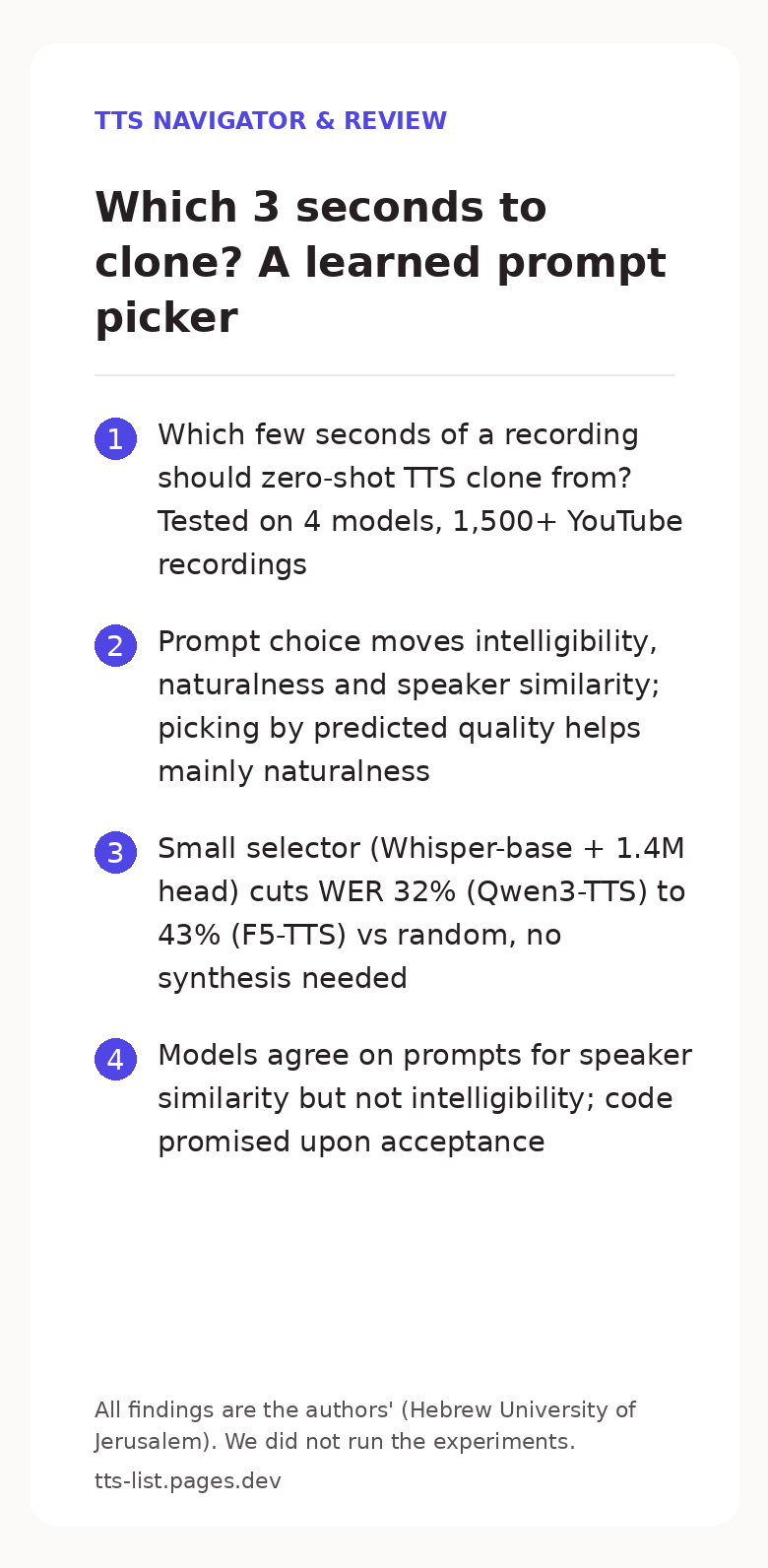
Zero-shot voice cloning demos always hand the model a tidy pre-cut prompt. Real users have a podcast episode or a voice message and a harder question: which few seconds? A new paper from the Hebrew University of Jerusalem (Turetzky and Adi) shows the choice is load-bearing - and that the common practice of picking the cleanest-sounding clip optimizes the wrong thing.
The setup: selection measured, not assumed
The authors cut over 1,500 English YouTube recordings (YODAS, CC-BY) into 19 candidate prompts each - 10 of 3 s, 6 of 5 s, 3 of 10 s from a 30 s stretch - and synthesized with four open TTS models from three families (Qwen3-TTS 0.6B and 1.7B, F5-TTS, Chatterbox): five target sentences, three seeds, every output scored for intelligibility (Whisper WER), naturalness (UTMOS, DNSMOS, and Audiobox Aesthetics as a held-out judge) and speaker similarity (ECAPA-TDNN cosine). Hundreds of thousands of outputs in total.
The findings that matter
- The prompt matters, and it is partly a stable property of the clip. Choosing well (by a "probe" oracle that actually synthesizes from every candidate) cuts Qwen3-TTS's WER by about a third and F5-TTS's by half versus a random pick. Much of the variance is prompt-attributable, not seed noise.
- Predicted quality misses the point. The standard UTMOS/DNSMOS rules improve mainly naturalness - what they are trained to predict - and recover little of the available intelligibility gain; speaker similarity is untouched. And judging a quality rule by its own predictor flatters it: the UTMOS rule keeps 41% of the oracle's UTMOS gain but only 18% by the held-out Audiobox judge (for F5-TTS, none).
- A small learned selector closes most of the gap. A frozen Whisper-base encoder plus a 1.4M-parameter ranking head, trained once per TTS model on that model's synthesis outcomes, picks prompts from audio alone - no synthesis at selection time. On 400 held-out recordings it lowers WER by 1.36 pp (32% relative) for Qwen3-TTS 0.6B and 43% relative for F5-TTS, beating the quality rules and nearly matching a probe that synthesizes 228 utterances per recording.
- Models agree on similarity, not on intelligibility. All four models largely pick the same prompt for speaker similarity (corrected correlations 0.68-0.88) - a property of the clip. Which prompt speaks intelligibly is largely model-specific (Qwen pair: 0.64; Qwen vs F5: 0.39; Chatterbox, which reads no transcript: at most 0.08). For transcript-reading models, prompts that end in silence and whose transcripts Whisper is confident about help; no single descriptor explains more than a sliver.
The noise twist
When candidates differ in recording conditions rather than content (LibriSpeech with controlled added noise), the quality rule does exactly its job - it picks the clean version 79% of the time and wins naturalness and similarity. Yet the audio selector still lowers WER more (by 0.42 pp), picking the clean version only 31% of the time. Clean and intelligible-to-the-model are simply different axes.
Caveats and availability
- Four models, English only (YouTube + LibriSpeech with added noise); prompts of 3-10 s within a 30 s budget. Other languages and conditions are open.
- The best selector is trained per TTS model - one labelling run of a few hundred thousand syntheses per model, paid once per model rather than per voice. Transfer across models is partial (51-85% of probe gain depending on the pair).
- The listening test (7 listeners) finds no naturalness cost but is too small to resolve the clarity advantage; prosody beyond pitch variability and tempo is unevaluated.
- Code is promised "upon acceptance" - not available today.
Why it matters
- A free quality upgrade hiding in plain sight. Anyone cloning from long recordings already makes this choice, usually by ear or by a quality score. This paper shows both are leaving intelligibility on the table - and that the fix is a 22M-parameter add-on, not a new TTS model.
- Benchmark hygiene: one fixed prompt per test sentence mixes the model's quality with the luck of the prompt. Reporting variance across prompts would separate the two - a methodological nudge the whole evaluation ecosystem could adopt.
- An honest dual-use note from the authors: better prompt selection lowers the effort of producing usable clones. They use only CC-BY and LibriSpeech audio, but note that a Creative Commons license is not the speaker's consent to be cloned.
Source (read; link verified November 2, 2026)
- What Makes a Good Audio Prompt for Zero-Shot TTS? Learning Prompt Selection from Synthesis Outcomes - arXiv:2610.40372 (October 29, 2026) - all findings, numbers and availability notes above.