Suaradee v0.2: an 8.5 MB Malay TTS that runs in a browser tab, halved its word errors by fixing phoneme timing - and still tells you it sounds muffled
November 15, 2026 - by TTS Navi. We read the model card in full; all results below are the author's own measurements.
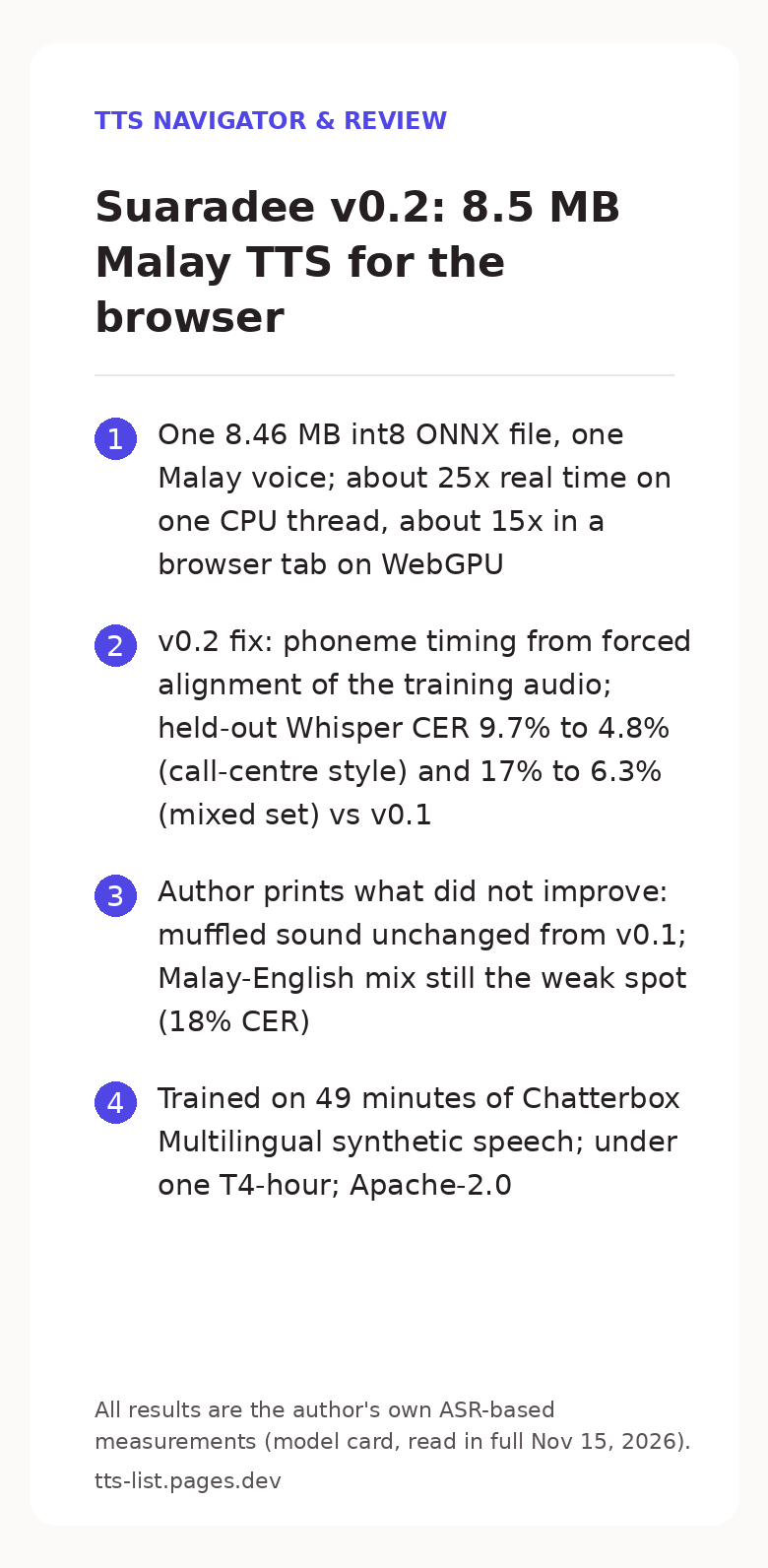
Suaradee v0.2 (Suarify, released November 15, Apache-2.0) is a Malay text-to-speech model that fits in a single 8.46 MB int8 ONNX file and speaks at about 25x real time on one CPU thread, or 15x in a browser tab on WebGPU via transformers.js - nothing leaves the device. It is a 7.9M-parameter model in the Paradee-8M architecture, starting from those weights, with a rule-based Malay front end (a 24,000-word lexicon for the pepet and taling vowels) writing phonemes in Kokoro-82M's 178-symbol vocabulary. The training data is synthetic: about 750 Malay sentences rendered by Chatterbox Multilingual, converted to one consistent voice, 49 minutes kept after trimming; training took under an hour on one T4. v0.1 and v0.2 landed the same day; v0.2 is the one to use.
The v0.1 to v0.2 fix, and its limits
The diagnosis is specific: half of the phoneme boundaries inside words in v0.1's training labels were more than one frame (25 ms) off, because they were guessed from word-length proportions. v0.2 re-times the phonemes of every Malay word from a letter-level forced alignment of the training audio (6,050 of 6,318 words) and retrains the identical architecture the identical way. The author measures the result with Whisper large-v3 as listener (CER, lower is better; the recogniser itself misreads about 9% of characters on the clips the model was trained to copy): on 40 held-out call-centre-style sentences, median CER drops from 9.7% to 4.8%; on a 60-sentence mixed held-out set, from 17% to 6.3%. The breakdown is kept visible: numbers and money improve from 21% to 2.9%, general text from 17% to 12%, and Malay mixed with English words does not improve - 17% to 18%, the model's weak spot, since only about 430 common English words are handled.
What it does not fix
The card is explicit that the muffled sound is unchanged from v0.1: roughly 30% less energy above 4 kHz than the speech it was trained on, with smeared upper harmonics - the cause is the decoder's training, not the timing fix, so the words got better and the timbre did not. Other stated limits: one synthetic female voice with no emotion or style control; short sentences only (split at sentence ends, at most 400 phonemes per piece); numbers, dates and phone numbers are read out in Malay by a rule-based normaliser. The held-out sentences come from the same prompt pool as training (different sentences, similar style), so free text from elsewhere will be harder than the headline numbers suggest - the card says this too.
Our analysis
Suaradee is the distillation recipe applied to a language with almost no open TTS: a large teacher (Chatterbox Multilingual) generates a small consistent corpus, a tiny student learns it in an hour, and the result runs anywhere ONNX does. The honest engineering detail worth copying is the forced-alignment fix - a reminder that in small-data TTS, label quality is often the whole ballgame, and "same architecture, same recipe, better alignment" can halve word errors without touching the model. The caveats are real: the entire training signal is one teacher model's synthetic speech (so the ceiling is the teacher's Malay), the voice is muffled by the author's own spectral measurement, English mixing - the natural register of Malaysian tech and business speech - is precisely where it fails, and all evaluation is ASR-based with no human listening. For a call-centre prototype, an accessibility widget, or an offline app that needs intelligible short Malay sentences today, 8.5 MB is a remarkable entry point; for anything brand-facing, wait for the decoder to be retrained.
Sources
- Suaradee v0.2 model card (read in full, November 15, 2026)
- Suaradee web demo (in-browser, on-device)
- Paradee-8M (architecture and initial weights)