Ovoz TTS v1: a 4.5M Uzbek voice that runs in your browser - with its bugs in the README
November 26, 2026 - TTS Navi. We read the model card in full. All figures are the authors' own measurements, not our tests.
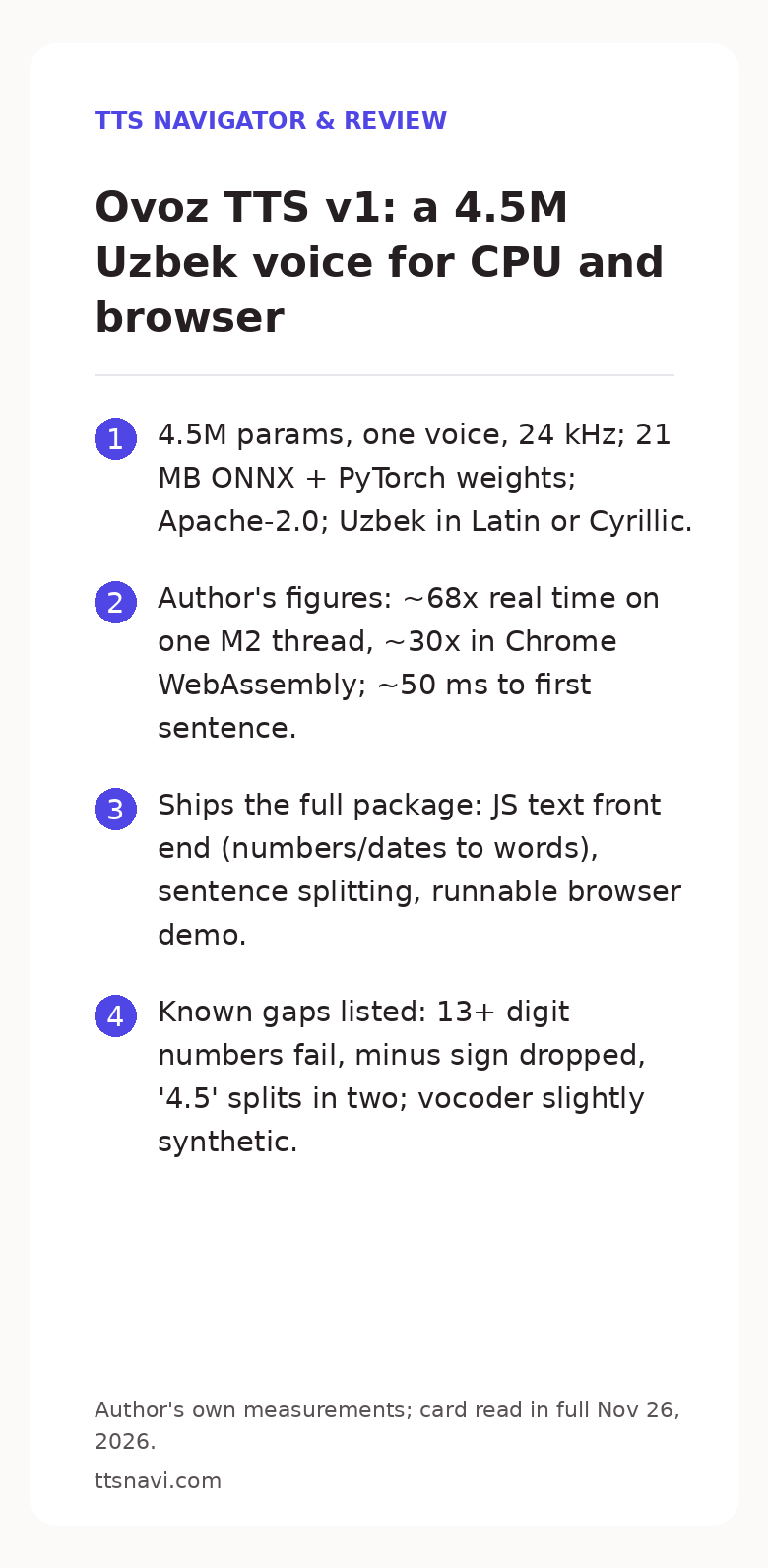
Ovoz TTS v1 (ali10x / OvozAI, released November 25, 2026) is a small Uzbek text-to-speech model: 4.5M parameters, one voice, 24 kHz, 21 MB as ONNX (opset 17) with PyTorch weights (step 45,000) alongside. The company reports about 68x real time on a single Apple M2 thread and about 30x in Chrome via WebAssembly on one thread, with the first sentence ready in roughly 50 ms. Apache-2.0. A live browser demo runs the actual model at ovozai.uz - no install, no account.
Ships a real front end, not just weights
The repo includes uz-frontend.mjs, the Uzbek text front end in JavaScript: Latin or Cyrillic input, with numbers, dates, times and percentages written out as words before phonemization, plus sentence splitting for the model's 512-token window. Inputs are tokens, a stress track, voice id, speed and two pitch controls (shift and range, with the note that 0.058 shift is about a semitone); outputs are 24 kHz float32 audio and per-token durations. That is a complete embeddable package - model, frontend, usage code - which at 4.5M parameters is the point: this targets CPU, browser and Telegram-bot deployment, not GPU demos.
The known-gaps section names real bugs
The card's own list: numbers of 13 or more digits fail in the front end, a minus sign is dropped, and "4.5" is read as two sentences; the vocoder has a slightly synthetic character. No MOS, no ASR round-trip numbers - the evidence offered is the runnable demo and the speed figures. Read it as what it is: a first release of a tiny, honest, single-voice Uzbek reader whose tokenizer bugs are documented rather than discovered.