trada-tts: a 10M-parameter Vietnamese TTS that runs in your browser, with the most transparent model card we have read this month
November 21, 2026 - TTS Navi. We read the trada-tts model card in full, including its ONNX export table and voice-construction notes. All figures are the author's own measurements, not our tests.
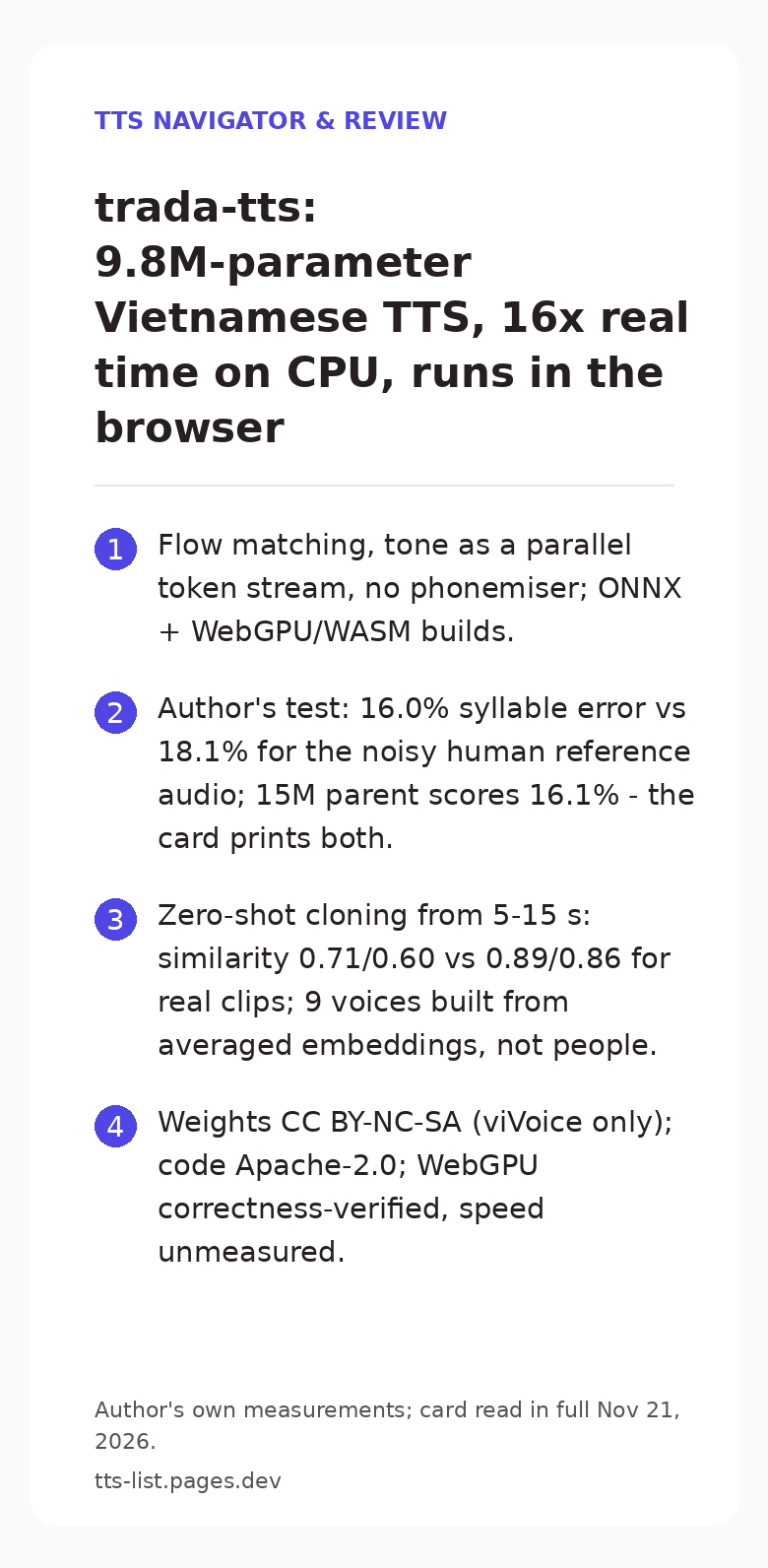
Trà Đá (tsdocode, released November 20, 2026) is a 9.8M-parameter flow-matching TTS for Vietnamese - 8.26M parameters turning text into latents and 1.54M decoding them to 24 kHz audio. It treats Vietnamese tone as a parallel token stream rather than running a phonemiser, uses a CAM++ 192-d speaker embedding for voice control, and ships four ONNX graphs (10 MB encoder, 23 MB flow model, 6 MB decoder, 28 MB speaker encoder) plus a JavaScript pipeline that runs it in the browser via WebGPU with a WASM fallback. Code is Apache-2.0; the weights are CC BY-NC-SA 4.0 - non-commercial - because they were trained only on the viVoice dataset.
The evaluation table prints its own noise floor
On 80 viVoice test utterances scored by Whisper large-v3-turbo, the model's syllable error rate is 16.0% - and the card prints, next to it, that the real human recordings score 18.1% under the same ASR, because the test audio is noisy YouTube material. The 15M-parameter parent model scores 16.1% on the same test, so the 10M version is, in the author's words, not measurably worse. DNSMOS OVRL on the published samples runs 3.22-3.45. Speed, author-measured: RTF 0.063 (about 16x real time) on 4 CPU threads of a server Xeon with the first sentence out in 0.14 s median; about 2x real time in WASM on 8 threads in headless Chromium on a shared server. WebGPU output was verified for correctness (waveform correlation 1.00000 against WASM) but not benchmarked on real GPU hardware - the card says exactly that.
Zero-shot cloning and nine synthetic voices, quantified
Cloning takes a 5-15 s reference clip. On unseen speakers, CAM++ cosine similarity between clone and reference is 0.71 and 0.60, against 0.89 and 0.86 for real clips of the same speakers - so it captures timbre and pitch, and the card warns it does not capture accent or speaking style. The nine preset voices are not recordings: each is the average speaker embedding of 6-63 viVoice channels of one gender, with a table showing maximum similarity to any single source channel (0.41-0.67, where a real speaker's own clips score 0.73 against their own average). Five of the voices blend channels from one TikTok content genre each - movie reviews, mystery storytelling, news, gaming, product sales - getting the genre's timbre without copying any creator.
Engineering details worth stealing
The card documents a one-line fix with outsized effect: a min_syllable_ms=160 duration floor took number-heavy text from 10.0% to 6.0% WER at a 2% speed cost (author-reported). Export correctness is verified, not assumed: ONNX versus PyTorch max relative difference is at most 2e-6 per graph, and the JavaScript pipeline produces waveforms with correlation 1.000000 against Python on identical noise. Phrasing is user-controllable with per-word break marks. Stated limitations: trained on 1-15 s utterances (long text is split at sentence and comma boundaries); the normaliser may read foreign words letter by letter; the small 32-d codec keeps quality clean but not studio grade.
Why it stands out
Small on-device TTS releases are common this year; honest ones are not. This card gives you the noise floor of its own test set, the similarity gap between clones and real audio, the provenance of every preset voice, a named reason the weights are non-commercial, and a responsible-use paragraph that actually says something (clone only with consent, disclose synthetic audio). For Vietnamese - a tonal language most edge TTS projects skip - this is a serious, runnable package, and a template for how to report one.
Sources
- https://huggingface.co/tsdocode/trada-tts (link unavailable)
- https://huggingface.co/datasets/capleaf/viVoice