Murivo-TTS: a 21M flow-matching engine for Yoruba, Hausa, Igbo and English
November 10, 2026 - by TTS Navi. We read the full model cards; what few measurements exist are the developer's own, and we say so where there are none.
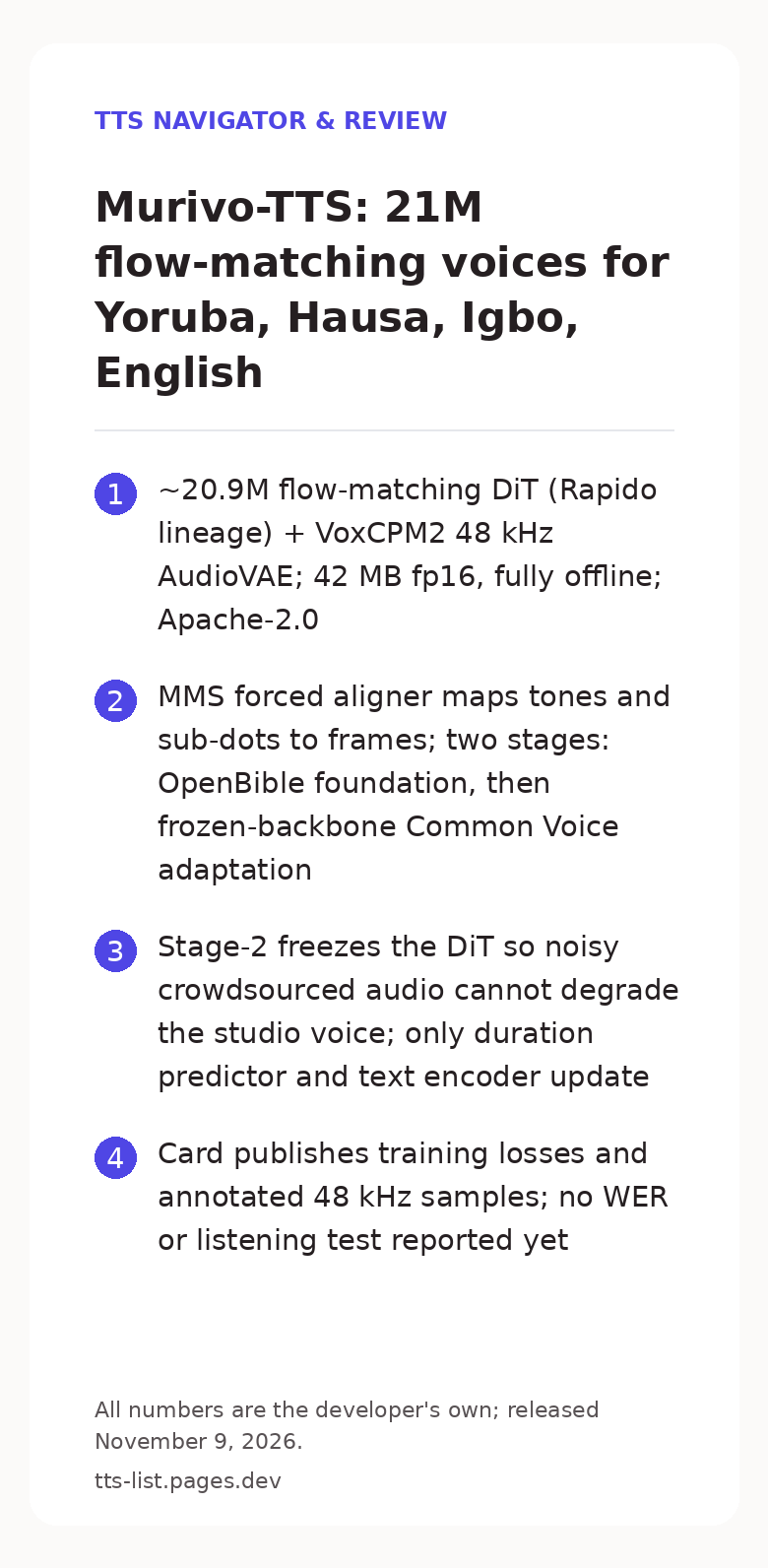
Nigeria's three major languages - Yorùbá, Hausa and Igbo, with well over a hundred million speakers between them - have almost no open TTS, and what exists rarely handles the tone that carries meaning in Yorùbá and Igbo. Murivo-TTS, released on Hugging Face on November 9 by solo developer Samuel Olubukun, is a family of four ~20.9-million-parameter text-to-speech engines (English, Yorùbá, Hausa, Igbo) that synthesize 48 kHz audio natively: a flow-matching Diffusion Transformer acoustic backbone in the Rápido TTS lineage, decoded by the VoxCPM2 48 kHz causal AudioVAE. Each checkpoint is about 42 MB in fp16, runs fully offline in pure Python and PyTorch, and is Apache-2.0.
How a 21M model learns tone languages
The training recipe is documented in unusual detail for a solo release. Character-level duration targets come from Meta's MMS forced aligner (facebook/mms-1b-all), mapping tones, sub-dots and orthography onto acoustic frames. Stage 1 trained on OpenBible narration - 5,000 steps for the Yorùbá model - with an early warmup that froze the DiT backbone to anchor text alignment before joint training. Stage 2 fine-tuned on Nigerian Common Voice for 1,800 steps with the backbone kept frozen, updating only the duration predictor and text encoder, explicitly so microphone noise and room acoustics in crowdsourced recordings cannot degrade the studio voice learned in stage 1. The card publishes its convergence table (stage-1 flow loss 0.8912; stage-2 duration loss 0.1881) and three 48 kHz showcase samples per language with notes on which tonal phenomena each sentence exercises.
Limits, as they stand
The card's own numbers are training losses, not quality metrics: there is no WER round-trip, no listening test, no MOS. The samples are developer-picked showcase sentences, and the Yorùbá checkpoint is labeled "Stage 2 Conversational (Step 1,800)" - an early checkpoint of a small model. The vocoder is borrowed (auto-downloaded from OpenBMB's VoxCPM2 on first run), and the English model is LJ Speech-based, so it is a single-voice family by design. Tone correctness for Yorùbá and Igbo is exactly the claim that needs native-speaker evaluation, and none exists yet.
Our analysis
Murivo's significance is the recipe, not the benchmark table it does not have. The two-stage design - studio-quality foundation, then frozen-backbone conversational adaptation - is a cheap, repeatable answer to the central problem of low-resource TTS: the abundant data (read religious text) is clean but unnatural, and the natural data (Common Voice) is noisy. Freezing the backbone in stage 2 is the kind of trick bigger labs use silently; here it is written down with the reasoning attached, alongside the MMS alignment step that makes tonal orthography learnable at 21M parameters. Combined with this week's Kolokwa release from AfriSpeech, West African languages went from "no open TTS" to "two different open recipes in two days." Judge Murivo by its samples today; judge it again when someone runs the evaluation the card honestly omits.
Sources
- Hugging Face model card: murivo-tts-21m-yoruba (read in full, November 10, 2026); sibling checkpoints: hausa, igbo, english
- Rápido TTS (acoustic architecture lineage); OpenBMB VoxCPM2 (48 kHz AudioVAE vocoder)
- Training data: multilingual-tts/open-bible and Nigerian Common Voice