HamsTTS: Levantine Arabic-English code-switching on 13k utterances, with the misses printed next to the passes
November 24, 2026 - TTS Navi. We read the model card in full, plus the project's published per-utterance evaluation file. All figures are the authors' own measurements, not our tests.
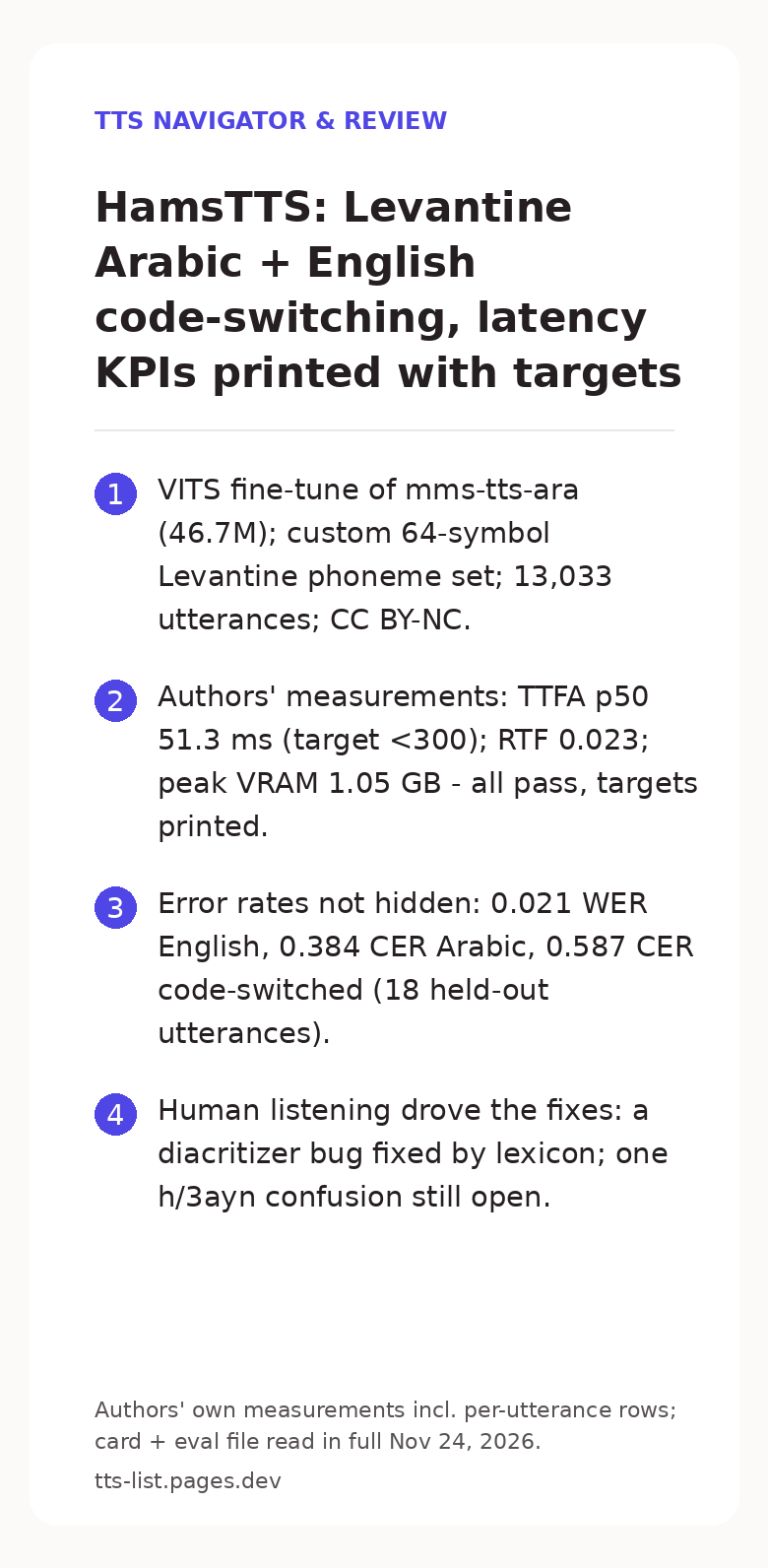
Most Arabic TTS speaks Modern Standard Arabic; most bilingual speakers in the Levant do not. HamsTTS (mohammed/hams-tts-levantine, built for Hams.AI, released November 23, 2026) is a VITS fine-tune of facebook/mms-tts-ara (46.7M parameters) aimed at Levantine Arabic, English, and switching between them mid-sentence. The character-level Arabic vocabulary is replaced with a custom 64-symbol IPA-derived phoneme inventory - Levantine-corrected (qaf to glottal stop, jeem to zh, dialect lexicon overrides) and shared across both languages. Three speakers, one per training corpus: ClArTTS (9,460 utterances, full corpus), Arabic Speech Corpus (1,873, Syrian-accented, full corpus), LJSpeech (1,700). Total 13,033 utterances. License is inherited CC BY-NC 4.0 from the base checkpoint - non-commercial - and the card says so in the second paragraph.
A latency table with targets in it
Measured on an RTX 4070 Ti, server mode, end-to-end on 18 held-out utterances: TTFA p50 51.3 ms and p95 139.2 ms against a <300 ms target; mean RTF 0.023 against <0.3; peak VRAM 1.05 GB against a 3 GB budget. The authors note they had no access to their originally planned L4 hardware and argue the margins are wide enough that the choice cannot flip a pass. Printing the target column next to the measured column is what turns benchmark numbers into an engineering claim.
The error rates they do not hide
ASR round-trip (faster-whisper large-v3) plus DNSMOS on the same 18 utterances, with per-utterance rows published: pure English 0.021 WER; pure Arabic 0.384 CER; code-switched 0.587 CER. The card explains part of that gap is the metric, not the model: Whisper transcribes to standard orthography while the model deliberately speaks Levantine pronunciation, so some "error" is a wrong reference. It is also careful not to hide behind that explanation - with 13k utterances across two Arabic speakers, it calls intelligible-but-imperfect a believable result at this scale, not a bug.
Listening found what the numbers did not
The most credible part of the card is what human listening caught. On round 2 it surfaced a pure text-pipeline bug - the mishkal diacritizer mapping dialect words onto unrelated MSA words (dialect "am" heard as MSA "uncle") - fixed with 8 lexicon entries, no retraining; and a genuine model-level confusion between h and 3ayn on at least one word, recorded as still open. Round 3 exists because listening found round 2 under-converged on English specifically; more epochs recovered English to its best level across all three rounds while Arabic held. The headline limitation is structural: there is no code-switched audio in the training set at all, so code-switch quality emerges from a shared phoneme inventory rather than from examples - and the language conditioning is token-level, not a per-frame embedding. If you are building dialectal or mixed-language Arabic speech, this card is the rare one that tells you exactly where the floor is.