PAWP-TTS 1.5M: a 6 MB bilingual English-Nepali voice that code-switches mid-sentence, benchmarked against human audio
November 22, 2026 - TTS Navi. We read the PAWP-TTS model card in full, including its latency methodology notes. All figures are the author's own measurements on small held-out sets, not our tests.
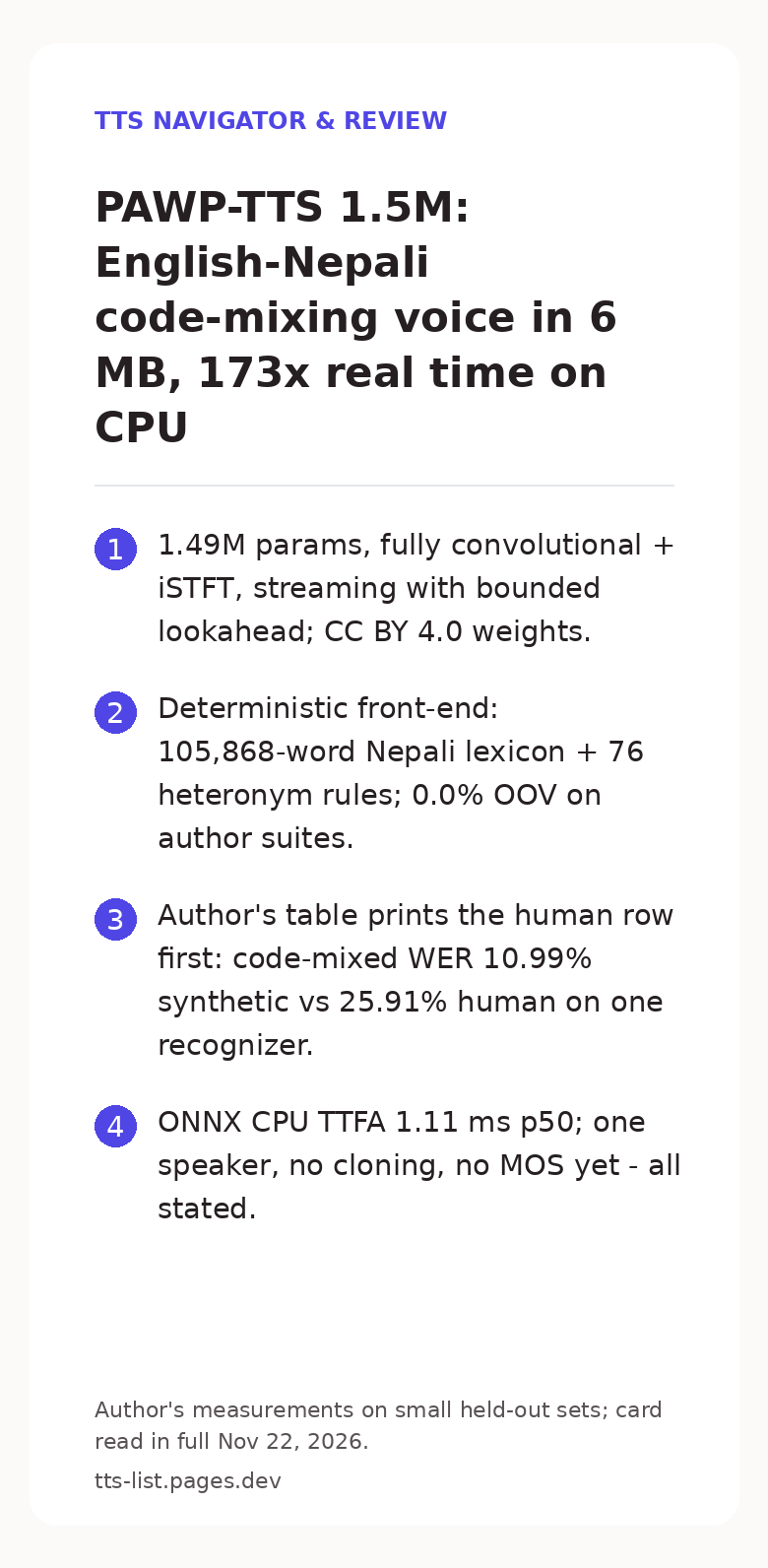
Text a Nepali speaker and the reply mixes Devanagari and English in the same sentence: flight, ticket, email stay English. PAWP-TTS 1.5M (Firoj112, released November 21, 2026) is built for exactly that register: a 1.49M-parameter (5.98 MB fp32) streaming TTS speaking English, Nepali and code-mixed text in one consistent voice at 24 kHz, no LLM at inference. The architecture is fully convolutional - ConvNeXt1D text encoder, duration/pitch/voicing/energy predictors, ConvNeXt1D acoustic network, and a ConvNeXt1D + iSTFT waveform decoder - with bounded lookahead for streaming. Weights and samples are CC BY 4.0, code Apache-2.0.
A deterministic front-end instead of neural guessing
The pronunciation brain is not in the weights: a 105,868-word Nepali lexicon (about 99% rule/paradigm-generated), 76 context-dependent heteronym rules with 152 readings, and eSpeak-NG for English feed a unified 128-token phonological inventory with language, stress and boundary flags. The card claims coverage of Kathmandu Nepali's four-way stop contrasts, dental/retroflex distinctions, gemination, and the sa/sha/ssa sibilant merger - and reports 0.0% out-of-vocabulary across its English, Nepali and code-mixed suites, with a Hindi /sh/ symbol-bleed check at 0.0% (author-run smoke tests, one flagged as not reviewed by native speakers).
The evaluation table prints the human row first
Held-out ASR intelligibility (single recognizer, small n: 30 English, 30 Nepali, 9 code-mixed sentences - the card states the sizes): human reference audio scores 2.63% WER English, 11.60% Nepali, and 25.91% code-mixed on that recognizer. The released checkpoint scores 4.86% / 11.41% / 10.99%. Read that carefully: on code-mixed text the synthetic voice is easier for the recognizer than the human recordings - plausible when human code-switching is fast and accented - and the card prints the row that makes that visible instead of hiding it. The table also tracks three checkpoints, so you can see the target-voice fine-tune trade English error (3.14% to 4.86%) for Nepali and code-mix gains. No MOS exists yet; the card says so.
Latency with methodology attached
Streaming time-to-first-audio at 60 ms chunks, batch 1, 3 warmups discarded, 30 timed utterances: ONNX Runtime on 4 CPU threads, 1.11 ms p50 (1.52 p99) neural-side, front-end 0.16 ms - 173x real time. PyTorch CPU 74x, RTX 4090 96x. The report excludes front-end time from the neural column and says so, which is the opposite of benchmark-blending. Training: 92k steps of multi-speaker pretraining with GAN discriminators on public corpora (LibriSpeech, LJSpeech, OpenSLR Nepali), then 20k steps of single-voice fine-tune on one RTX 4090, then a 10k-step polish phase.
Named limits
One speaker only, no zero-shot cloning. Occasional iSTFT phase coloration on sustained fricatives or vowels. The training feature cache predates the final lexicon and a va-to-ba rule update, with a rebuild planned - an admission most cards would omit. Together with yesterday's Malagasy mg-voca and Ukrainian mova-tts, PAWP-TTS marks a pattern this week: sub-10M to sub-1B models for languages the frontier labs skip, with evaluation sections that tell you where the floor is.