PsarAI-Speech-Flash: code-switching Khmer-English-French TTS in 257 MB, with the ASR transcript printed next to each sample
November 14, 2026 - by TTS Navi. We read the model cards in full; all results below are the author's own measurements.
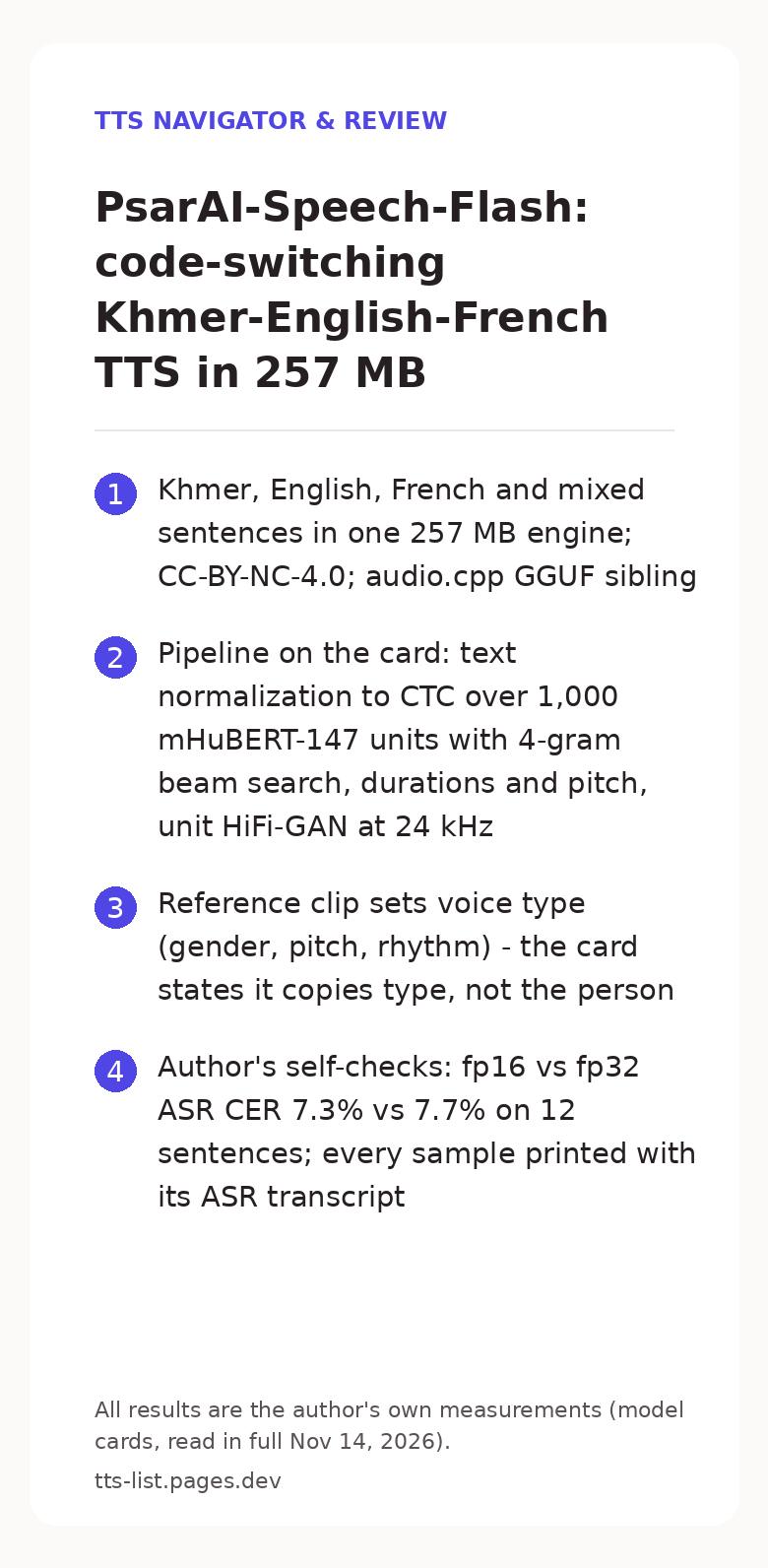
One day after a from-scratch Khmer VITS made our picks, Khmer gets a second, very different entry: PsarAI-Speech-Flash (November 13, CC-BY-NC-4.0) is the small, fast engine of the PsarAI-Speech family, speaking Khmer, English and French - including mixed Khmer-English and Khmer-French sentences, the way Khmer is actually texted. The full PsarAI-Speech (3.2 GB) does zero-shot cloning; Flash strips that to 257 MB and a deliberately narrower promise: a reference clip sets the voice type - gender, pitch, rhythm - and the card says plainly it "copies voice type, not the person."
The architecture
The pipeline is fully spelled out on the card: text is normalized (numbers to words to characters), then a speaker-conditioned text-to-unit model predicts discrete speech units - CTC over the 1,000-unit mHuBERT-147 codebook with a unit 4-gram beam search (kenlm) - then durations and pitch, then a unit HiFi-GAN vocoder conditioned on speaker and pitch produces 24 kHz audio. Weights are stored in float16 and computed in float32. The speaker encoder is CAM++ (weights from the MIT-licensed Chatterbox release). A GGUF sibling package targets the audio.cpp runtime, and the card's samples were rendered through it to prove parity.
The self-checks
Two habits here deserve imitation. First, the quantization check: twelve sentences across Khmer, English, French, mixed and numbers, transcribed back with ASR - float32 scores 7.7% CER, float16 7.3%, with 7 of 12 sentences identical and correlation above 0.999, labeled explicitly as a small no-listen-back check. Second, every sample on the card ships with a "Heard" column: what PsarAI's own ASR transcribes from the generated audio, spelling slips and all, so a visitor sees the intelligibility evidence rather than a claim. In the mixed Khmer-English demo the ASR hears the English words as Khmer transliteration, which tells you as much about the evaluator as the model - and the author leaves it in. The three voice-type demos print CAM++ similarity scores of 0.38 to 0.61, consistent with "type, not person."
Our analysis
Code-switching is the right problem for Cambodian products: mixing English (or French) words into Khmer sentences is default register, and most multilingual TTS treats it as an edge case. A unit-LM with a 4-gram over mHuBERT units is an unfashionable but practical choice in 2026 - small, fast, fully inspectable, and easy to port to runtimes like audio.cpp, which is exactly what the GGUF sibling does. The "voice type, not voice" framing is both honest scope and sensible safety posture for a lightweight engine, and printing your own ASR's mistakes next to your samples is a credibility move more model cards should steal. The caveats: the license is non-commercial, the checks are twelve-sentence scale with no human listening, the voice-type similarities are modest by cloning standards (by design), and we could not find a paper or training-data documentation beyond the cards. For Khmer-language apps that need mixed-script speech on modest hardware today, this is the most practical artifact we have seen; for anything requiring real cloning or commercial use, the full PsarAI-Speech or another license applies.
Sources
- PsarAI-Speech-Flash model card (read in full, November 14, 2026)
- PsarAI-Speech (full model, zero-shot cloning)
- PsarAI-Speech-Flash-GGUF (audio.cpp build)