PersonaPlex-7B: full duplex speech-to-speech with persona control - and our own CPU run, 18.6x slower than real time
November 25, 2026 - TTS Navi. We read the repo and model card in full and ran the model ourselves on CPU. Vendor benchmark figures are NVIDIA's own measurements on an A100 80 GB; the molt run figures are ours.
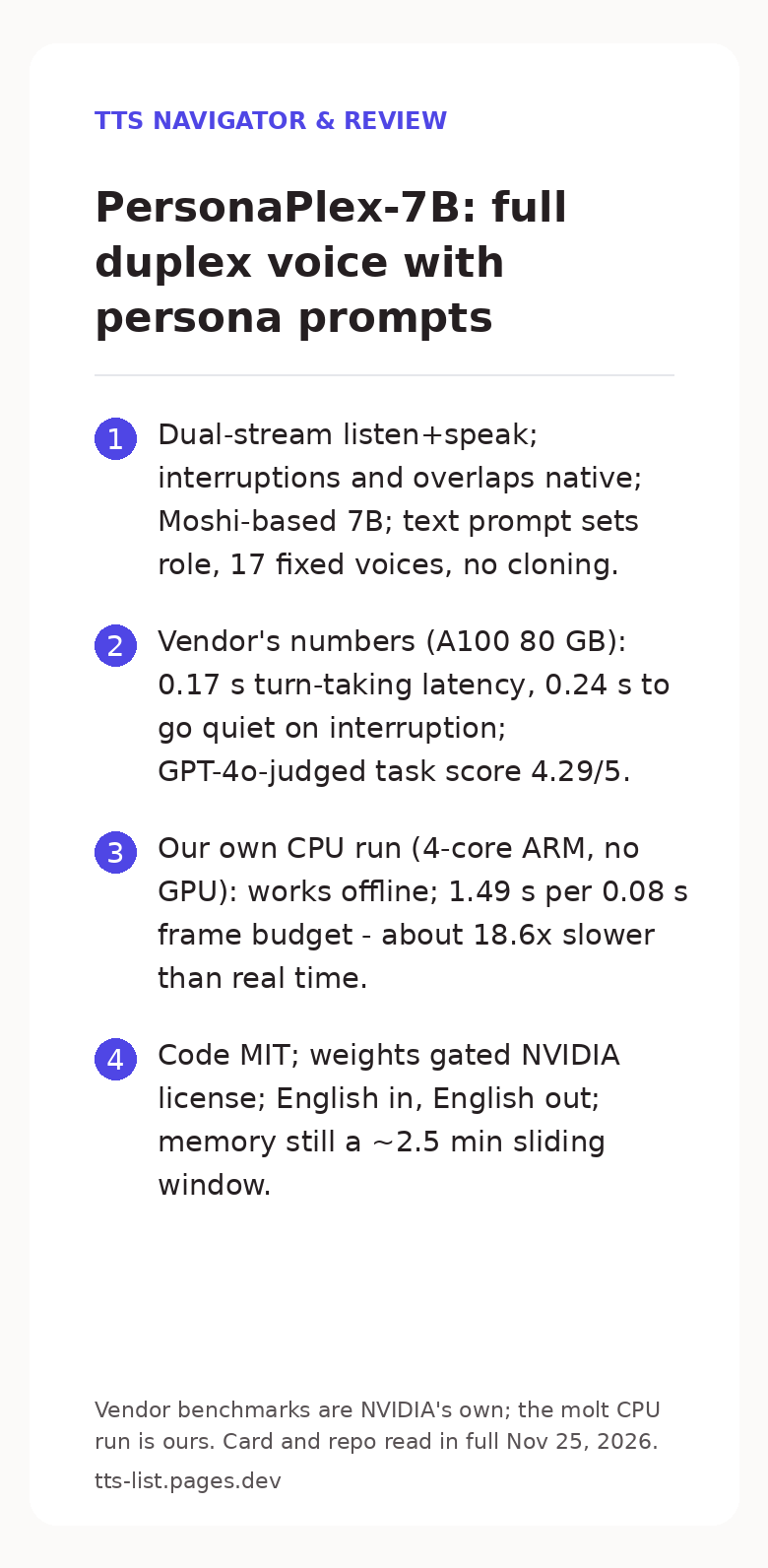
A post going around claims NVIDIA "just solved the biggest bottleneck in voice AI" with a brand-new model. The model is real and genuinely interesting; nearly every framing claim in the post is not. PersonaPlex-7B is a full-duplex speech-to-speech conversational model from NVIDIA: one model that listens and generates speech at the same time (dual-stream), so it handles interruptions, barge-ins, overlaps and rapid turn-taking without an ASR-to-LLM-to-TTS pipeline in the middle. It is built on Kyutai's Moshi architecture and Moshiko weights with the Mimi codec, 7B parameters, 24 kHz audio in and out. Its own model card lists the release date as January 15, 2026 - about ten months before the viral post - and the GitHub repo (12,313 stars as of November 25, 2026) has been public since early January. Persona control comes from two prompts set before the conversation starts: a text prompt for role, background and scenario, and a voice prompt (audio tokens) for vocal characteristics.
Full duplex is real - and it is not the whole voice-agent problem
What PersonaPlex removes is the sequential pipeline: no waiting for speech recognition to finish, then a text model, then synthesis. Listening and speaking run concurrently, and the model updates its state from your ongoing speech while still producing fluent output. The official materials present it as a conversation layer: the card and README document voice and persona prompting, the server and offline evaluation, and say nothing about tool calling, business logic, retrieval or external integrations. Our own test was offline speech only, so we verified none of those capabilities and draw no conclusion about them. What the full-duplex design directly addresses is the part of voice demos that feels robotic - the dead air, the inability to interrupt.
Personas are prompted, voices are picked from a fixed set
The text prompt sets the persona: the repo ships examples from a QA assistant ("You are a wise and friendly teacher...") to customer service roles with names, prices and pickup schedules baked into the prompt. The voice prompt selects vocal characteristics from 17 pre-packaged embeddings: four natural and five variety voices per gender (NATF0-3, NATM0-3, VARF0-4, VARM0-4). This is not arbitrary voice cloning - you pick from a fixed set, not from your own recordings. Training data: synthetic conversations for assistant and customer-service roles, plus real conversations from the Fisher English corpus (7,303 conversations). A recent repo update pins the system prompt (voice + text) in context for the whole conversation, enabling what NVIDIA calls endless stable conversations - but conversational memory is still a sliding window of roughly the last 2.5 minutes.
English only, in both directions
The card's stated use case: English speech input, English speech response. The language tag is en. Anyone expecting a multilingual voice agent out of the box will not find one here; the Moshi backbone's Helium LLM gives plausible out-of-distribution text behavior, but the card is explicit that the supported path is English speech to English speech.
The vendor's own numbers
NVIDIA reports FullDuplexBench results on the card (their benchmark, their runs, on A100 80 GB): smooth turn-taking takeover rate 0.908 with 0.170 s latency from when you stop speaking to when the agent starts responding; user-interruption takeover rate 0.950 with 0.240 s from your interruption to the model going quiet; a GPT-4o-judged task adherence score of 4.29 out of 5; speaker similarity to the voice prompt 0.650 (WavLM cosine). Those are the model's own measured numbers on datacenter hardware, not ours - the next section is ours.
"100% open source and free" needs an asterisk
The code is MIT. The weights are not: they sit under the NVIDIA Open Model License, the download is gated (you must log in to Hugging Face and accept the license), and the base Moshiko weights carry CC-BY-4.0. The card does say the model is ready for commercial use, so this is permissive by lab-release standards - but "open source" in the strict sense applies to the code only. Deployment cost is also real: supported hardware is NVIDIA Ampere/Hopper (A100/H100), Linux, PyTorch; a CPU-offload flag exists for smaller GPUs but nothing in the card promises CPU-class real-time performance.
We ran it on a 4-core ARM box with no GPU
We ran it ourselves on an Oracle ARM Neoverse-N1 (4 cores, 23 GB RAM, no GPU) using the official moshi code, the official BF16 weights (16.7 GB), voice NATF2 and the default assistant prompt, on the first 10 seconds of the official input_assistant.wav sample (125 frames at 12.5 frames per second), timing each frame with perf_counter in a copy of the official offline script changed by exactly 3 timing lines. It runs: the model loaded, generated 10 seconds of output audio plus a coherent English reply, and exited cleanly - peak memory about 18.2 GB of the 23 GB available. But it is far from real time: each frame took about 1.49 seconds (model step mean 1.404 s, audio decode 0.086 s) against a real-time budget of 0.08 seconds - roughly 18.6x slower than real time - so the 10-second sample took 281 seconds end to end (about 186 seconds in the frame loop). On this class of hardware PersonaPlex is an offline batch tool, not a conversational demo. Caveats: one 10-second sample, and we judged the transcript only, not the audio quality - this run says nothing about how good it sounds overall. The generated reply transcribes as: "Hey, let me know if you have any questions. Yeah, you can stop it by washing the rice," - you can listen to the actual output below and judge it yourself.
Three patches it took to run on CPU at all
The stock code did not run on CPU out of the box. Loading the voice embedding crashed trying to deserialize onto a CUDA device until we passed map_location="cpu" in lm.py; the sphn dependency needed CMAKE_POLICY_VERSION_MINIMUM=3.5 to compile on ARM; and torch had to be pinned below 2.5 to satisfy the official requirements. None of these are in the README prerequisites. If you plan a CPU evaluation, budget for them.
Where it sits against what we have covered
PersonaPlex joins a small set of full-duplex open releases we have tracked: speculative-listening decoding for full-duplex latency, Haru-4B's 65 ms framing-latency self-host option, Phonic's speech-to-speech agents, and Apriel-Voice-27B's MIT speech-reasoning preview. PersonaPlex's differentiator is persona control (text role plus a fixed voice set) on top of a ten-month-old, heavily-starred Moshi fine-tune with vendor benchmark tables - plus the reminder that virality and freshness are different things.