Block's Dessa: a full-duplex voice model trained only on human speech - what is claimed, what the demos show, what is missing
Published October 25, 2026 · Built from Block's official Dessa page and the TechCrunch and The Verge reports, all read in full on October 25, 2026. Every capability claim is Block's own - we did not test the model, and no outside hands-on exists. Our analysis is marked as such.
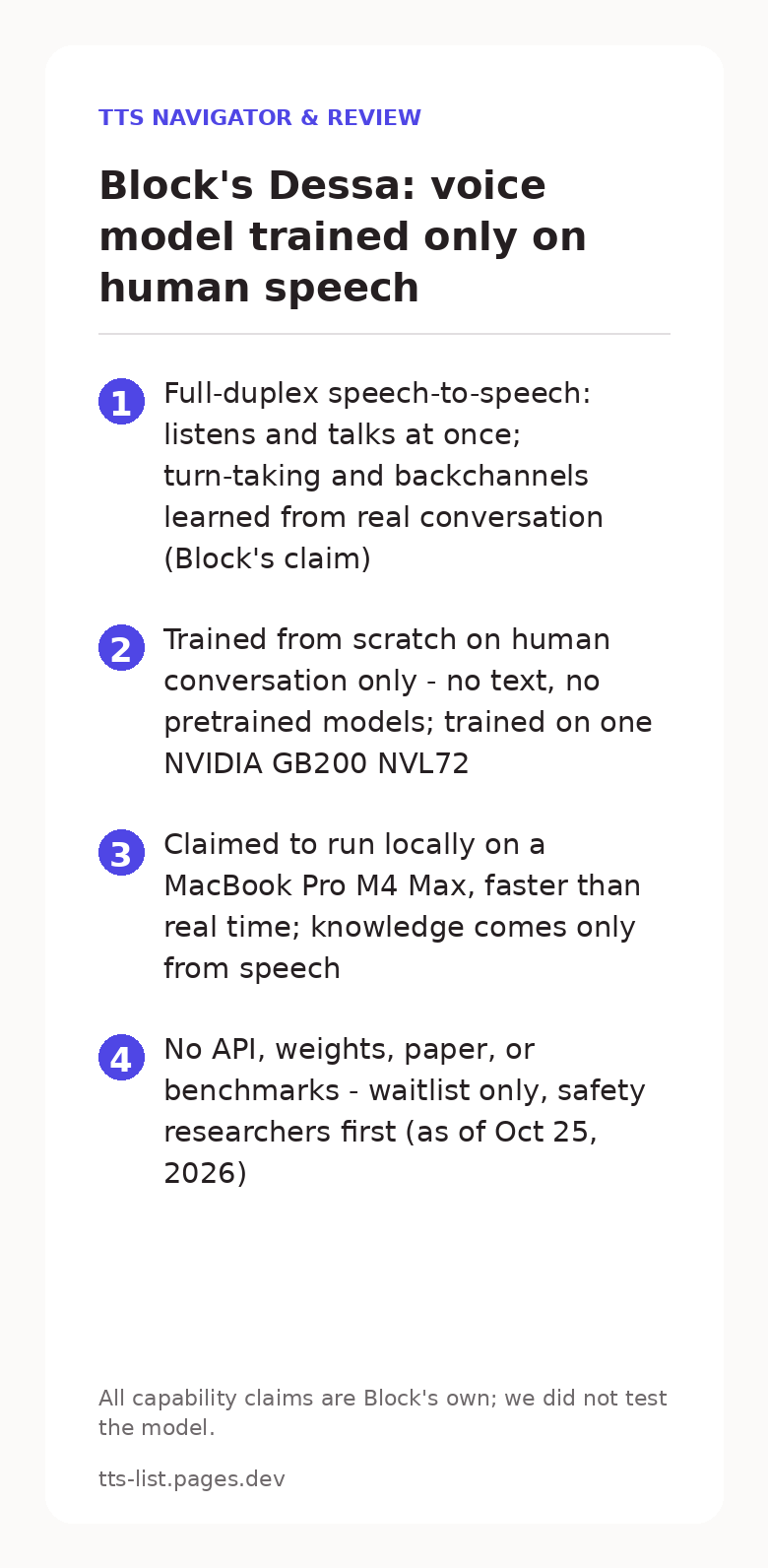
Block, Inc. - Jack Dorsey's company, better known for Square and Cash App - has published a voice model called Dessa that it describes as "the most authentic full-duplex speech model ever built." The claim that sets it apart from every provider on this site: Block says Dessa was trained from scratch on nothing but human conversation - no text, no pretrained models - and learned to hold a real-time conversation simply by listening. This article separates what the company claims, what the published demos show, and what is still missing.
What Dessa is, on Block's own description
- Speech-to-speech, full-duplex. Audio in, audio out: it listens and talks at the same time, the way people do. Block says turn-taking and backchannels ("yeah!", "got it!", "ooh") were learned from real conversation, not engineered as rules, and that it knows when to cut in.
- Trained only on human speech. "No text, no pretrained models." Everything the model knows - including its facts - comes from conversational audio. Block claims it learned language "from hundreds of times fewer words" than text LLMs need.
- Fast and local. Inference runs faster than real time, and Block says it runs locally on a MacBook Pro M4 Max or better.
- One rack to train. Training ran on a single NVIDIA GB200 NVL72 system.
- Emotion is native. In Block's words, the model "natively hears and speaks emotion, sarcasm, laughter, a frustrated sigh, a voice cracking with sadness." There is no text prompt, so there are no emotion tags.
Block's stated reasons for building it: curiosity ("can a model learn to talk the way babies do, without ever seeing a written word? It can. It's just very hard"), better human-AI interaction, and safety - in the team's framing, a voice AI that is deaf to a user's distress is itself a safety problem.
Who built it
Dessa comes from a self-described "very small" research lab inside Block, founded by former members of the Toronto deep-learning startup of the same name, and led by Ragavan Thurairatnam. The page lists six researchers (Louay Hazami, Hashiam Kadhim, Qi (Alex) Liu, Rayhane Mama, Aydin Polat, Marc Tyndel) plus interns, and says the team reports directly to Jack Dorsey. The lab says it has built deep-learning models since 2012 and generative speech models for over eight years.
What the demos show - and what they are
The page carries roughly twenty recordings, each described as a live, unsteered conversation: Dessa laughs mid-sentence when something is funny rather than laughing on cue after you finish; it gets louder when asked; it finishes a speaker's sentence when they blank on a movie title; told about a surprise trip, it gasps "oh my god" and answers "with what sounds like teary gratitude" (Block's description). There are guessing games, life advice, and a head-to-head clip of Dessa talking with OpenAI's GPT-Live-1 - with Block's disclaimer that both voices are AI-generated and that GPT-Live-1's developer is not affiliated with Block and has not reviewed or endorsed Dessa.
Two outside newsrooms listened to the same material. The Verge heard "a mostly natural back and forth" but also awkward, uncanny moments: in one clip the model mistakes the speaker for someone named "Ronaldo"; in another it wanders into an unexpected tangent about Bryan Singer's Superman films. In the Dessa-versus-GPT-Live-1 clip, The Verge's reporter judged Dessa the more natural of the two. TechCrunch's headline verdict was "sounds eerily human." Keep the framing straight: these are curated clips published by the vendor. No outsider has held a free-form conversation with Dessa, and Block has published no evaluation numbers of any kind.
Access: none yet
There is no API, no price, no open weights, no technical paper, and no public demo to try. The page offers a waitlist (name plus an institutional email) and says a small group of AI safety researchers will get early access "to find the risks we haven't anticipated." The page's privacy notice is dated October 21, 2026; Jack Dorsey and Block's own accounts amplified the launch on X on October 23. Thurairatnam posted that Dessa is "a GPT3 moment for speech" - file that under vendor enthusiasm, not evidence.
Why it matters if the claims hold
- Turn-taking learned, not engineered. Production voice agents today bolt turn detection onto a cascaded STT - LLM - TTS pipeline, and interruption handling is one of the hardest parts to get right. Full-duplex research models exist (Kyutai's open-weight Moshi; OpenAI's GPT-Live, which TechCrunch notes Dessa resembles), but Dessa's distinct claim is learning timing, emotion, and knowledge from speech alone, from scratch. If that generalizes, it collapses a lot of pipeline plumbing.
- The knowledge question is wide open. A model whose entire knowledge comes from raw conversation audio has no documents, no tools, and no retrieval. What it knows, and how often what it says is true, is completely unevaluated. The Verge's "Ronaldo" mix-up is a small preview of what unconstrained use will surface.
- There is a business path. TechCrunch points out that Square already uses voice AI to handle ordering; a fast on-device model with native emotion maps directly onto Block's restaurant and retail customers - a plausible reason this project exists beyond research.
- Emotion without tags cuts both ways. Most expressive TTS today (ElevenLabs v4, Fish Audio Drama 3) steers emotion with inline voice tags; TechCrunch notes it is unclear whether Dessa's emotion is secretly tag-steered too. If it is genuinely end-to-end, control and disclosure questions follow - presumably why the safety-researcher call went out before any public release.
Caveats
- Every capability claim above is Block's own. We did not test the model, and no one outside Block has published a hands-on.
- The demos are vendor-curated; the awkward moments already visible in them suggest freer conversation will surface more.
- "World's first... trained only from human speech" is Block's own hedge ("as far as we know"), not an established record.
- Nothing technical has been published: no architecture, parameter count, training-data description, or benchmark. The MacBook M4 Max inference claim and the single-GB200-NVL72 training claim are unverified.
- Launch timeline is inferred from the page's privacy notice (October 21, 2026) and press coverage (October 23-24); Block has not given a formal release date.
Sources (all read in full October 25, 2026)
- Block - Dessa, the Conversation Model trained only on speech (official page) - all product and training claims, demo descriptions, team, waitlist.
- TechCrunch - "Block's new voice model sounds eerily human" (October 24, 2026) - launch context, Dorsey and Thurairatnam X posts, GPT-Live comparison, Square voice-ordering note, voice-tag observation.
- The Verge - "Jack Dorsey's Block made an AI model that talks to you like an awkward new friend" (October 23, 2026) - independent listening impressions, including the demos' awkward moments.