Haru-4B is not ordinary TTS: what its 65 ms latency claim includes, and leaves out
November 17, 2026 - TTS Navi. We read the model card and technical blog in full. Performance and training claims are the project authors' reports, not our tests.
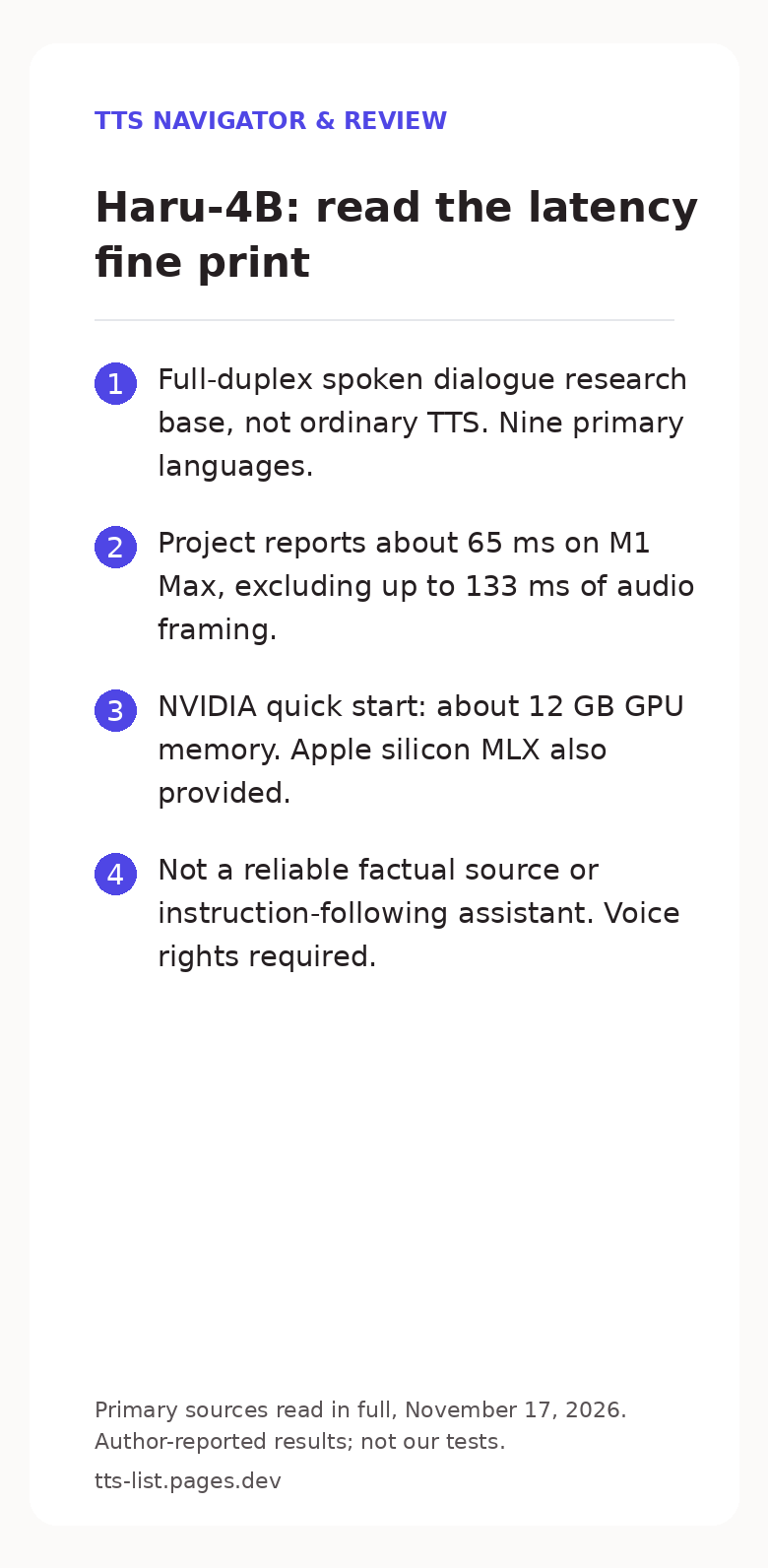
Haru-4B is a full-duplex spoken-dialogue research base model, not a conventional text-to-speech engine or a ready-made factual assistant. Its November 13 technical blog reports roughly 65 ms latency on an Apple M1 Max, but explicitly excludes audio framing, which can add up to 133 ms. That qualification matters more than the headline if you are designing a voice conversation.
What simultaneous listening and speaking means here
Haru combines incoming user audio, outgoing model audio and outgoing text within each language-model position. At 7.5 Hz, it consumes and produces an audio frame every approximately 133 ms. Each audio frame is a 64-dimensional continuous latent; a small MLP with one-step MeanFlow sampling predicts the next latent. This avoids a separate acoustic transformer and discrete audio codebooks. Frame rate is an architectural quantity, not independently measured response latency.
Reading the 65 ms claim carefully
The project blog reports p50 latency of 65.2 plus or minus 1.5 ms with int8 weights in its native Swift app on an M1 Max. The table includes microphone input, one model step, socket handoff, output waiting and headphone output, using wired devices. It excludes the audio-framing delay of up to 133 ms. A separate approximately 15 ms figure on NVIDIA B300 covers audio encoding, decoding and one language-model step, not the same complete I/O path. Neither number is our measurement or a universal guarantee.
Local deployment is not a CPU-only TTS comparison
The official quick start suggests an NVIDIA GPU with about 12 GB of memory. The project also ships an Apple silicon MLX implementation with a native macOS app and a vLLM-Omni plugin. A character card sets persona; a clean, single-speaker reference recording of 3 seconds to 3 minutes sets the voice. The release supplies no default voice clips. Only use a voice you have the right to use. Bluetooth can add latency, so the project recommends wired headphones and a wired microphone.
Nine primary languages does not mean equal quality everywhere
The model card lists English, Spanish, Portuguese, German, French, Chinese, Japanese, Russian and Korean. The blog reports over 40 million hours of speech spanning more than 160 languages, including over 13 million hours of separated full-duplex dialogue. These are project-reported training figures, not independently audited data counts or evidence of equal performance in 160 languages. The blog says synthetic LLM dialogues and TTS speech were excluded from its pretraining mixture.
A conversation foundation, not an assistant replacement
The card explicitly says this pretrained base model is not a reliable source of facts and does not follow instructions like an assistant. Natural interruptions, backchannels and overlap are a different objective from dependable answers or tool execution. Code and weights are Apache-2.0 according to the repository and card. For evaluation, separate conversational timing, language quality, factual accuracy and voice rights. We have not run Haru, measured its latency or tested its multilingual quality. The blog says more detailed training documentation and code are planned.
Sources
- https://huggingface.co/higurashi-ai/Haru-4B
- https://blog.higurashi.ai/melte/haru4b/
- https://github.com/higurashi-ai/Haru