AnadilLazTTS: a full fine-tune of a 2.29B foundation model for Laz, an endangered language - and a card that admits what it has not measured
November 21, 2026 - TTS Navi. We read the AnadilLazTTS model card in full. The card reports no automatic quality metrics yet, and we say so below rather than implying any.
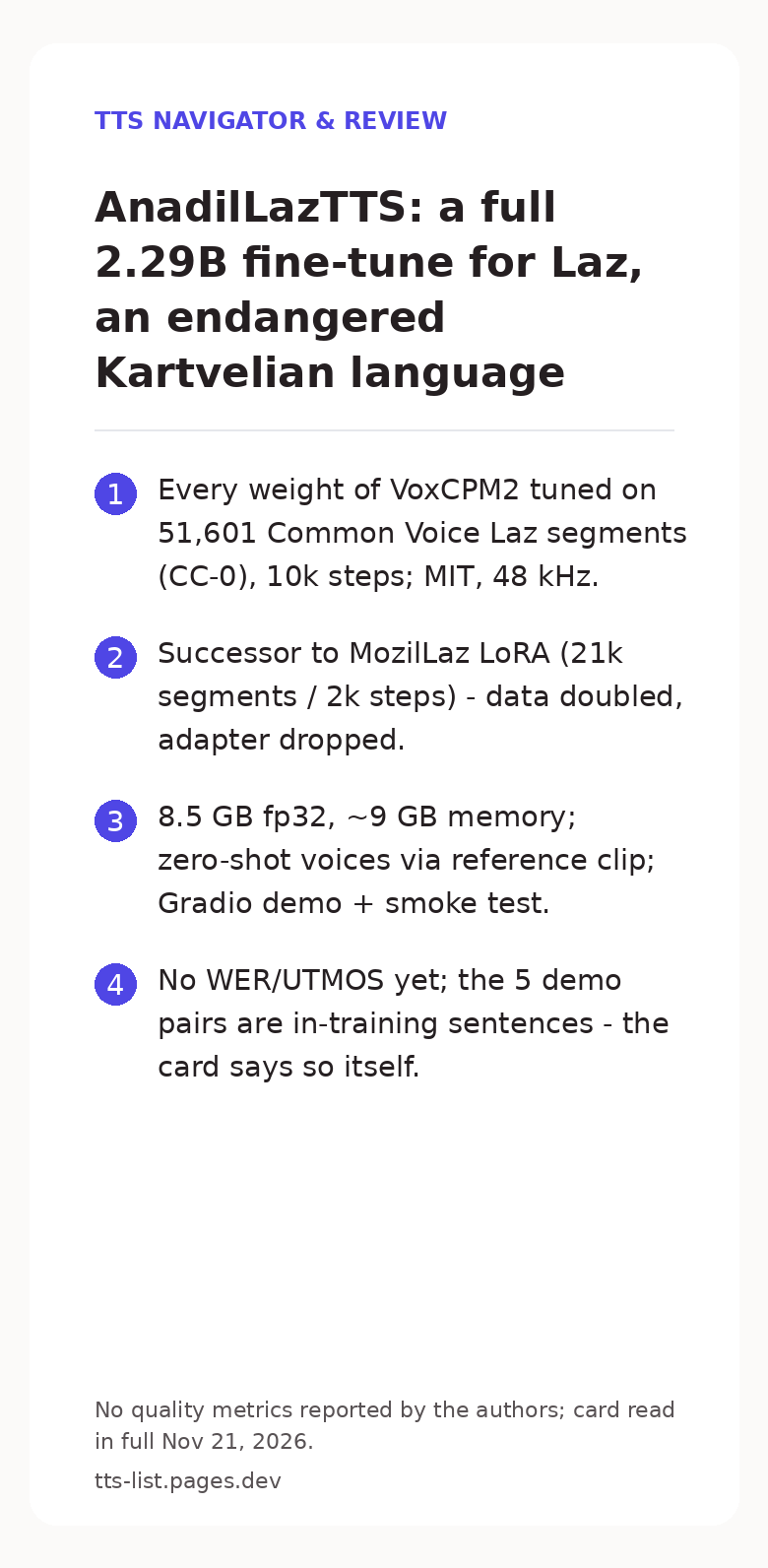
Laz is a Kartvelian language spoken by a small community in Turkey and Georgia. On November 20, 2026, Anadilorg released AnadilLazTTS: a full fine-tune - every weight, no adapter - of openbmb's VoxCPM2 (2.29B parameters) on 51,601 single-speaker segments from Mozilla Common Voice Laz 27.0 (CC-0), trained for 10,000 steps. The result is an 8.5 GB fp32 checkpoint producing 48 kHz speech, released under MIT, versioned 0.1.0. It is the successor to the same group's MozilLaz LoRA (21,071 segments, 2,000 steps), and the jump from LoRA to full fine-tune more than doubled the training data.
What you get and how you run it
The model was trained on a single speaker label, so other voices come from VoxCPM2's zero-shot cloning: pass a reference clip to inference.py or the Python API and the model approximates that voice. The repo bundles five sample sentence pairs, a Gradio demo, and a smoke test that checks weight integrity in seconds or runs a full Laz sentence end to end. Expect about 9 GB of memory at fp32; CUDA is preferred, Apple Silicon works but slower.
The honest part: no metrics yet
The card states plainly that automatic metrics (WER, UTMOS) have not been computed, and that the five demo pairs are in-training sentences using the authors' own reference recordings - not held-out evidence. A Laz speaker community can judge the samples; nobody else can, yet. We covered tujia-tts yesterday, a 6.4-hour single-speaker VITS for another endangered language that shipped with an ASR-loop probe and a printed noise floor; AnadilLazTTS represents the opposite resource strategy - fine-tune a large multilingual foundation model instead of training small from scratch - and its next step is the same measurement discipline.
Why it matters anyway
For endangered languages the binding constraint is rarely architecture; it is data and a community willing to do the work. A full fine-tune of a 2.29B tokenizer-LM on 51k Common Voice segments is currently one of the largest Laz speech models in existence, MIT-licensed, with a one-command path from text to audio. The gap to close is evaluation: a held-out test set, an ASR-loop error rate, and ideally judgments from Laz speakers. Until those exist, treat the release as a strong starting checkpoint, not a finished voice.