Fritter-TTS: a full fine-tune of Qwen3-TTS on one voice, consent gate included
November 10, 2026 - by TTS Navi. We read the full model card; the training details and pipeline below are the developer's (Daniel Rosehill) account, not our measurements.
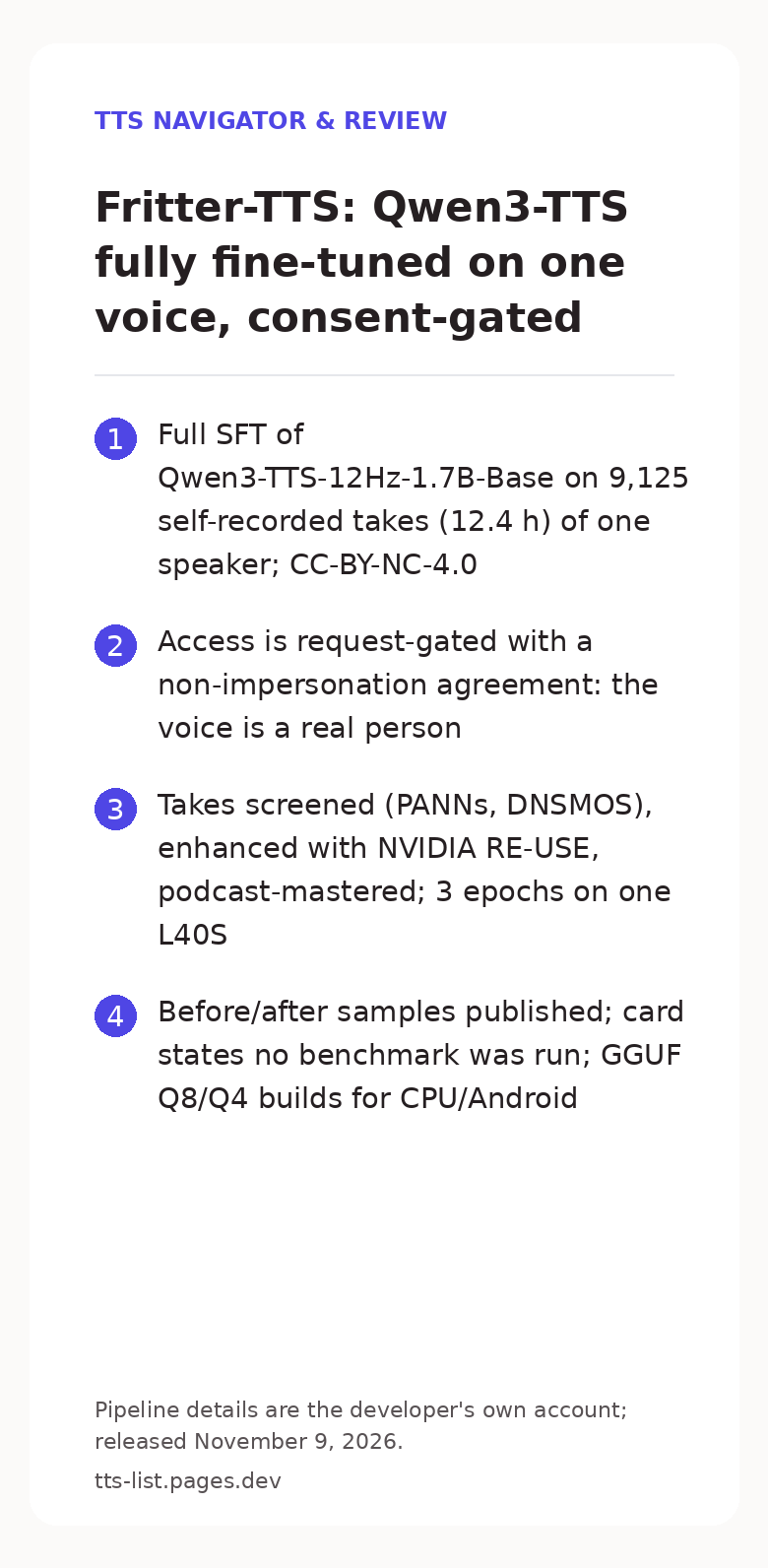
Most voice-clone releases hand you a zero-shot model and leave consent as an exercise for the user. Fritter-TTS v1, released on Hugging Face on November 9, does the opposite on both counts: it is a full fine-tune of Qwen3-TTS-12Hz-1.7B-Base on exactly one voice - its author, Irish-accented English speaker Daniel Rosehill - and the repo is access-gated with an explicit non-impersonation agreement, because the voice belongs to a real person. CC-BY-NC-4.0.
The pipeline is the release
The card documents a complete single-speaker production line. Source audio is 9,125 self-recorded takes of at most 15 seconds - about 12.4 hours after trimming - from his read-aloud sentence corpus, screened with PANNs sound-event tagging and DNSMOS quality scoring, with Hebrew sentences excluded and digit-heavy takes deliberately kept so numbers and version strings are read the way he says them. Every take then went through NVIDIA's RE-USE speech enhancement (run locally through an audio.cpp GGUF build) and a podcast chain (EQ, de-esser, 2:1 compression, -20 LUFS) before resampling to 24 kHz. Training was full SFT from the base model with the upstream script plus fixes (label shift, sub-talker, text projection applied in training), fp32 master weights with bf16 autocast, LR 7e-6, three epochs, on a single L40S. The goal is technical English that survives dictation workflows: AI model names, Linux commands, acronyms and version numbers read correctly.
Evidence and limits, as stated
The card is explicit that the model "has not been benchmarked: no listening score or metric is reported here." What it offers instead is a before/after table: the same ten passages through the untuned base model cloning Daniel's voice from one reference versus through the fine-tune, with the full release run on a public samples space. Long passages are generated sentence by sentence and joined, since training takes were capped at 15 seconds - a limitation stated, not hidden. For on-device use there are Q8_0 and Q4_K_M GGUF builds for qwentts.cpp (CPU, Android, Vulkan) in a sibling repo.
Our analysis
Fritter is worth covering less for the model than for the norms it demonstrates. The consent design is the part the ecosystem should copy: a real person's voice, gated by request, with the non-impersonation condition attached at the door rather than in a license nobody reads. The data engineering is the second lesson - 12 hours of one microphone, cleaned by an explicit screen-enhance-normalize chain, was enough for a full 1.7B fine-tune on one rented GPU, which puts "your own voice, done properly" within individual reach. And the honesty pattern holds: no invented MOS, joined long-form disclosed, base-model (Apache-2.0, Alibaba) and fine-tune (CC-BY-NC) licenses kept separate. If you are planning a personal voice, this card is currently the most complete public template for doing it consensually and reproducibly.
Sources
- Hugging Face model card: Fritter-ASR/Fritter-TTS (read in full, November 10, 2026; gated)
- Public before/after samples space; GGUF on-device builds
- Base model: Qwen3-TTS-12Hz-1.7B-Base (Apache-2.0); NVIDIA RE-USE (enhancement)