Sudanese Arabic in 4.7 hours: a Chatterbox fine-tune with an honest scoreboard
November 14, 2026 - by TTS Navi. We read the model card and dataset in full; all results below are the author's own measurements.
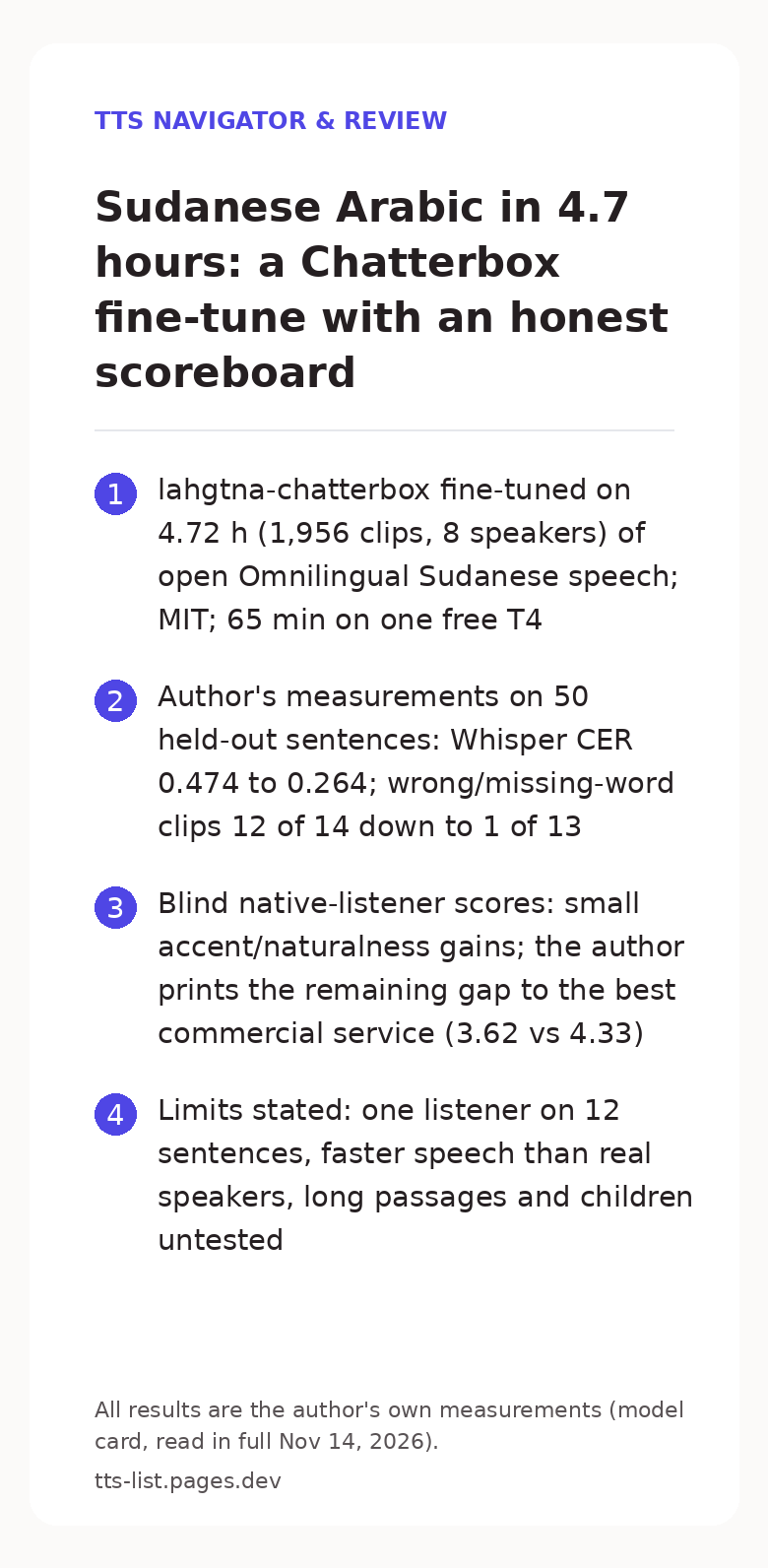
sudanese-chatterbox is a text-to-speech model for Sudanese Arabic (apd), released November 13 by Muntasir Elagami under MIT. It is lahgtna-chatterbox-v1 - Chatterbox Multilingual already fine-tuned for Arabic dialects - fine-tuned once more on 4.72 hours (1,956 clips, 8 speakers) of Sudanese speech derived from Meta's openly licensed Omnilingual ASR Corpus. The entire training run took 65 minutes on one free Kaggle T4: three epochs over only the T3 text-to-speech-token model, leaving Chatterbox's speech decoder and voice encoder untouched. The training dataset is published separately under CC-BY-4.0.
The evaluation, as reported
The card's table is the kind of small-scale evidence we wish more releases printed. Fifty Sudanese test sentences in four real Sudanese voices that were never in training: Whisper CER per clip capped at 1 drops from 0.474 for the base model to 0.264 for the fine-tune (real Sudanese speech scores 0.126). A native listener flagging clips with wrong or missing words goes from 12 of 14 base clips to 1 of 13. On 1-5 blind ratings the fine-tune edges the base on "Sudanese?" (3.62 vs 3.50) and "natural?" (3.46 vs 3.21) - and the author prints the uncomfortable comparison too: the best commercial service scored 4.33 and 4.42 in the same blind round, "so a clear gap remains." The qaf-to-[g] dialect shift was already correct in the base and stays correct. All twelve listening sentences are on the card with their blind ratings, not hand-picked.
The stated limits
The model speaks about 9.4 letters per second against 8.5 for real speakers and still drops a word occasionally. The listening evidence is one native listener on twelve sentences: the author frames the gain as clear on word accuracy and small on accent. Training data is spontaneous speech from eight adults; long passages, children's voices and other Sudanese regional accents are untested. Two operational notes: the pinned lahgtna-chatterbox commit needs one-line attention-backend edit to expose alignment maps, and at that commit the Perth audio watermark is commented out - the author tells you to re-enable it before publishing generated speech, and to clone only voices whose owners consented. One caveat we found ourselves: the card links a GitHub project repository for the full method, but that repository returns 404 as of today; the card and dataset carry the substance meanwhile.
Our analysis
This is the dialect-TTS playbook at its most reproducible: a permissively licensed base with a dialect slot, a few hours of openly licensed in-dialect speech, a free GPU for an hour, and a scoreboard that reports the commercial gap instead of hiding it. The interesting measurement is the asymmetry the author names - 4.7 hours moved word accuracy dramatically (CER nearly halved) but accent and naturalness only slightly, which matches the intuition that dialect identity lives in the data volume you do not have. The evaluation is tiny (one listener, twelve sentences, capped CER) and the author says so in the same table that reports it, which is exactly how small evidence should be presented. For Arabic-dialect builders, the reusable pieces are the recipe (T3-only fine-tuning at lr 2e-5, 735 steps) and the reminder that Meta's Omnilingual ASR corpus is a growing source of consented, openly licensed dialect speech. The honest next step is also obvious: more speakers, a second listener, and long-form tests.
Sources
- sudanese-chatterbox model card (read in full, November 14, 2026)
- sudanese-arabic-speech dataset (CC-BY-4.0)
- lahgtna-chatterbox-v1 base model