tiny-voca Saudi: a 4.5M dialect fine-tune that scores worse than its base - and says why that is fine
November 25, 2026 - TTS Navi. We read the model card in full. All figures are the author's own measurements, not our tests.
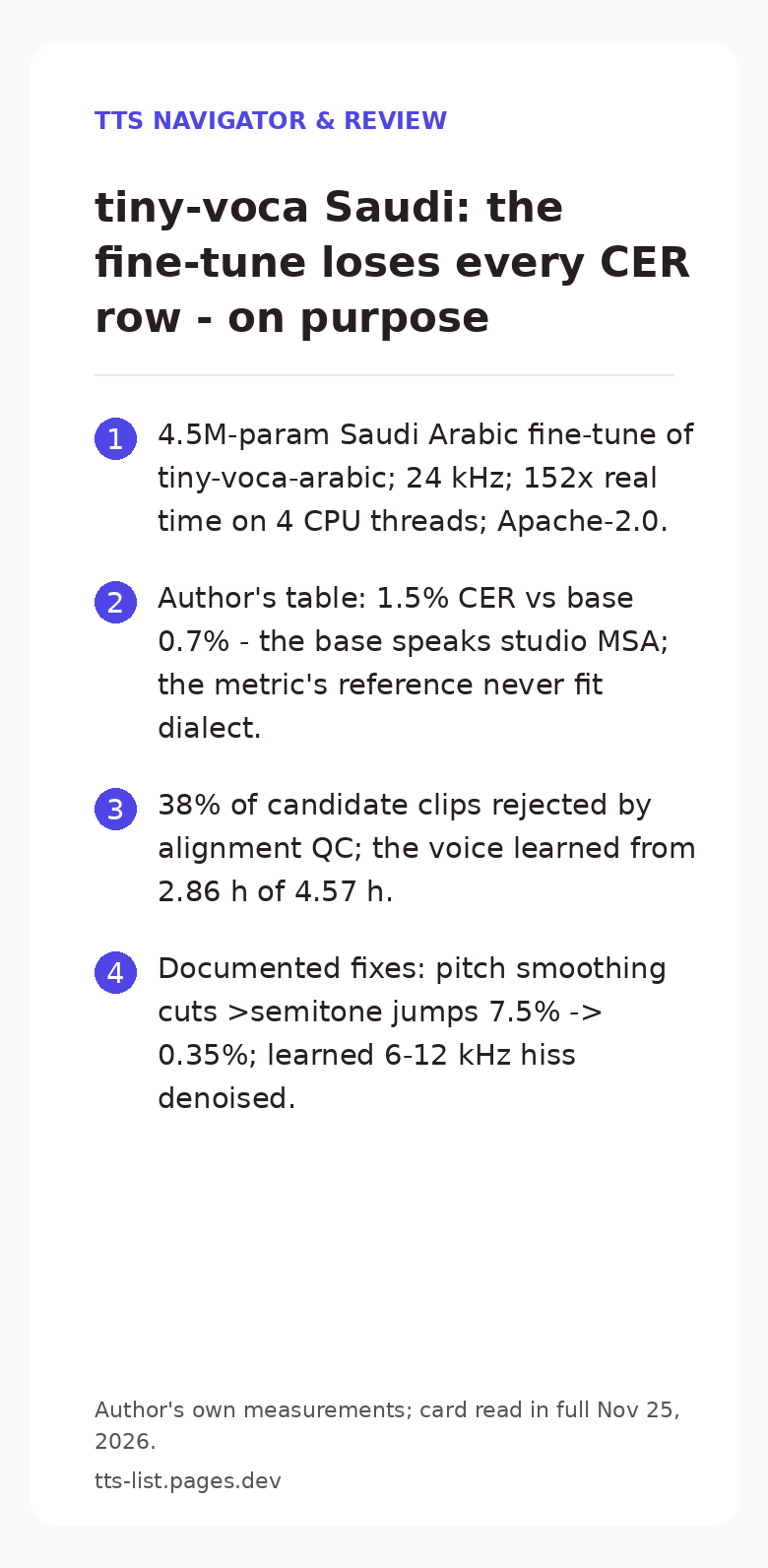
Most fine-tune announcements claim improvement. Messam174/tiny-voca-arabic-TTS-saudi (released November 23, 2026) prints a table where its own model loses: Whisper round-trip on held-out recordings of the speaker gives the Saudi fine-tune 1.5% CER / 7.0% WER against the base tiny-voca-arabic's 0.7% / 4.9% (validation; test row 1.8% vs 0.8% CER). The card then does the analysis most cards avoid: the base speaks studio MSA trained on an MSA duplex corpus, so an ASR system transcribes it more cleanly; the fine-tune reproduces a dialect narrator recorded outside a studio, and the metric's reference was never the right ground truth for it. Both stay under 2% CER. The model: 4,531,723 parameters (18 MB PyTorch, 21 MB ONNX), one Saudi male voice, 24 kHz mono, no separate vocoder, about 152x real time on 4 CPU threads for the acoustic model alone, RTF 0.092 including the CATT diacritizer. Apache-2.0.
The pipeline is dialect-aware on purpose
Numbers become words, CATT diacritizes, a 49-symbol rule-based phoneme front-end inherited from tiny-voca-arabic converts text, and then a "Saudi reading" switch (case_endings=False) drops the optional case endings and tanween the way a Saudi speaker actually reads - during annotation, each clip's endings were kept or dropped by CTC likelihood, so the model learned both readings. Two post-processing fixes are documented with numbers: pitch smoothing (Hann average over log-F0) drops frame-to-frame jumps above one semitone from 7.5% to 0.35% of frames on this low 96 Hz voice, and a stationary denoise filter removes 6-12 kHz hiss that the source recordings carried and the model had learned.
Data QC as a first-class result
Of 4,286 candidate clips (4.57 h), 1,613 - 38% - were rejected by alignment QC because dialect speech read with MSA rules misaligns; the voice the model learned from is the surviving 2,673 utterances, 2.86 h. Training ran 104k to 119k steps (GAN from 107k) on one RTX 3060. The stated limits are equally concrete: one voice; Saudi phonology like qaf-as-g is only implicit from recordings, not a phoneme rule; the MSA-trained diacritizer sometimes picks an MSA reading of a dialect word (fix by supplying tashkeel yourself); Latin script, emoji and most symbols are skipped.
Lineage and why it matters
This is the third generation of a family we have covered at the root: n4ze3m's tiny-voca (English, synthetic-data limits) to oddadmix's Arabic version to this Saudi dialect voice - architecture and training code unchanged, only continued training on a new voice. The release is a useful counterweight to leaderboard culture: a dialect model whose value is precisely that it does not sound like the clean-MSA reference the metrics reward, with the scoreboard printed anyway.
Sources
- https://huggingface.co/Messam174/tiny-voca-arabic-TTS-saudi
- https://huggingface.co/oddadmix/tiny-voca-arabic