Tui Voice Mini: a 4.5M-parameter Malayalam TTS shows how fast tiny-voca is becoming a base model
November 18, 2026 - TTS Navi. We read the model card in full. Performance and training claims are the project authors' reports, not our tests.
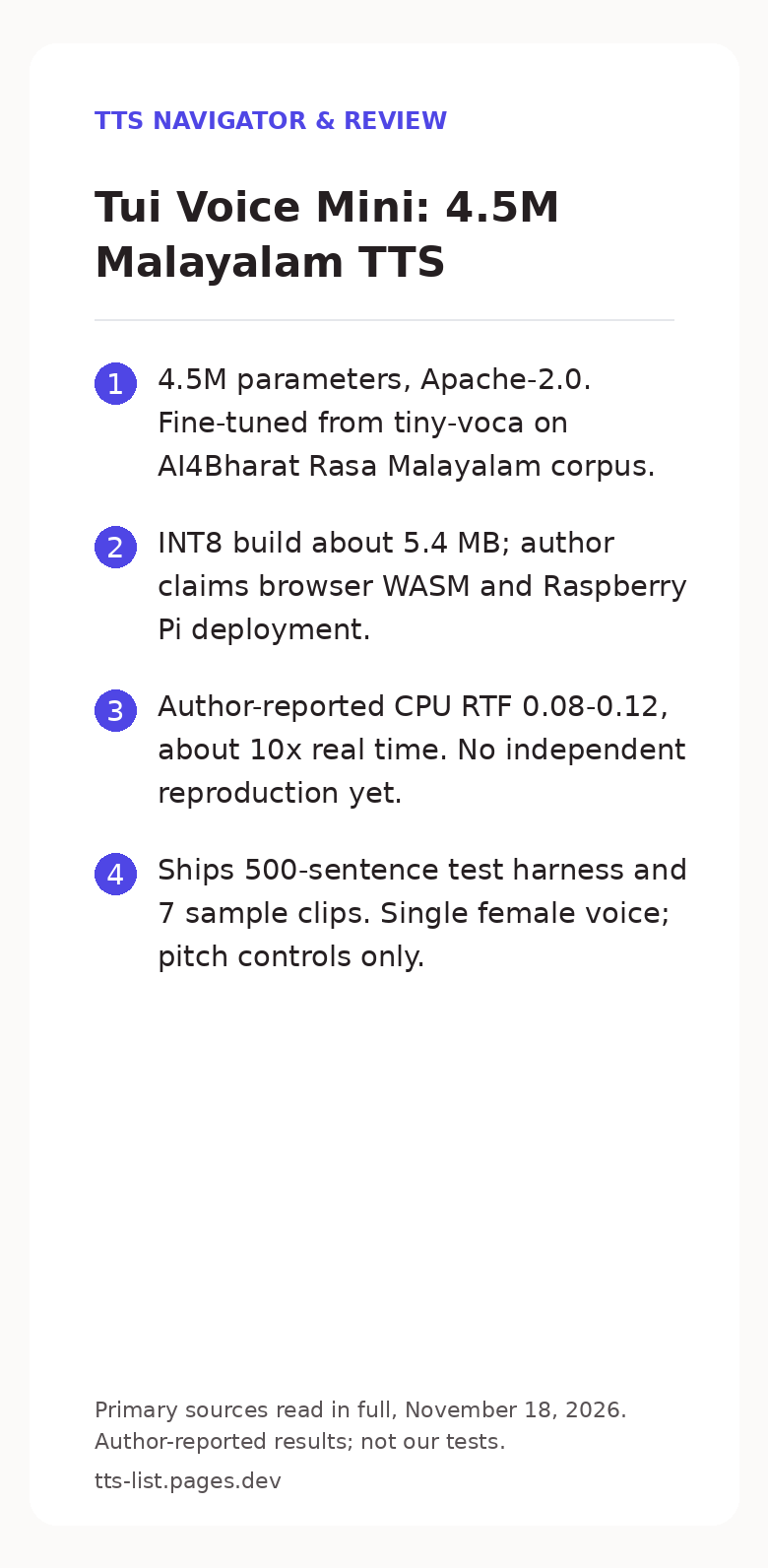
Four days after tiny-voca appeared as a 4.5M-parameter English TTS trained on synthetic data, it has its first language offspring. Tui Voice Mini Malayalam, published on Hugging Face on November 17, 2026 by Cyrax321, fine-tunes the tiny-voca architecture on the AI4Bharat Rasa Malayalam female corpus and releases the result under Apache-2.0. For on-device TTS in a low-resource language, the licensing alone makes it notable.
Same skeleton, new language
The model keeps tiny-voca's 4,537,291-parameter layout: a 4-block transformer text encoder, duration and pause heads, a prosody predictor for continuous F0, a cepstral decoder, and an integrated source-filter synthesizer that needs no external neural vocoder. What changed is the front end: a 76-slot phoneme budget mapped to all 59 Malayalam phonemes, including long and short vowels, conjunct clusters and explicit chillu characters, phonemized with eSpeak NG. Training ran 40,000 steps on a single NVIDIA L4 with adversarial multi-period and multi-resolution discriminators.
Artifacts for real deployment targets
The repository ships PyTorch FP32 at 18.2 MB, FP16 at 9.1 MB, an ONNX opset-17 graph at 21.4 MB and an INT8 ONNX build around 5.4 MB, plus OpenVINO files, full training checkpoints and seven sample clips covering greetings, news, station announcements and IVR prompts. The card claims inference under 30 MB of RAM, in browsers via WebAssembly, and on Raspberry Pi-class ARM boards. We have not run these builds; the footprint figures are the author's.
Author-reported numbers, read with care
The card's comparison table reports a CPU real-time factor of 0.08 to 0.12, roughly ten times real-time, against 0.25 to 0.35 for Piper Malayalam and 0.30 to 0.45 for Meta MMS-TTS VITS. Lower RTF is better. This is the author's own benchmark table, not an independent measurement, and no listener study is reported. Training-log metrics at step 40,000 include 100 percent validation pause accuracy, 0.097 duration length error, 93.4 percent voicing accuracy and F0 RMSE of 3.73 semitones; these measure convergence, not perceived naturalness.
A reproducible evaluation harness is included
Unusually for a card this small, the repository includes its benchmark suite: a 100-sentence dev set, a 500-sentence main test balanced across conversational, news, long compounds, questions, numbers and code-switching, and a 200-sentence stress set of rare conjuncts and tongue twisters, with scripts for grapheme CER, WER, speaker error rate, audio integrity, F0 RMSE and efficiency metrics. That means claims can be checked by anyone, even though the reported results remain internal.
Why this matters beyond Malayalam
The practical questions this release answers: can a sub-5M-parameter TTS cover a language with complex conjuncts, run fully offline in a browser, and stay commercially usable? The author's evidence says plausibly yes. What is not yet shown: any human listening evaluation, any third-party reproduction of the speed table, and multi-speaker support - the release is a single female voice, with runtime pitch-shift and pitch-range controls as the only voice variation. If you build Malayalam IVR or accessibility tools, the samples and harness make a same-day evaluation realistic.
Sources
- https://huggingface.co/Cyrax321/tui-voice-mini-ml
- https://github.com/Cyrax321/tui-voice
- https://huggingface.co/datasets/ai4bharat/Rasa