TiHon-TTS: a 100K-parameter Vietnamese TTS aimed at microcontrollers - simulated, not yet on silicon
Published November 3, 2026 · Built from the Hugging Face model card (ngocthien/tihon-tts) and its linked arXiv abstract, read in full on November 3, 2026. All measurements are the author's (Nguyen Ngoc Thien); we did not run the model. Uploaded to Hugging Face on November 2, 2026 - one day old at read time.
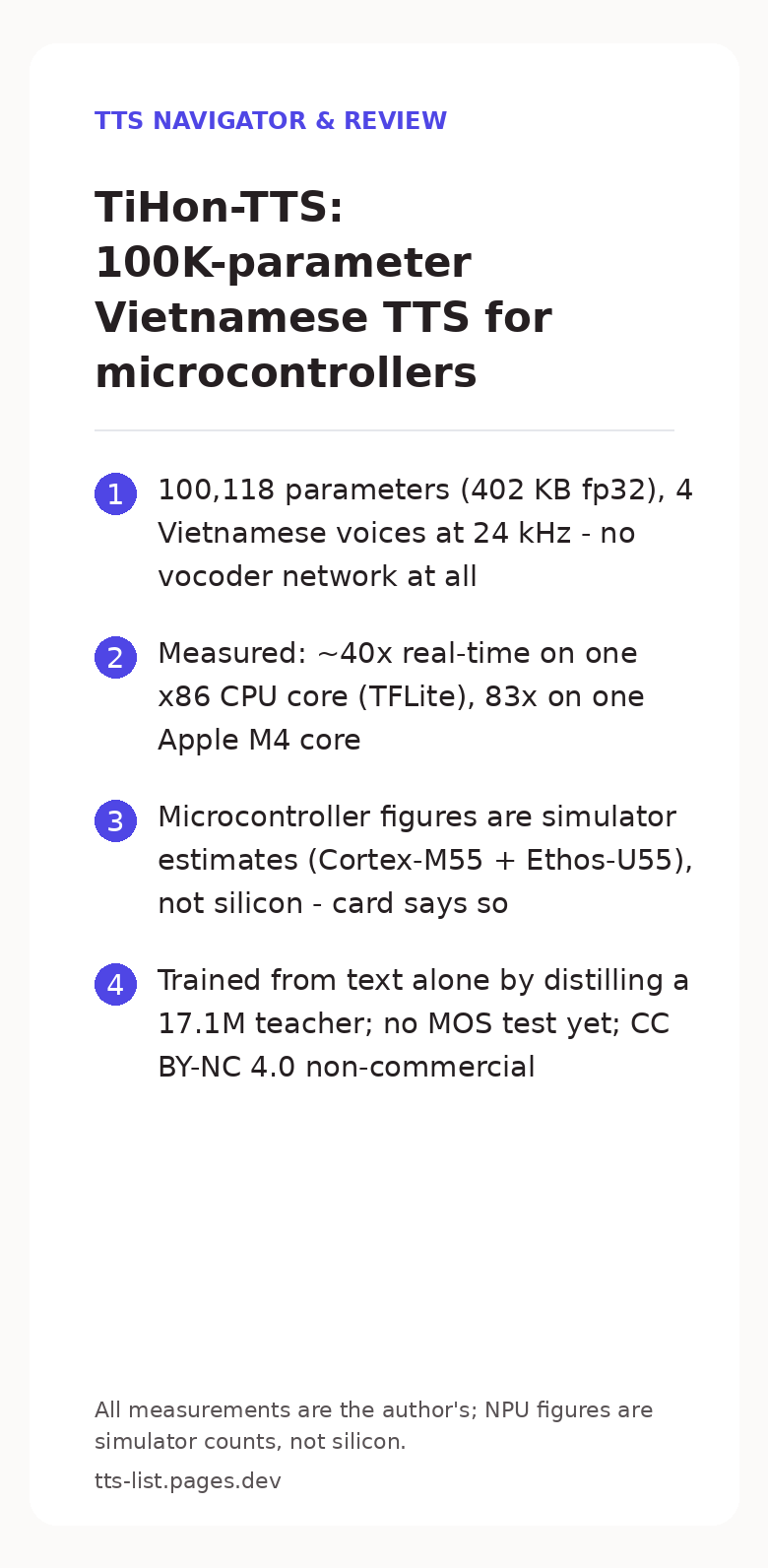
A hundred thousand parameters is roughly one-thousandth the size of the small open TTS models people actually deploy today. TiHon-TTS fits Vietnamese speech synthesis into 100,118 learned parameters - 402 KB in fp32 - with four voices (three female, one male) at 24 kHz. There is no vocoder network at all: the model predicts pitch, voicing and spectral envelopes, and a deterministic harmonic-plus-noise synthesizer generates the waveform. Its target is the smallest hardware class that still runs neural networks: Arm Cortex-M55 microcontrollers with an Ethos-U55 NPU.
What stands out
- Designed for Vietnamese from the tokenizer up. Each syllable becomes 5 tokens - onset, medial, nucleus, coda (tone folded into coda), plus a prosody token - instead of borrowing a multilingual scheme. This is a language-first design, not a port.
- Real CPU speed numbers, honestly labeled simulated NPU numbers. Measured: about 40x real-time on one x86 core (TFLite) and 83x on one Apple M4 core. Simulated: roughly 6.6M Cortex-M55 CPU instructions plus 4.7M Ethos-U55 NPU cycles per second of audio - the card explicitly says these are simulator instruction/cycle counts, "not a measured silicon benchmark," and Vela-based estimates may run 30-90% higher.
- Trained from text alone. The four voices were distilled from a 17.1M-parameter teacher plus Vocos vocoder on 78.7K Vietnamese text chunks - no paired audio for the target voices was needed. Training used 80K steps, mixed precision, and an adversarial fine-tune at the end; the card reports where the checkpoints sit and notes the training code is not released.
- Self-critical where it counts. Intelligibility: CER 1.0-2.3% across the four voices (36 held-out sentences each, Zipformer ASR, spelling variants counted as errors). Limitations stated plainly: buzzy timbre, voicing flicker, teacher errors passed through, and no MOS listening test at all.
Keep in mind
- License is CC BY-NC 4.0 - non-commercial only. One voice's training data (Ngoc Huyen) is itself CC BY-NC. Products are out; research and personal projects are in.
- The NPU int16 deployment package is access-on-request, not in the repo.
- At this size the model is single-style per voice - no emotion or style control.
Why it matters
- Vietnamese keeps showing up in efficient TTS. Between arrowhead-fletch-tts (14 Indic languages, 4-bit CPU) and now TiHon, the low-resource-language edge-TTS niche is one of the most active corners of the field - arguably because big-vendor coverage is weakest exactly there.
- Distillation-as-compression, again. Same pattern as PiVo-1.4M (today's other pick): a large teacher's voice compressed two-to-three orders of magnitude down. Two examples in two days do not make a trend, but "voice as a compressed artifact of a big model" is now a testable hypothesis rather than a one-off.
- The honest label is the news. A 100K-parameter TTS that runs on a microcontroller would be headline material if measured on hardware. The author ships the simulator numbers clearly marked as simulator numbers - which is exactly how this kind of claim should arrive.
Source (read; link verified November 3, 2026)
- ngocthien/tihon-tts - Hugging Face model card (uploaded November 2, 2026) - architecture, training data, CER/speed/NPU estimates, limitations and CC BY-NC 4.0 license above.