Faster Kokoro on a CPU? nano-edge-tts changes the decoder, not the whole voice model
November 17, 2026 - TTS Navi. We read the model card and all 10 pages of the paper in full. Results below are reported by the paper author.
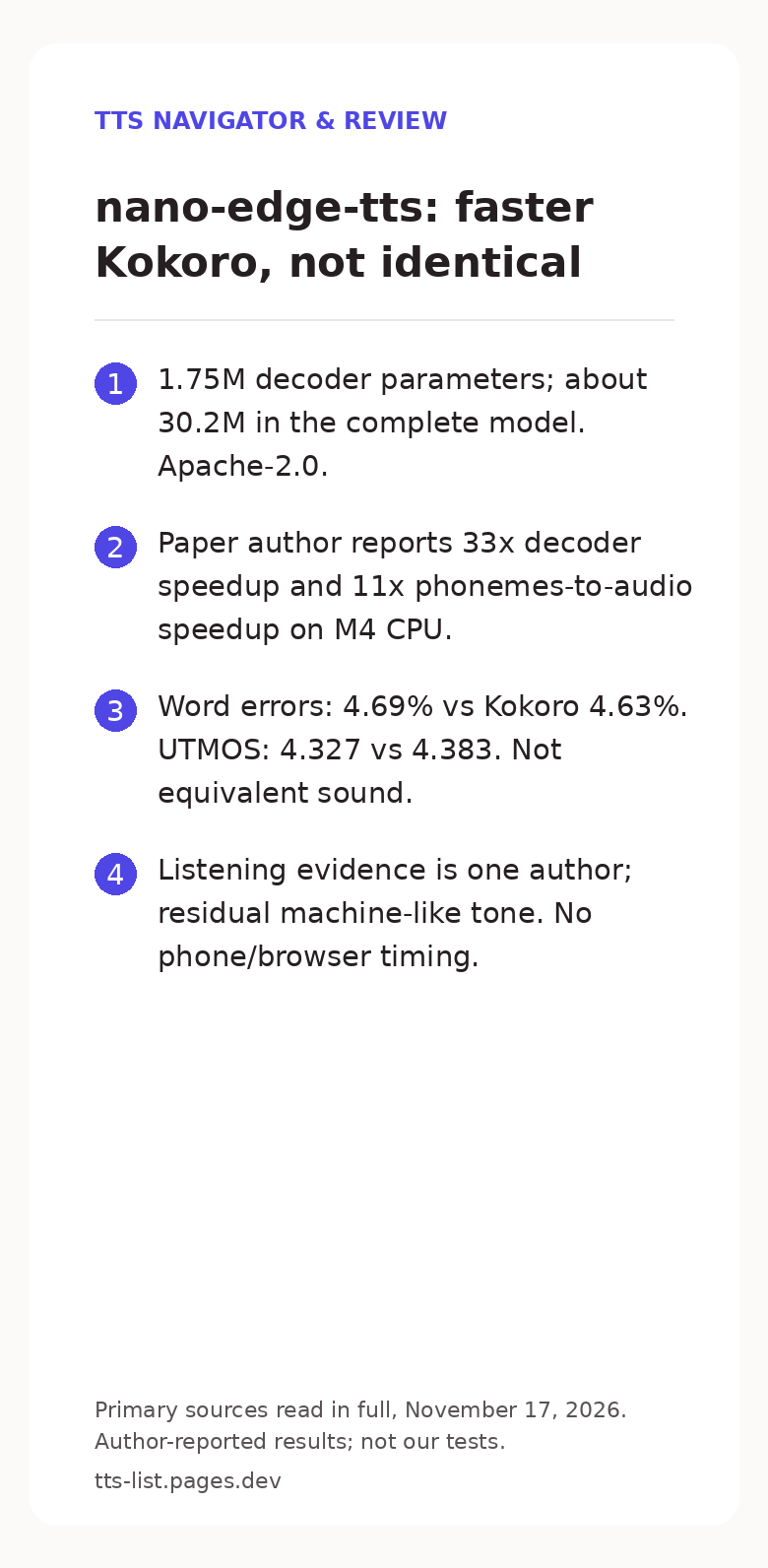
nano-edge-tts is an Apache-2.0 replacement for Kokoro-82M's waveform decoder, not a complete 1.75M-parameter TTS system. The whole pipeline remains about 30.2M parameters. For an existing English Kokoro CPU application, the interesting question is whether its reported speed and memory savings justify a small but audible quality tradeoff.
A new decoder, not a port or weight conversion
The Hugging Face repository was created November 11; a Show HN post followed November 15. Mike Chumba replaces a 53.3M-parameter waveform decoder with a 1,749,643-parameter mapper and renderer. Kokoro's text processing, durations, pitch and voices stay unchanged. Learned networks operate at 80 and 160 frames per second, setting frequency-bin gains on pulses and noise. Fixed signal processing reconstructs audio. The novelty is moving learned computation away from audio rate, rather than merely quantizing Kokoro.
Three different size and speed quantities
The author's paper reports decoder weights falling from 213 MB to 7 MB. That is decoder-only storage, not the entire package. On one Apple M4 CPU thread in PyTorch, decoder real-time factor fell from 0.1378 to 0.0042 across 240 validation sentences, about 33 times faster. The phonemes-to-waveform pipeline fell from 0.1411 to 0.0127 on six sentences totaling 55 seconds, about 11 times faster. Lower real-time factor is better. This pipeline measurement starts at phonemes, and is not a benchmark of arbitrary raw-text preprocessing or a phone app.
Quality stayed close on metrics, not identical
On 240 validation sentences, Whisper small.en made 238 word errors on the replacement versus 235 on Kokoro: 4.69% versus 4.63%, where lower is better. UTMOS on 28 clips was 4.327 versus 4.383, where higher is better. These are author-reported objective metrics, not a multi-listener naturalness trial. The frequently quoted 9-of-12 blind pairs heard as the same came from an earlier checkpoint and one listener, the author. On defect-selected clips, the released model tied on 5 of 11 pairs, won one and lost five.
The negative results are useful for deployment
Some voiced sounds retain a faint machine-like tone, especially around 1 to 4 kHz. The paper reports that larger networks and better paired spectral fit did not reliably fix it. An adversarial WavLM critic helped earlier defects, while training targets cut from whole-sentence teacher audio improved the remaining metric gap. Two later artifact-specific losses improved their own statistics without an audible improvement to the listener. A better number was not automatically a better voice.
What to test in your Kokoro app
Training used Kokoro's 28 American and British English voices; other languages may run but are untested. The unchanged text side still has 28.5M parameters and accounts for 69% of the reported remaining CPU time. The paper reports roughly 0.75 GB peak process memory versus 1.4 to 1.7 GB for the original on its six-sentence test, not a guaranteed deployment ceiling. There is no phone or browser speed test. Compare matched sentences and your own voices before shipping: the published listening evidence is one person's, and the teacher remains the quality target.
Sources
- https://huggingface.co/drmhse/nano-edge-tts
- https://huggingface.co/drmhse/nano-edge-tts/resolve/main/paper.pdf
- https://news.ycombinator.com/item?id=50506255