Tontaube V1.1: long-form voice cloning with five style sliders and a 1.8 GB CPU build - and a license that is not open source
November 16, 2026 - by TTS Navi. We read the TontaubeV1.1 model card in full; the evaluation numbers are the authors' LLM-judged results on the previous version, labeled as such by the card itself.
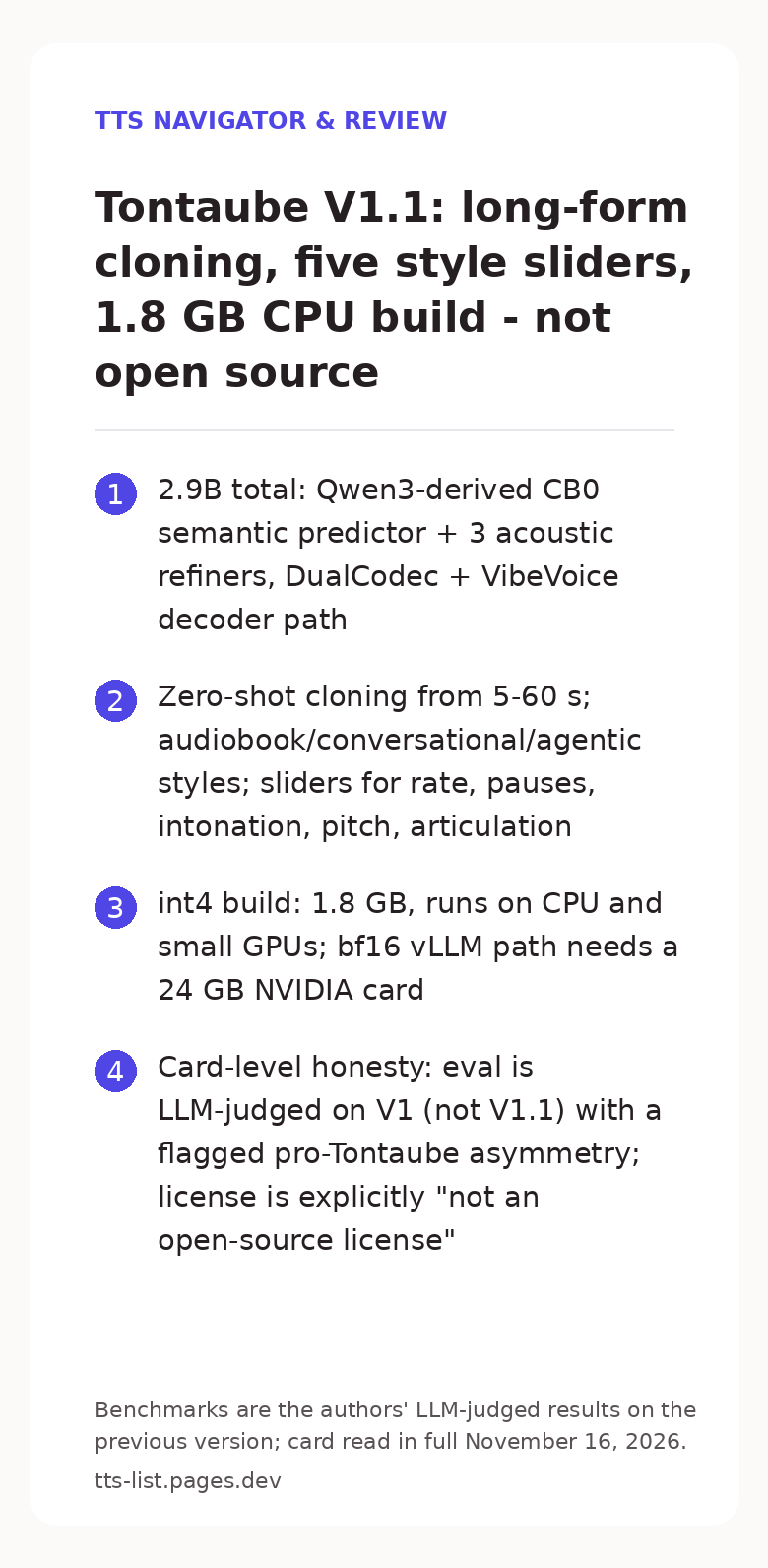
TontaubeV1.1 (card created November 10, updated this week) is a multilingual TTS release aimed squarely at the "audiobook on my own hardware" use case: expressive zero-shot cloning from 5-60 seconds of reference audio, bounded-context long-form generation, and WAV/MP3/Opus streaming. English and German are the primary languages; Spanish, French, Italian, Dutch and Portuguese are listed as supported but - in the card's own words - "have not been evaluated by native speakers; no comparative quality claims are made for those languages." That sentence sets the tone for the whole card.
Four predictors and a borrowed decoder
The system is four causal codebook predictors totalling 2.9 billion parameters: CB0 (1.85B, derived from Qwen3-1.7B) generates semantic audio and duration from character-level text with compact BPE-encoded language and style controls; CB1-CB3 (Qwen3-0.6B-derived, progressively shallower) add acoustic detail. The streams decode through DualCodec, then a VibeVoice acoustic encoder/decoder with a small trained adapter for continuous reconstruction and streaming, and a CTC recogniser on CB0's output lets the server retry English pieces that skipped text. New in V1.1: five style sliders (speaking rate, pauses, intonation range, pitch level, and crisp-to-normal articulation), three speaking styles (audiobook, conversational, agentic), and an int4 build - 1.8 GB instead of 6.4 GB - that runs on small GPUs and CPUs, while the bf16 vLLM path wants a 24 GB NVIDIA card.
An evaluation section that argues against itself, on purpose
The card's benchmark table comes with an unusually long list of disclaimers, all worth repeating because they are the disclaimers most vendors skip. The numbers were measured on TontaubeV1, not V1.1. The judge is an LLM (Gemini 3.1 Pro Preview) scoring 400 fixed English passages twice in both presentation orders. Against ElevenLabs Flash v2.5 the result is parity (50.1% prosody preference, 48.9% correctness - a coin flip); against Fish Audio S2 Pro, Gradium and Cartesia Sonic 3 the Tontaube preference runs 82-86% on prosody - but the card itself flags that those three comparisons used fixed provider voices while Tontaube used the cloning reference, and "this asymmetry may favor TontaubeV1." It closes by listing what the evaluation does not measure: voice similarity, overall sound quality, multilingual quality, long-form continuity, streaming quality. Net: an LLM-judged, previous-version, English-only result with a known structural advantage. Informative, not decisive.
The license is the other headline
TontaubeV1.1 ships under the Tontaube Community Model License 1.0, which the card explicitly states "is not an open-source license." If you are building a product, that sentence is the release. The weights are downloadable and self-hostable, the inference repo is public, but the terms are the vendor's own community license, not Apache or MIT - read COVERED_FILES.md and the third-party notices before integrating. This is the same distinction we flagged on the FAQ page: open-weight and self-hostable is not the same thing as open source, and the commercial-use line is drawn by the license text, not by the download button.
Who should look
If your question is "can I clone a voice and narrate long-form text on my own hardware," this is one of the most complete current answers: style sliders for delivery, a bounded-context mechanism for long documents, an int4 path for CPU, and honest documentation of where the evidence ends. The honest documentation cuts both ways, of course - German phoneme realization "can be imperfect," the five other languages are untested by native speakers, and autoregressive generation "can omit, repeat, or alter text." For production German audiobooks, test before you commit; for everything commercial, read the license first.
Sources
- TontaubeAI/TontaubeV1.1 model card (read in full, November 16, 2026)
- Tontaube inference repository (v1.1.0)