KittenTTS 2: the tiny-CPU family grows a 1.7B cloning flagship - and the license, not the size, is what to read first
November 16, 2026 - by TTS Navi. We read the model card and the full Stellon Labs Community License text; capability descriptions are the authors', license terms are quoted from the license itself.
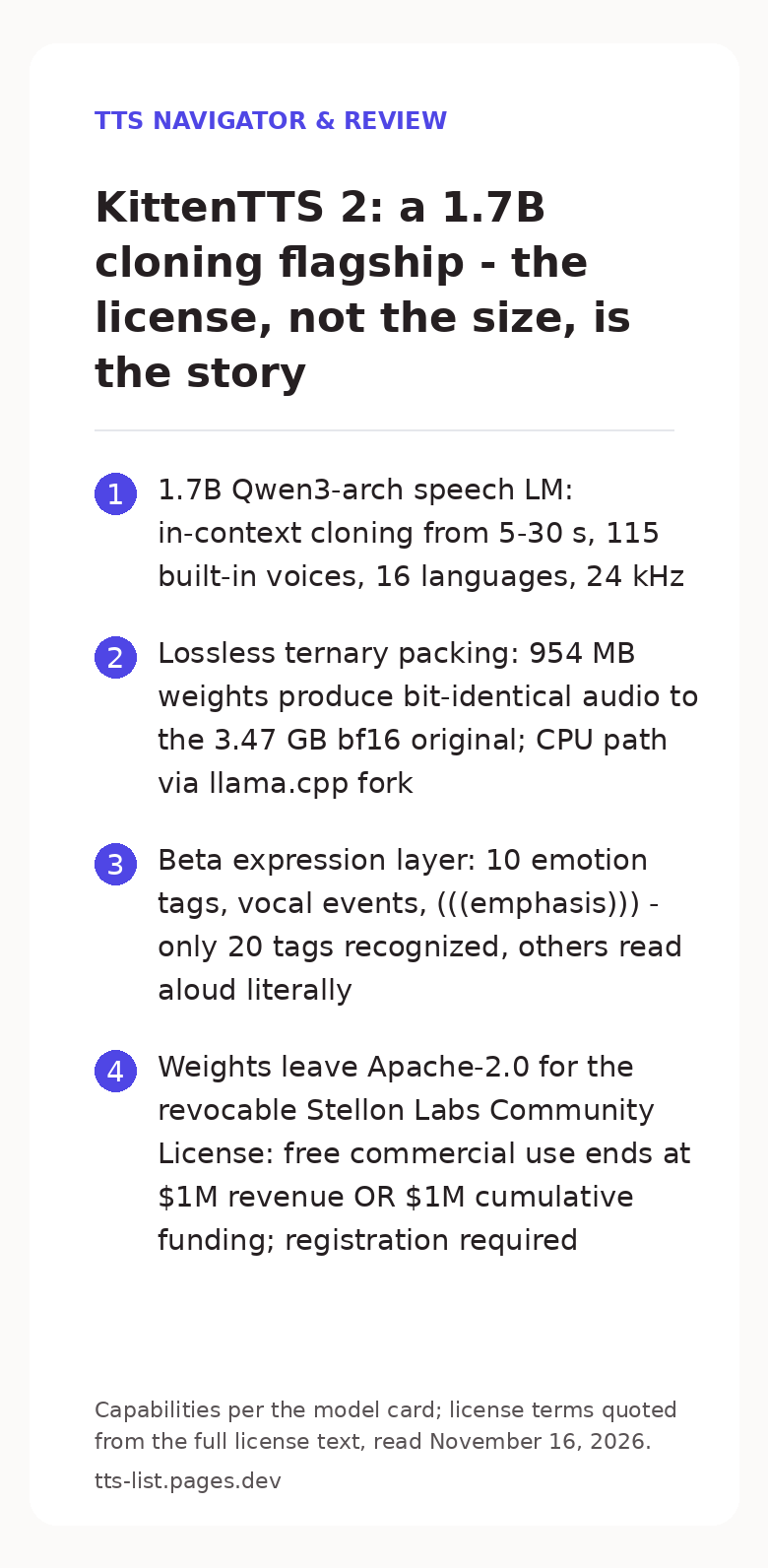
Kitten TTS made its name with models that fit in tens of megabytes and run on a CPU - we covered the Apache-2.0 Mini, Nano and Pico two weeks ago. The family's flagship KittenTTS 2 is a different animal: a 1.7B-parameter speech language model (Qwen3 architecture) with in-context voice cloning from a 5-30 second reference clip, 115 built-in voices, and named voices across 16 languages. The repo has been up since late October, but the family was re-uploaded under a "stellon-admin" account on November 13, and the license story is why it is back in the conversation this week. One correction to the secondary coverage making the rounds: the card lists 115 voices, not the 47 being quoted.
What the model actually does
Text goes in, S3 codec tokens come out, a built-in decoder renders 24 kHz audio - no external vocoder, no Hugging Face login. The eight legacy voices from 0.8 (Bella, Jasper, Luna and friends) carry over, so existing code keeps working; non-English languages are reached through named voices (SpanishAbuela, JapaneseTrainConductor), because "the voice is what carries the accent." A beta expression layer takes one of ten leading emotion tags ([joyful], [stern], [tender]...), inline vocal events (laughs, sighs, gasps) and (((triple-parenthesis))) emphasis - only twenty tags are recognized, rarer ones get read aloud as literal text, which is a lovely failure mode to know about before it happens to you. Two card-level practicalities: pass normalize=False for non-English text (the normalizer is English-tuned and mangles numbers and dates), and emotion control "steers delivery rather than guaranteeing it."
Ternary weights that are actually lossless
The interesting engineering is the packing. The language model's linear weights are ternary - each value is exactly one of {-scale, 0, +scale} per 128-wide group - so the default "packed" download stores them at 1.6 bits per weight, 954 MB instead of 3.47 GB, producing bit-identical audio. An "emb4" variant halves that to 469 MB by quantizing the one non-ternary piece (the 324M-parameter embedding, at a stated L2 relative error of 0.118 - the card tells you exactly which part is lossy). Decoders swap similarly: 459 MB default or a 39 MB distilled 4-bit student, trading fidelity for footprint, not speed. On CPU there is a llama.cpp fork with GGUF weights. This is the same family that ships 8 MB ONNX models; the flagship keeps the discipline at 200x the size.
The license: read this part twice
The 0.8-series weights were Apache-2.0. The KittenTTS 2 weights are under the Stellon Labs Community License (we read the full text). The terms that decide production plans: research, non-commercial and limited commercial use are free; commercial use requires registering with Stellon Labs; and the commercial grant terminates automatically once you or your affiliates pass US $1,000,000 in annual revenue or in total cumulative funding - either trigger, whichever comes first, at which point you need a separately negotiated license. The license is explicitly revocable, requires attribution including a visible "Powered by KittenML" notice, and forbids using the model or its outputs to train or distill any other foundational model (fine-tunes and LoRAs of the model itself are excepted). Outputs are yours. Two components keep their own terms: the speaker-embedding model (pyannote, MIT) and the kittenml Python package (Apache-2.0). The small Mini/Nano/Pico models remain Apache-2.0 - the split is real: capability upstairs, permissiveness downstairs.
The practical read
For personal projects, research and small tools, this is a strong cloning option with honest engineering docs and a CPU path. For a funded startup, the funding clause is the trap: cumulative funding counts, not just revenue, so a seed round can end the free commercial grant before you ship. That is not a reason to avoid the model - it is a reason to price the conversation with Stellon Labs before writing integration code, and to keep the Apache-2.0 small models in mind for jobs that do not need cloning.
Sources
- KittenML/kitten-tts-2 model card (read in full, November 16, 2026)
- Stellon Labs Community License (full text read)