Sten-TTS 1.7B: Swedish TTS with 12 regional voices - and a confidence interval on its own CER claim
November 26, 2026 - TTS Navi. We read the model card in full. All figures are the authors' own measurements, not our tests.
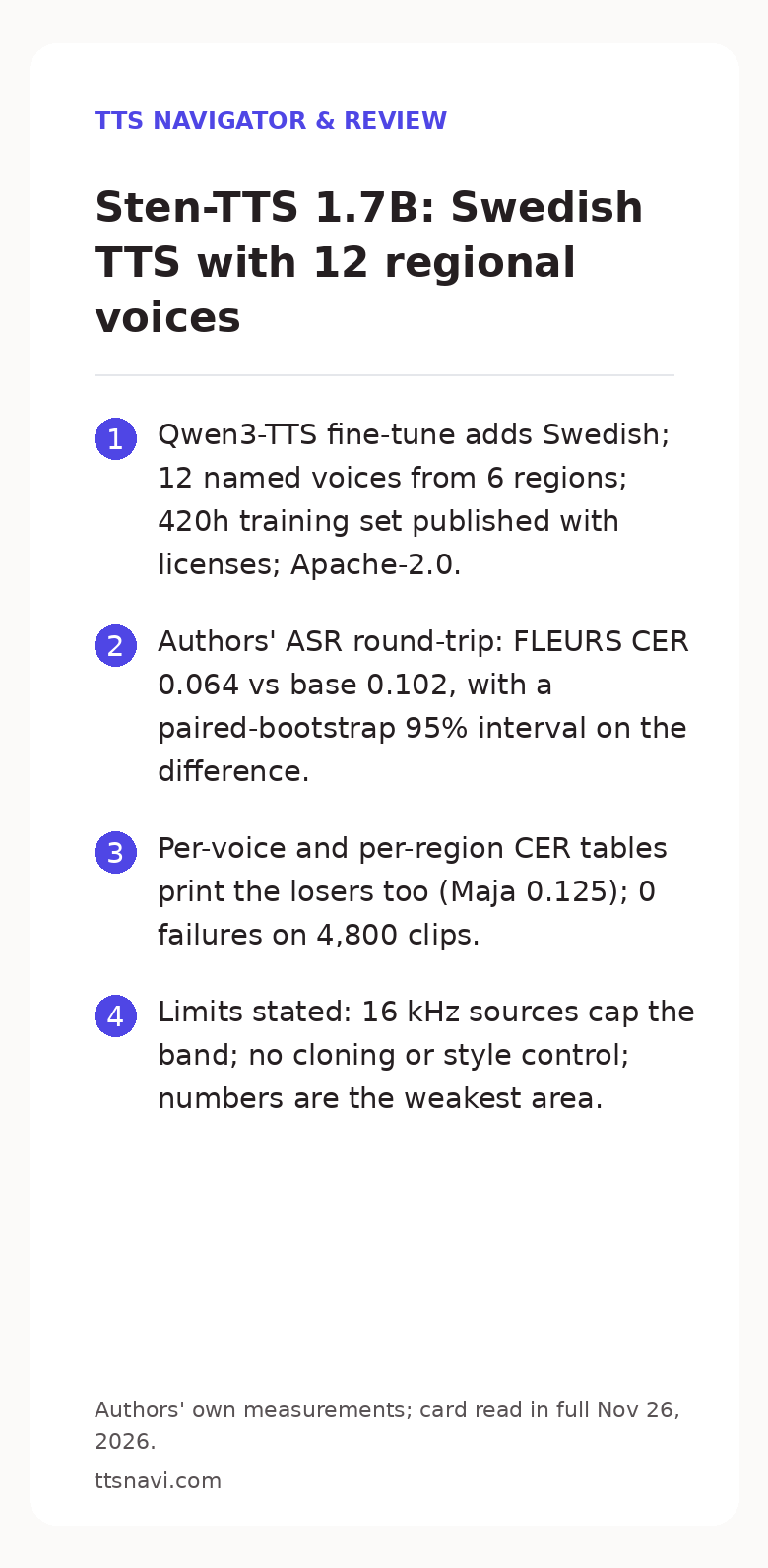
Sten-TTS-1.7B (swedishembedded, released November 25, 2026) is a full fine-tune of Qwen3-TTS-12Hz-1.7B-Base that adds Swedish: 12 named voices (6 female, 6 male) from 6 regions of Sweden, trained on 420 hours (376 h Swedish, 44 h English so English words inside Swedish sentences keep their English pronunciation), 194,769 utterances, in 32 minutes on 11 GH200 GPUs. The checkpoint loads unconverted in the upstream qwen-tts package, and the whole training corpus is published as the Sten-TTS Voice dataset with held-out sets, sources and licenses (NST Swedish CC0, RixVox-v2 ODC-BY, LibriVox CC0, FLEURS and LibriTTS-R CC-BY). Apache-2.0.
An evaluation that argues with itself
The authors' ASR round-trip (Qwen3-ASR-1.7B transcribing, CER lower is better) on sentences the model never saw: FLEURS sv_se 0.064 vs 0.102 for the base model cloning the same voices; code-switching 0.062 vs 0.069; numbers 0.157 vs 0.179. Unusually, the FLEURS claim carries a paired-bootstrap 95% interval (-0.049 to -0.027 on the difference, n=2,400 pairs) - the part most TTS cards skip. Just as unusual: the card tells you how to misread its own metric, noting the recogniser scores 0.147 on the voices' real held-out recordings - higher than on the synthesized speech - and explicitly says that reflects the 1999-era 16 kHz recordings, not that the model is clearer than its speakers.
The per-voice table keeps the bad news
All 12 voices are in the table, including the ones that lose: Maja (Western southern Sweden) reads FLEURS at 0.125 CER and numbers at 0.234, dragging her region to 0.108 FLEURS against 0.050-0.061 elsewhere. Reliability is stated separately from quality: 0 failures on 4,800 FLEURS clips (no silence, no overruns). Voice consistency is measured by speaker-encoder identification (1.00 for every voice), and the card warns that the 0.995 cosine similarity on both synthesized and real clips means the encoder separates little - read the identification result, not the similarity, as the evidence.
Limits stated on the card
Most Swedish training audio - including every named voice - is 16 kHz, so the 24 kHz output lacks the top of its band. The 12 voices are read-speech speakers recorded around 1999, anonymous NST speakers; the model takes no style instruction and does not clone. There is no text normalisation, so numbers, dates and abbreviations are the weakest area (the 0.157 Numbers CER against 0.064 FLEURS shows it). English-only text was not evaluated, and Finland Swedish is not covered. The card also carries a commercial offer block from Swedish Embedded AB - the model itself is Apache-2.0 and the data is public.
Sources
- https://huggingface.co/swedishembedded/sten-tts
- https://huggingface.co/datasets/swedishembedded/sten-tts-voice