An 18-speaker Kikuyu TTS from 12 hours of WAXAL audio - and a card that lists what it has not checked
November 24, 2026 - TTS Navi. We read the model card in full. The card reports no evaluation numbers; everything below about quality or licensing is the card's own statement, not our test.
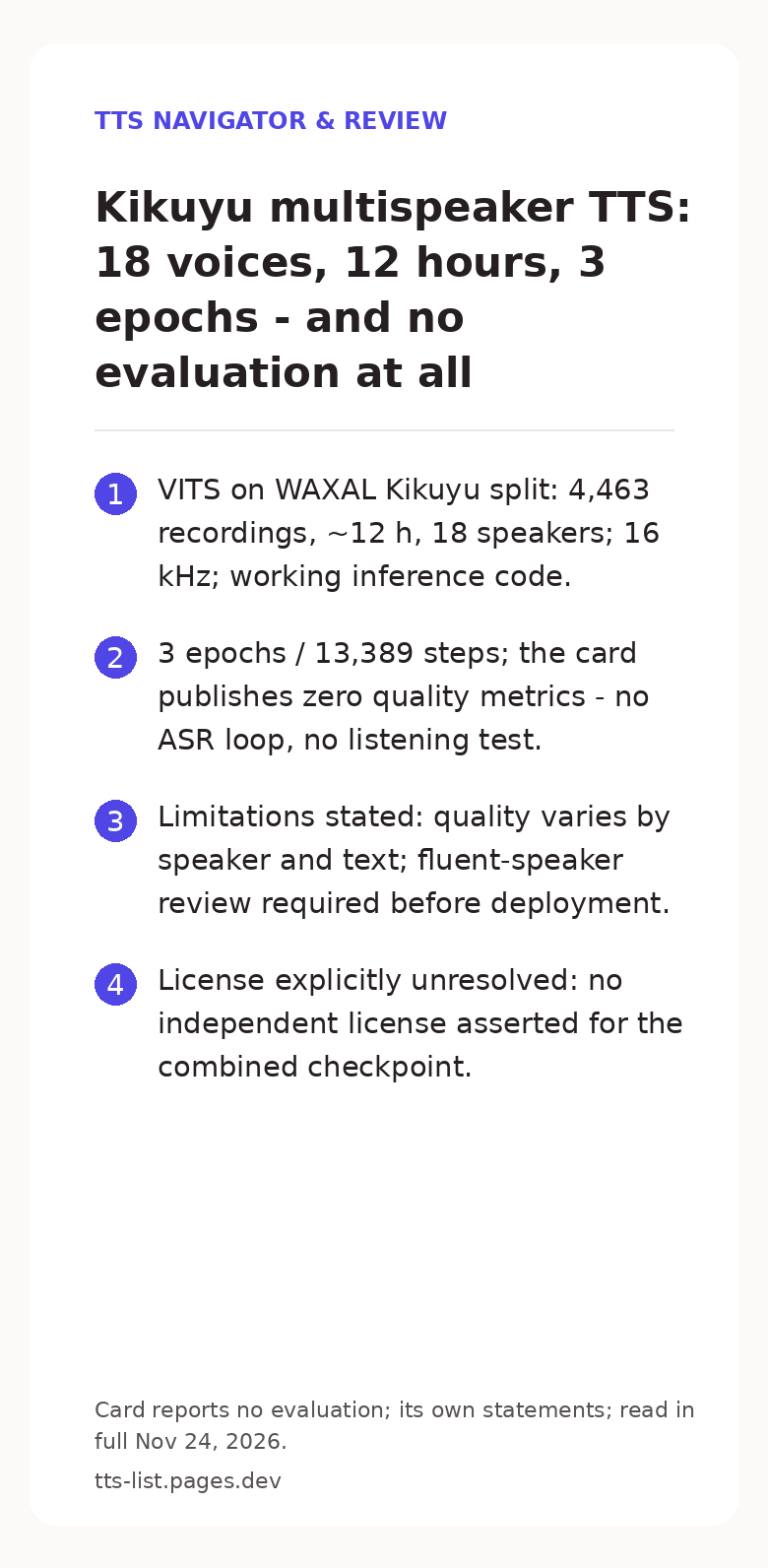
Kikuyu, a Bantu language of central Kenya spoken by millions, has almost no open speech tooling. Mwau/kikuyu-multispeaker-tts-v2 (released November 24, 2026) is a multi-speaker VITS in transformers format: 18 speakers (speaker_id 0-17, 256-dimensional speaker embeddings), 16 kHz output, 37-symbol vocabulary, custom VITS configuration and modeling code loaded with trust_remote_code, and a complete copy-paste inference example that selects a voice by ID. Training data is the Kikuyu split of the WAXAL speech corpus: 4,463 recordings, approximately 12 hours, 18 speakers, per the training manifest (validation and test splits excluded from those figures).
What three epochs buys
The card reports 3 training epochs and 13,389 optimization steps - a short run by any standard, and the author does not pretend otherwise. There are no evaluation numbers: no ASR round-trip, no listening test, no MOS, no error rates of any kind. The limitations section instead says what to expect: quality and intelligibility may vary across speakers and inputs, the training data is limited, performance across Kikuyu dialects and speaking styles needs further evaluation, and generated speech should be reviewed by fluent Kikuyu speakers before deployment. For a language with this little tooling, a runnable 18-voice starting point is still worth having - as long as nobody reads "released" as "validated", a distinction this card itself insists on.
The license is stated as unknown
The most unusual line is the licensing section: the conditions of the combined model - pretrained components plus training data - "require further review", and the author asserts no independent license for the combined checkpoint. The custom VITS implementation retains its original copyright and licence notices, and WAXAL's own conditions are referred to the dataset documentation. Version 2 is described only as distinct from a v1 fine-tuned on 29 hours of newly collected recordings. Compare this with the many cards that slap a license badge on derivative weights and move on: here the absence of an answer is documented as an open item.
Why cover a model with no metrics
Because the card is the honest version of a common situation. Low-resource releases often ship with the same gaps - minimal training, no evaluation, unclear licensing - but say nothing, leaving users to discover them. This one puts the gaps in the README: treat it as a research checkpoint to evaluate, not a component to ship. If you work on Kenyan languages, it gives you 18 voices, working code, and an explicit list of the checks that still need doing - dialect coverage, per-speaker quality, fluent-speaker review, and a licensing pass before any redistribution.