mg-voca: a 21 MB Malagasy TTS for phones, with a "What nobody has checked" section every release should have
November 22, 2026 - TTS Navi. We read the mg-voca model card in full, including its "What nobody has checked" section. All figures are the author's own measurements, not our tests.
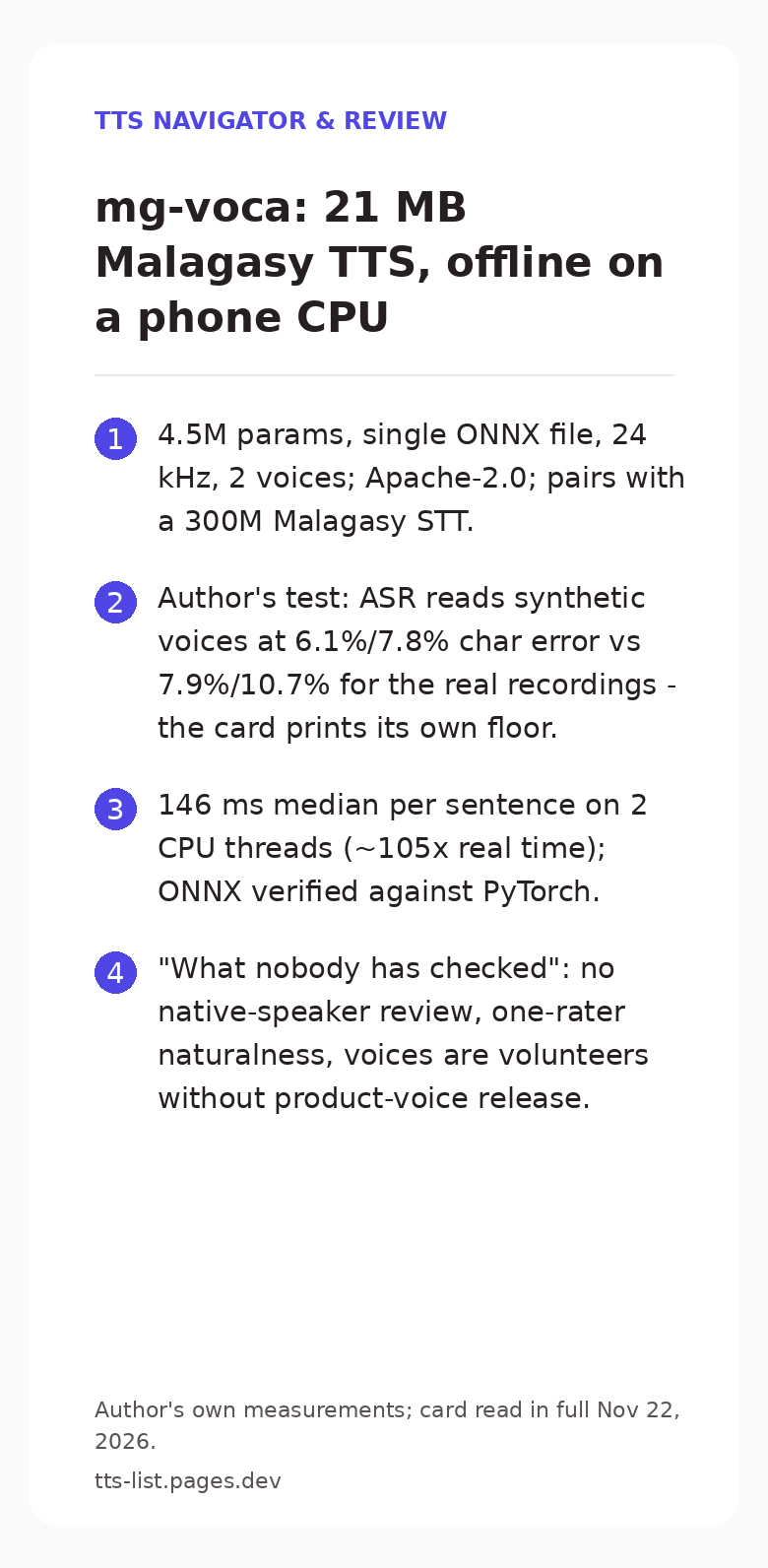
Malagasy, the national language of Madagascar, has almost no open speech tooling. mg-voca (darioooooo0o, released November 21, 2026) is a 4.5M-parameter Malagasy TTS - 21 MB as a single ONNX file, no PyTorch needed, 24 kHz output, one female and one male voice - built on the tiny-voca architecture (transformer encoder, duration predictor, frame transformers, source-filter waveform generator, no separate vocoder). Letters with stress flags go in; audio comes out. It is the speaking half of a pair with the same author's 300M Malagasy speech-to-text model, so an app can hear a command and answer aloud, fully offline. Code and weights are Apache-2.0; the voices come from the Afrivoice Malagasy dataset (CC-BY-4.0).
Measured against its own noise floor
The card's first table asks the right question: can an outside recognizer understand the synthetic voice? On 28 held-out sentences per voice - including numbers, dates and Ariary amounts - an independent ASR reads the synthetic female voice at 6.1% character error and the male at 7.8%, against 7.9% and 10.7% for the real speakers' own recordings on the same test. The card itself supplies the reading: the recognizer handles the synthetic voice about as well as the real people, which says nothing about whether a Malagasy speaker finds it pleasant. Speed: 146 ms median per sentence on 2 CPU threads (about 105x real time, ONNX Runtime). The ONNX export was verified against PyTorch within float noise.
The honesty section, verbatim in spirit
A section titled "What nobody has checked" lists: no native Malagasy speaker has reviewed the pronunciation, the demo phrasings, or the loanwords; the single rater found French app words respelled by rule (credit becomes kredy, parametres becomes parametra) and possibly wrong-sounding; the 3.5-out-of-5 naturalness figure is one person's blind rating - "do not quote 3.5 as a quality score" is the card's own sentence; stress follows a penultimate-syllable rule that only grave-accented spelling can override for exceptions; long text is out of scope, short commands are the target. The two voices are named as real volunteers from Afrivoice - speaker IDs IXtzHfrU and bReJIOgP, about 15 and 14 hours after filtering - who did not sign a product-voice release; for a commercial voice, the card says, record your own speaker and fine-tune, about one GPU-hour.
Why this release matters
Low-resource TTS releases usually fail in one of two ways: no evaluation at all, or numbers without a floor to compare them against. mg-voca prints its floor, caps its own claims, names its speakers and their consent status, and ships the front end (numbers, dates, times, currency, abbreviations, stress) as a dependency-free Python file with Kotlin and Swift ports in the app SDK, with a fingerprint check so the model refuses a mismatched front end. It continues the tiny-voca lineage we covered for English and Malayalam, and it is currently one of the most responsibly packaged first releases for an underserved language.
Sources
- https://huggingface.co/darioooooo0o/malagasy-tts-mgvoca
- https://huggingface.co/darioooooo0o/malagasy-stt-300m