Location matters: where you inject voice and style prompts into a TTS decoder changes what the model can control
November 21, 2026 - TTS Navi. We read the paper in full. All results are the authors' experiments on proxy embedding metrics - the paper itself notes it ran no listening tests.
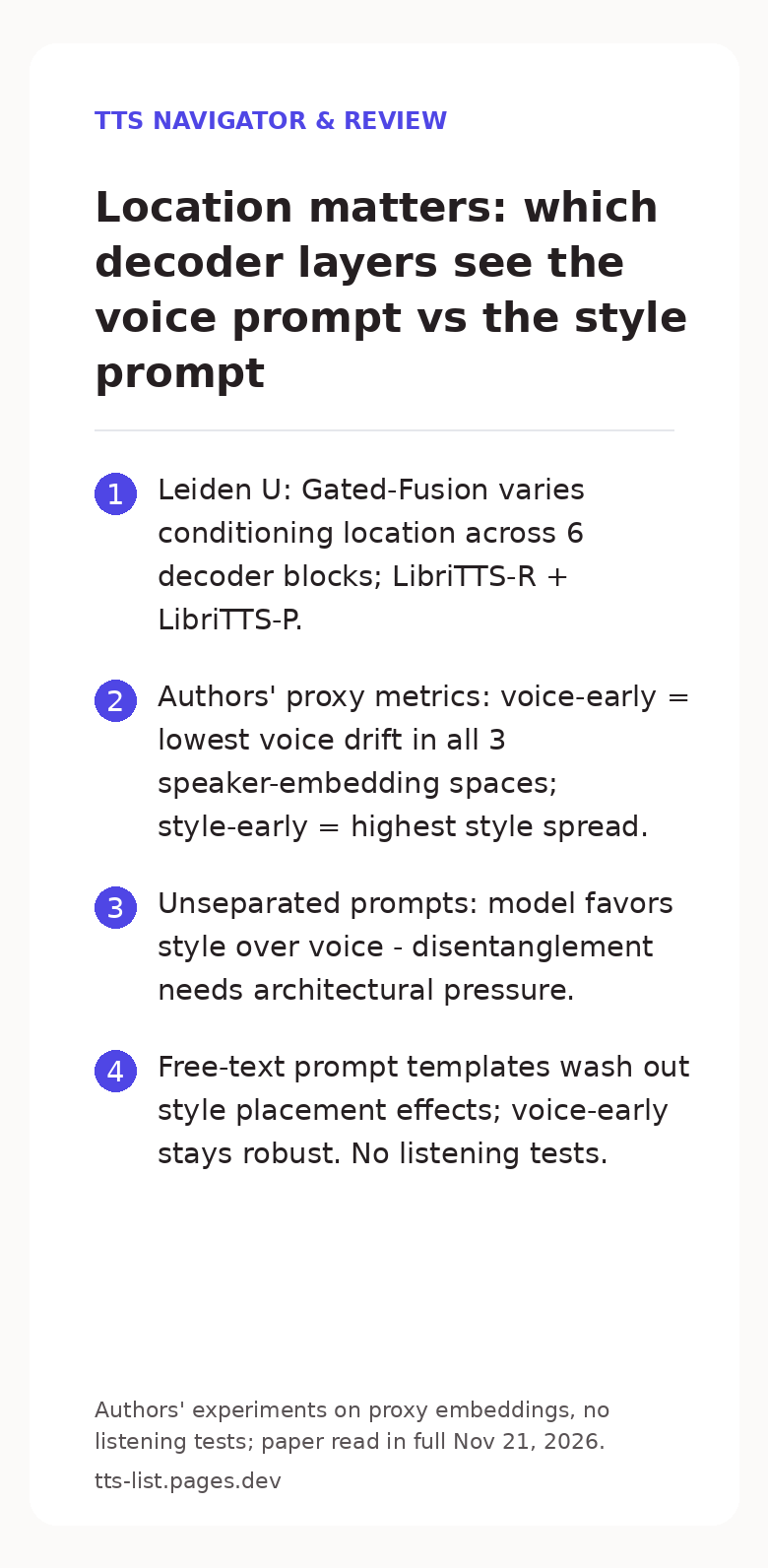
Prompt-controlled TTS promises "any voice, any emotion", but the two controls fight each other: change the style prompt and the voice drifts. This paper (arXiv 2611.24125, November 18, 2026; Lindevelt, Verberne and Broekens, Leiden University) asks a question most systems answer by accident: at which decoder layers should each prompt enter? The authors build Gated-Fusion - voice and style prompts encoded separately by T5-large, then mixed before cross-attention with fixed, layer-dependent gating weights - and compare four variants on a 6-block transformer decoder over WavTokenizer codes: prompts concatenated (Concat), fused equally everywhere (Equal), style in early layers and voice late (Style-early), and the reverse (Voice-early). Training is on LibriTTS-R with LibriTTS-P human annotations: 515 hours, 2,295 speakers, with voice described by age/sex/pitch/texture prompts and style by speed/loudness/arousal/valence.
Measuring control without listeners: spread and drift
There are no listening tests in this paper - the authors flag that themselves as a limitation. Instead they define two quantities in proxy embedding spaces: spread (how much output varies when you vary one prompt, holding the other fixed - you want this high for the factor you are controlling) and drift (how much the held-fixed attribute changes anyway - you want this low). Voice is measured in three speaker-embedding spaces (ECAPA-TDNN, TitaNet, WavLM); style in seven acoustic-prosodic features with arousal/valence from two different emotion models. Statistics are mixed-effects models with Holm-corrected contrasts, with a GEE robustness check - unusually careful machinery for this literature, needed because samples sharing a prompt are not independent.
The asymmetry, in the authors' experiments
Voice drift falls as voice conditioning moves earlier: Voice-early shows the lowest drift in all three embedding spaces (ECAPA-TDNN .227, TitaNet .470, WavLM .125, cosine distances where lower is better) - the model appears to lock in speaker identity early, leaving later layers free to modulate prosody. Style shows the mirror image: Style-early achieves the highest style spread (3.536/3.532 under the two emotion models) and Voice-early the lowest. The largest single contrast in the study is Style-early versus Voice-early on style spread. Meanwhile the plain Concat baseline has the lowest style drift but the highest voice drift: given both signals unprompted, the model favors style - the authors' reading is that prosody is simply more useful for next-token prediction than global identity, so disentanglement needs architectural pressure, not just separate prompts.
Prompt phrasing can wash the architecture out
The study repeats everything with template prompts - the same categories rendered through 15-20 handwritten sentence templates, randomized per sample - instead of structured category strings. Under this realistic prompt diversity, the placement effects on style shrink sharply (the test statistic for style spread drops from 411.3 to 63.8). The exception is voice drift: its placement effect is essentially unchanged (a 4% reduction), making early voice conditioning the most robust finding of the paper. One more sobering observation: the input text itself acts as a competing style signal - with prompts fixed, varying the text produces style distances approaching the spread of neutral prompts.
Takeaways and limits
Practical guidance, per the authors: there is no single best placement - choose by application priority. Voice-early when identity consistency matters (audiobook characters, brand voices); style-early when expressiveness is the product. Limits, per the authors: one encoder-decoder transformer architecture; fixed rather than learned gating weights; proxy metrics without perceptual confirmation; and LibriTTS-R is mostly neutral audiobook speech, so emotional range is untested. For anyone wiring prompts into a TTS stack, the durable lesson is that "add a prompt encoder" is not a design decision - where the prompt lands in the network is.