21Codec: pull speaker identity out of the audio tokens, put it back at the decoder - and pay for it in WER
November 23, 2026 - TTS Navi. We read the paper in full. All results are the authors' experiments, including their two listening studies, not our tests.
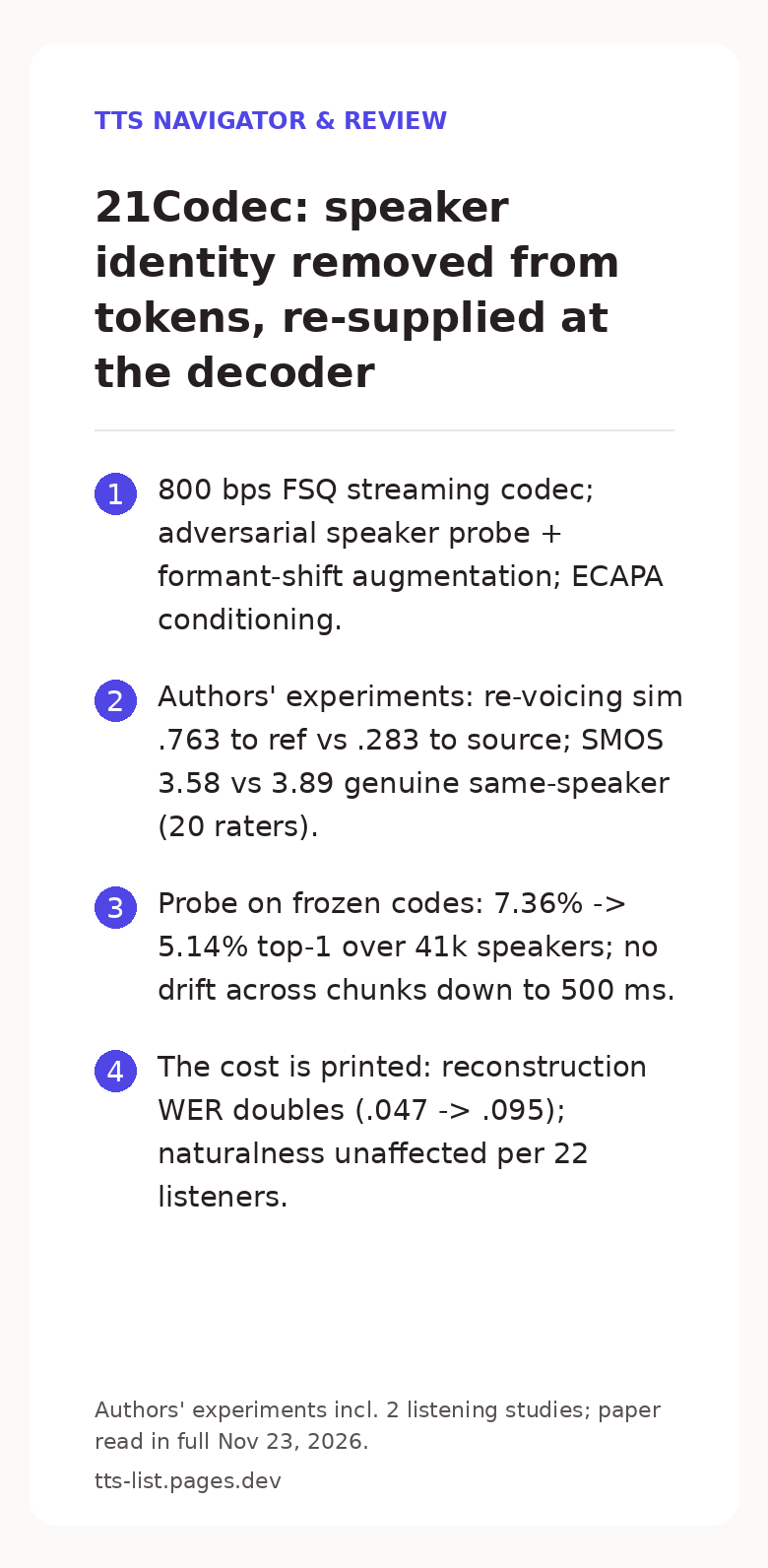
When a modern TTS streams, its codec decoder sees only a short chunk of audio tokens at a time - and because most codecs bake speaker identity into the tokens, each chunk re-infers who is speaking. The audible result in current models, per this paper, is a voice that drifts mid-utterance. 21Codec (arXiv 2611.24094, November 18, 2026; Lindevelt, Verberne and Broekens, Leiden University - the same group behind the layer-wise conditioning study we covered two days ago) treats this as a representation problem: an 800 bps, 50 Hz FSQ codec trained with an adversarial speaker-classifier probe and NANSY-style formant-shift augmentation so the tokens carry as little speaker information as possible, while a single external ECAPA-TDNN embedding conditions every decoder frame. Identity enters once, not per chunk. Same group, same week, connected thesis: their earlier paper argued identity should enter late and style early; this one removes identity from the token stream so the two never compete.
Does re-voicing work? Objective and human answers
Decoding the same source codes with a different speaker's embedding: cosine similarity to the reference reaches .763 (vs .869 for a genuine same-speaker utterance), while similarity to the source drops to .283, close to the .191 between genuinely different speakers - the source voice is largely gone from the output. In the authors' SMOS study (20 raters after exclusions), re-voiced samples scored 3.58 against 3.89 for genuine same-speaker pairs and 1.50 for genuinely different ones, with cross-language references falling to 1.38 - the effect is large (repeated-measures ANOVA, F(1,19)=78.7, p<.001). On recoverability: a standalone probe trained on the frozen codes drops from 7.36% to 5.14% top-1 over 41,481 speaker classes (chance 0.002%), a 30% relative reduction, statistically significant by McNemar test; on a held-out subset, 15.8% to 11.0%. Suppressed, not erased - the paper says reduced, and the numbers back exactly that word.
Streaming without drift, with measurements
The chunk-causal transformer decoder (future chunks masked, arbitrary chunk sizes) matches non-causal decoding down to 500 ms chunks, speaker similarity within .002; at 160 ms chunks it runs at RTF .129 on CPU and .035 on GPU (i9-13900K, RTX 4090, ONNX Runtime, batch 1). In the decisive experiment - uncached chunked decoding of the same token sequence - WavTokenizer and NeuCodec drift across speakers as chunks shrink, while 21Codec's similarity stays flat near the natural-audio band (0.735 +/- 0.063 through the same windowing).
The trade-off, printed in their own table
Identity-free tokens cost intelligibility: reconstruction WER on unseen speakers rises from .047 (unconditional twin) to .095, CER from .025 to .052, while speaker similarity improves .818 to .903. Naturalness is not part of the trade-off - 22 listeners rate the two settings indistinguishable (3.30 vs 3.19) - and the authors flag that DNSMOS ranks their model first, above unprocessed audio, while listeners rank it fourth, so they read the objective metrics as "conditioning does not degrade quality" rather than a codec ranking. Limitations stated: training stopped after 5 days for budget, not converged, so the numbers are a lower bound; and the method leans on the chosen speaker-embedding model. Code release is promised. For streaming TTS builders, this is the cleanest demonstration yet that speaker drift is a choice of representation, not an inevitability - with the price tag attached.