Decodability is not controllability: VoxCPM2 speaker control lives at early layers, not where probes look best
Published October 26, 2026 · Built from arXiv:2610.29345, read in full on October 26, 2026 - method, results, and discussion. All results below are the paper's own experiments; we did not run the models. Interpretive commentary is marked as ours.
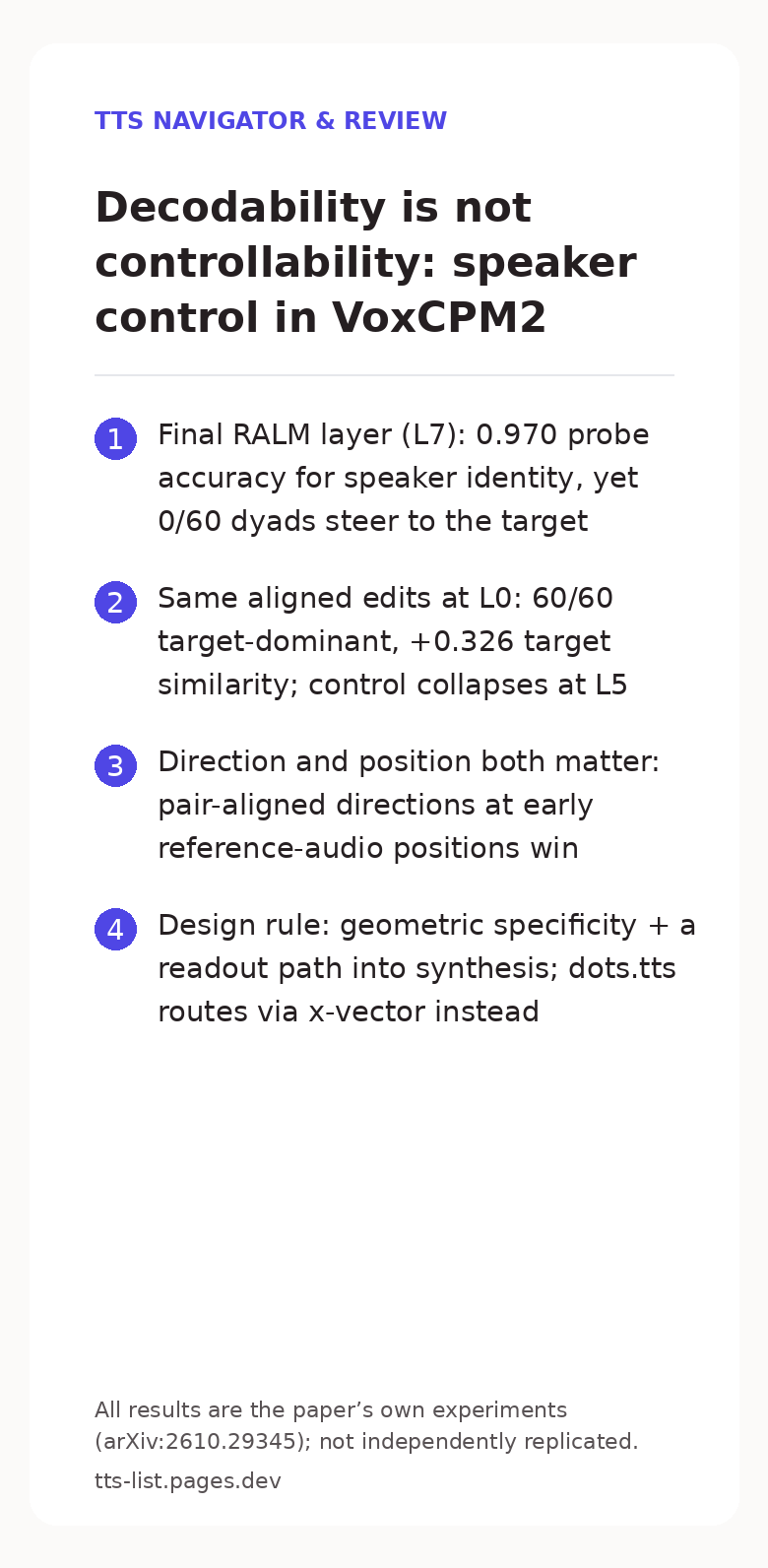
If you want to steer a voice in a modern continuous-latent TTS model without retraining, where do you intervene? A natural heuristic is to pick the layer where a linear probe reads speaker identity most accurately. A new paper from VoxNexus (Singapore) - Decodability Is Not Controllability (arXiv:2610.29345, October 21, 2026) - shows that heuristic picks exactly the wrong layer in VoxCPM2: the layer with near-perfect probe accuracy is causally inert for steering, while an early layer with slightly lower probe accuracy controls the voice almost perfectly.
The setup
VoxCPM2 encodes reference audio into AudioVAE patches, interleaves them with text embeddings, and runs them through a TSLM plus an eight-layer residual acoustic language model (RALM); a flow-matching LocDiT then renders the waveform. The authors (Yuanzhong Zheng, Wei Huang, Ming Ma, Kailun Jin, Youhai Jiang) intervene on post-block RALM hidden states at prefill, keeping the already-computed KV cache, across 30 speakers and 60 directed source-to-target dyads. Probes are trained on 300 held-out utterances from the same speaker pool, with five-fold cross-validation grouped by transcript and permutation-corrected significance - a tighter methodology than most steering papers.
The headline result
| RALM layer | Reference-audio probe accuracy | Aligned-edit target gain (ΔSIMB) | Target-dominant dyads |
|---|---|---|---|
| L0 | 0.947 | +0.326 [0.298, 0.353] | 60/60 |
| L3 | 0.963 | +0.227 [0.204, 0.250] | 52/60 |
| L7 | 0.970 | 0.000 [-0.002, 0.001] | 0/60 |
At L7, speaker identity is almost perfectly decodable from reference-audio states (0.970), yet pair-aligned edits there move the generated voice toward the target in zero of 60 dyads. At L0, the same kind of edit succeeds in all 60. A finer six-layer sweep over 25 dyads shows the controllable region spans L0-L3 and collapses sharply at L5. The authors' explanation is routing, not information: early reference-audio edits propagate through later attention blocks into the final conditioning state that reaches the acoustic generator ("readout reach"); post-block L7 reference-audio edits sit beyond the last mixing block, so the information is present but disconnected from synthesis.
Direction and position both matter
- Pair-aligned directions win. At L0, the source-to-target direction beats equal-norm orthogonal and random directions by +0.342 and +0.340 in target similarity - the controls isolate the effect, since every intervention carries the same norm.
- Position matters as much as layer. Reference-audio positions beat non-audio and final-state aligned interventions by about +0.31. Final-state interventions mainly damage intelligibility (WER up +0.096 to +0.127 across layers) without buying target control.
- The mechanism is two-sided. Aligned L0 edits both displace the source (ΔSIMA = -0.467) and attract the target (post-intervention SIMB 0.467 vs SIMA 0.173). Orthogonal perturbations push away from both speakers - leverage without direction.
- Robust to scale. A norm sweep at 0.5x, 1x, 2x, 5x the native norm all produce target attraction (gains +0.186 to +0.387), with the largest at the native norm.
It generalizes beyond the probe setup
- An independent speaker encoder (CAM++) reproduces the depth ordering: gains +0.237 / +0.190 / +0.001 at L0/L3/L7, with 55/60, 43/60, 0/60 dominant dyads.
- Retrieval against five-utterance prototypes of 30 held-out speakers: at L0 both ECAPA and CAM++ rank the intended target top-1 in 46/60 dyads; at L7, 0/60 for both.
- Reference-audio aligned edits cost essentially nothing in intelligibility (ΔWER around -0.003, CI crossing zero).
- Double-blind listening tests confirm people hear the shifted voice as the intended target.
The dots.tts counterexample - architecture decides the route
The same recipe fails differently in dots.tts, a second architecture: backbone edits displace the source voice without attracting the target (mean target gain non-positive across directions, 0/60 dominant everywhere), because dots.tts anchors speaker identity through a direct x-vector input rather than through reference-audio states. Ablating that x-vector collapses source similarity from 0.849 to 0.006. In other words: where speaker control lives is an architectural property - VoxCPM2 routes it through early reference-audio states; dots.tts routes it through a dedicated conditioning input.
What this means in practice (our read)
- Probe accuracy is the wrong compass for control-site selection. The paper's title is the lesson: decodability measures what a layer knows, not what it controls. Anyone doing activation steering on speech models should run equal-norm direction controls before trusting a probe-chosen layer.
- Two requirements for training-free speaker control. Geometric specificity (a direction aligned to the actual speaker pair, not noise) and readout reach (a computational path from the edited state into acoustic synthesis). Miss either and you get nothing - or just worse audio.
- Expect per-architecture answers. The VoxCPM2 recipe does not transfer to dots.tts; each model family needs its own intervention map. For open-weights voice-cloning work, this paper is a good template for how to draw that map.
Caveats
- All results are the paper's own experiments on VoxCPM2 and dots.tts; we did not run the models. There is no independent replication yet.
- The speaker universe is 30 speakers / 60 dyads - solid for a steering study, but not a claim about every voice or every language.
- The work studies speaker identity control, not emotion, style, or prosody steering; generalizing the depth pattern to other attributes is an open question.
Sources (read in full; link verified October 26, 2026)
- arXiv:2610.29345 - Decodability Is Not Controllability: Local and Anisotropic Speaker Control in Continuous-Latent TTS (Zheng, Huang, Ma, Jin, Jiang; VoxNexus; submitted October 21, 2026) - all method and results above.