Parrot-TTS: Vietnamese TTS that prints its tone errors - and its speakers' consent
November 25, 2026 - TTS Navi. We read the model card in full. All figures are the authors' own measurements, not our tests.
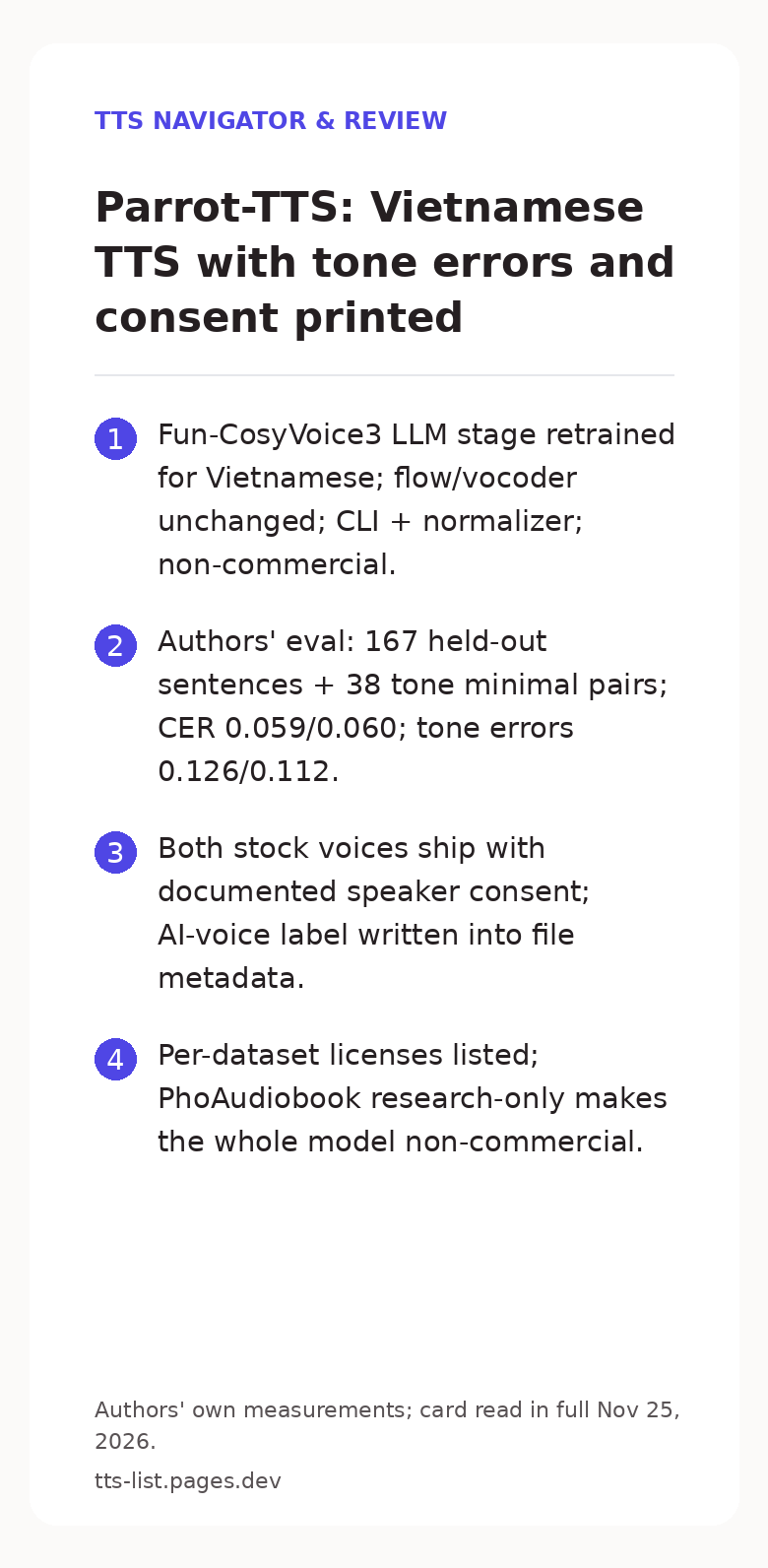
Vietnamese is a tonal language where a wrong tone is a wrong word, so a Vietnamese TTS lives or dies on tone accuracy - and most cards never measure it. Parrot-TTS (rin98s/Parrot-TTS, released November 24, 2026) re-trains the text-reading LLM stage of Fun-CosyVoice3-0.5B for Vietnamese (fp16, about 1.3 GB) while keeping the base model's flow and vocoder, and ships a CLI (the package is still called vietvoice), a text normalizer, and your-own-voice conditioning from a reference clip plus transcript. It runs on CPU at about 4-5 seconds per second of audio, faster on GPU. License: free for personal, educational and research use; commercial use excluded - and the card explains why: one of its four training sources (PhoAudiobook) is research-and-education only, so the whole model inherits non-commercial status. The other sources - FLEURS vi_vn (CC BY 4.0), YODAS vi000 (CC BY 3.0), LSVSC (CC BY 4.0) - are listed with their licenses, and the base model is Apache-2.0.
The evaluation is tonal, not just textual
The authors transcribe generated speech with Whisper on 167 held-out sentences (excluded from model selection) and, separately, 38 tone minimal pairs: CER 0.059 and 0.060 for the two voices, tone error rates 0.126 and 0.112, speaker similarity to the reference 0.906 and 0.941. Printing a tone-error row next to CER is the part most Vietnamese TTS cards skip - and 11-13% tone errors is a honest number that tells you the model is usable but not finished.
Consent as a shipped feature
Two stock voices ship, with named personas and usage guidance: Thanh Thanh (Southern female, podcasts and storytelling) and Thanh (Southern male, radio-style reading). The card states both original speakers agreed to have their voices published under these names. It also bans imitating anyone who has not consented, requires AI-generated labeling on published audio, and notes that files written by the CLI already carry a synthetic-voice label in their metadata. At a moment when voice releases routinely dodge the consent question, putting it in the spec table is worth calling out.
What is not there
No MOS or human listening study, no Northern-accent voices yet ("on the way"), CPU speed is usable-not-fast, and the license blocks commercial products. For Vietnamese personal, educational and research use, though, this is a complete local package: normalizer, two consented voices, cloning from your own clip, and a tonal evaluation printed on the card.