Guā-hâng TTS: an 18M Taigi voice by an author who does not speak Taigi - judged by ears, with the baselines printed
November 26, 2026 - TTS Navi. We read the model card in full (English and Chinese versions). All figures are the author's own measurements, not our tests.
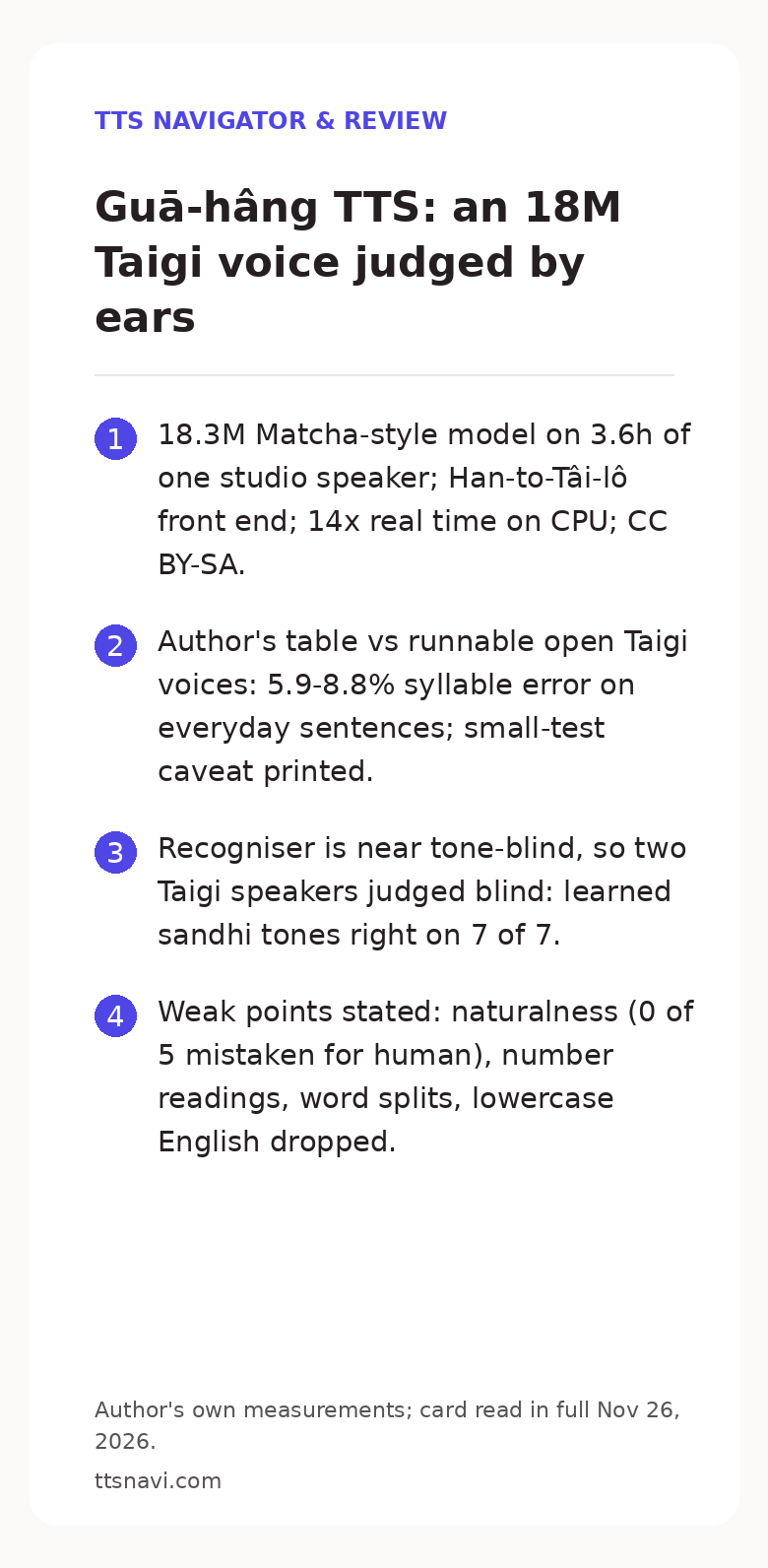
Guā-hâng (外行, "layman" - the author, an American in Taipei, does not speak Taigi) is a Taiwanese Hokkien TTS released November 25, 2026: an 18.3M-parameter Matcha-TTS-style acoustic model trained from scratch on 3.6 hours of the Suí-siann studio corpus (one speaker, Ms. Ông Siù-iông, recorded 2018-2019), plus an unchanged English-trained Vocos vocoder. A rule-based front end converts Han characters to Tâi-lô and reads numbers, dates, times and money (254 of 256 rule test cases pass). It runs on CPU at about 14x real time. Weights CC BY-SA 4.0 (the corpus is share-alike), code MIT. Built by one person with Claude writing most of the code.
A comparison table with the caveats attached
The author's ASR round-trip (a Breeze-ASR-26 fine-tune, explicitly near tone-blind - it measures syllables, not tones): on 8 everyday MOE sentences the model reads back at 8.8% (learned sandhi) and 5.9% (rules sandhi) syllable error rate against 2.9% for real recordings; on 24 harder Common Voice sentences 19.0%/21.6% against 23.2% for real speakers - at the real-speaker level on that harder set. The runnable open baselines are in the same table: OmniVoice-Taigi-SuiSiann 12.7%/20.2% (given each sentence's own Tâi-lô), a CosyVoice3 Taigi LoRA 27.5%/31.7%, MERaLiON Hokkien 37.3%, Suí-siann VITS 43.1%, untrained CosyVoice3 72.5%. And the caveats are printed next to the numbers: tests are small (102 syllables, so three syllables are three points), some test sentences overlap the front end's lexicon, and OmniVoice with tones ignored already reads back better (2.0% vs 4.9%) - most of its errors are tones.
Ears decide what the recogniser cannot
Because the recogniser barely hears tones, two Taigi speakers listened blind with real speakers mixed in: tones "all right" on 7 of 7 learned-sandhi clips vs 3 of 6 rules-sandhi (hence learned is the default), real speakers 10 of 10, the other open voices 2 of 14. Naturalness is the stated weak point: on the later page neither listener mistook any clip for a real person (0 of 5). Two listeners and 13 clips is presented as a first look, not a verdict.
The wrong-reading list is the real documentation
Known misreadings are itemized: unsettled number readings (8 and 5 in years, 元 vs $), 921 read as a number instead of digits, word-split ties (便當店 can come out as "pawnshop"), lowercase English words silently dropped while capitals are spelled out. The author's roadmap is equally direct: this front end is voice-independent and the bigger OmniVoice model already beats the acoustic model with tones ignored - so the obvious next step is a bigger voice behind this front end. For an under-served language with almost no open voices, this is what a useful first release looks like.