Apriel Voice 27B Preview: ServiceNow open-sources speech understanding + reasoning + tool calls (MIT) - but it does not speak
Published October 31, 2026 · Built from the Hugging Face model card (primary source), read in full on October 31, 2026. All benchmark scores are ServiceNow's own runs from the card, in thinking mode - we label them as such. We did not run the model.
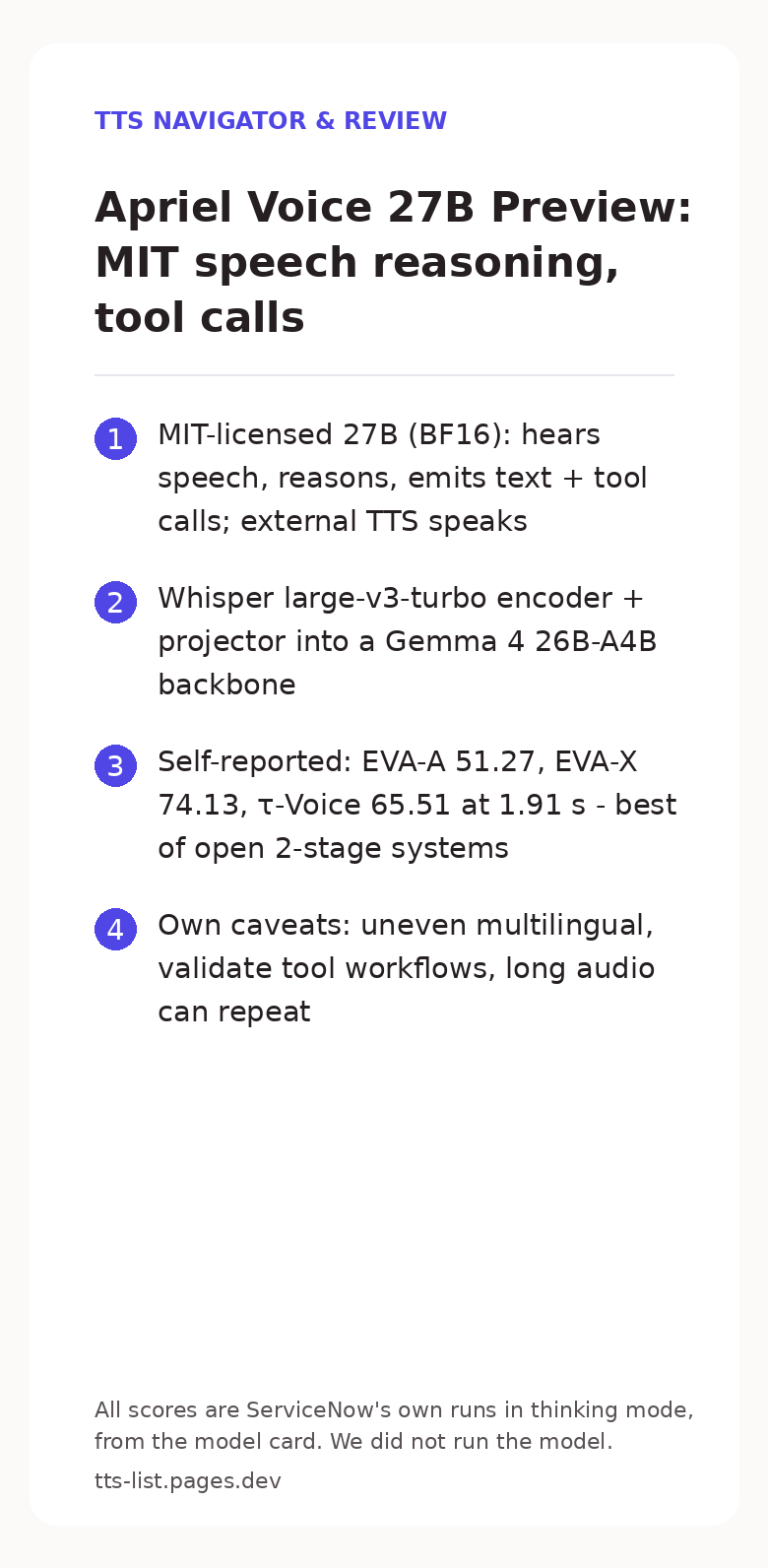
ServiceNow's AI lab has released Apriel Voice 27B Preview on Hugging Face under the MIT license. It is a speech-understanding and reasoning model, not a talker: audio goes in, the model reasons over the conversation, and text responses and tool calls come out - you pair it with an external speech synthesizer and your own turn-taking logic to build a voice assistant. The card is explicit that "the checkpoint itself generates text and tool calls rather than native full-duplex speech."
Architecture and capabilities
- A Whisper large-v3-turbo speech encoder feeds a learned projector into a Gemma 4 26B-A4B backbone (27B params, BF16). Training first aligns the speech interface, then adapts it with speech tasks and text replay; a technical report describes the recipe.
- What it does: transcription, speech translation, spoken question answering, instruction following, multi-step reasoning, and structured function calling - with audio, text, images and tool results sharing one conversation context.
- Long audio: the processor chunks 16 kHz mono input into 30-second slices; the team observed good behavior up to about 30 minutes, supports more with quality caveats, and recommends thinking mode for long inputs.
The vendor's numbers - self-reported, thinking mode
- Headline: EVA-A 51.27 (service accuracy), EVA-X 74.13 (conversational experience), τ-Voice pass@1 65.51 at 1.91 s mean response latency - equal-domain means, thinking mode on.
- The comparison table's own context: proprietary native S2S systems still lead on task success - GPT Realtime 2.1 at 69.82 τ-Voice (1.55 s) and Gemini 3.8 Live Extended Thinking at 84.19 (1.50 s) - while every open-weight two-stage system listed (UltraVox v0.6, Gemma 4-12B-IT, Audex-30B-A3B) scores far below Apriel (26.80 / 24.20 / 17.15). So the honest reading: best open two-stage system in its own table, behind the proprietary S2S leaders.
- ASR: LibriSpeech WER 2.23% test-clean / 5.15% test-other; GigaSpeech 10.20%.
- Text reasoning mostly survives the speech adaptation: MMLU-Pro 84.42, GPQA Diamond 80.40, AIME 2024 92.0, and τ² 70.95 vs the Gemma backbone's 68.93 (GPT-5.2 as user simulator).
The card's own caveats - unusually plain
- Multilingual performance is uneven; English results do not imply comparable quality in other languages. Noisy and distant-microphone speech remain hard.
- Faithfulness and reliable completion of complex tool workflows "remain limitations" - the card tells you to validate tool arguments, results, and final task completion yourself.
- Long recordings can produce repetition or lose coherence; the end-to-end experience depends on your synthesizer and turn-taking components as much as on the model.
- Benchmark scores "do not guarantee the same accuracy, throughput, or latency on a different workload or deployment."
Why it matters
- A serious enterprise lab just made speech-reasoning ownable. MIT license, full weights, and a serving recipe (vLLM settings included) means a company can run a voice-agent brain on its own GPUs and pair it with any TTS - the modular counter-argument to this week's closed S2S launches (Phonic-1, Rime Prism).
- The table separates "hears and reasons" from "talks." Apriel's EVA-X of 74.13 edges Gemini 3.8 Live's 73.5 on conversational experience in the vendor's own runs, yet it ships no voice at all - a reminder that in two-stage designs, the TTS you choose is half the product.
- Preview honesty: 96 downloads last month, "preview" in the name, and a limitations section that reads like a reviewer's checklist - useful signal for anyone benchmarking it this weekend.
Source (read in full; link verified October 31, 2026)
- ServiceNow-AI/Apriel-Voice-27B-preview - Hugging Face model card - primary source: architecture, all benchmark tables (EVA/τ-Voice/WER/text reasoning), serving settings, limitations, MIT license. Release coverage dated October 30, 2026.