What does a voice-cloning TTS model actually "know" about a voice? SAEs find 684 interpretable features - but probing is not steering
Published November 1, 2026 · Built from the full paper (arXiv:2610.40505), read in full on November 1, 2026. This is a research paper by UT Austin and NYU authors; all findings are the authors'. We did not run the experiments.
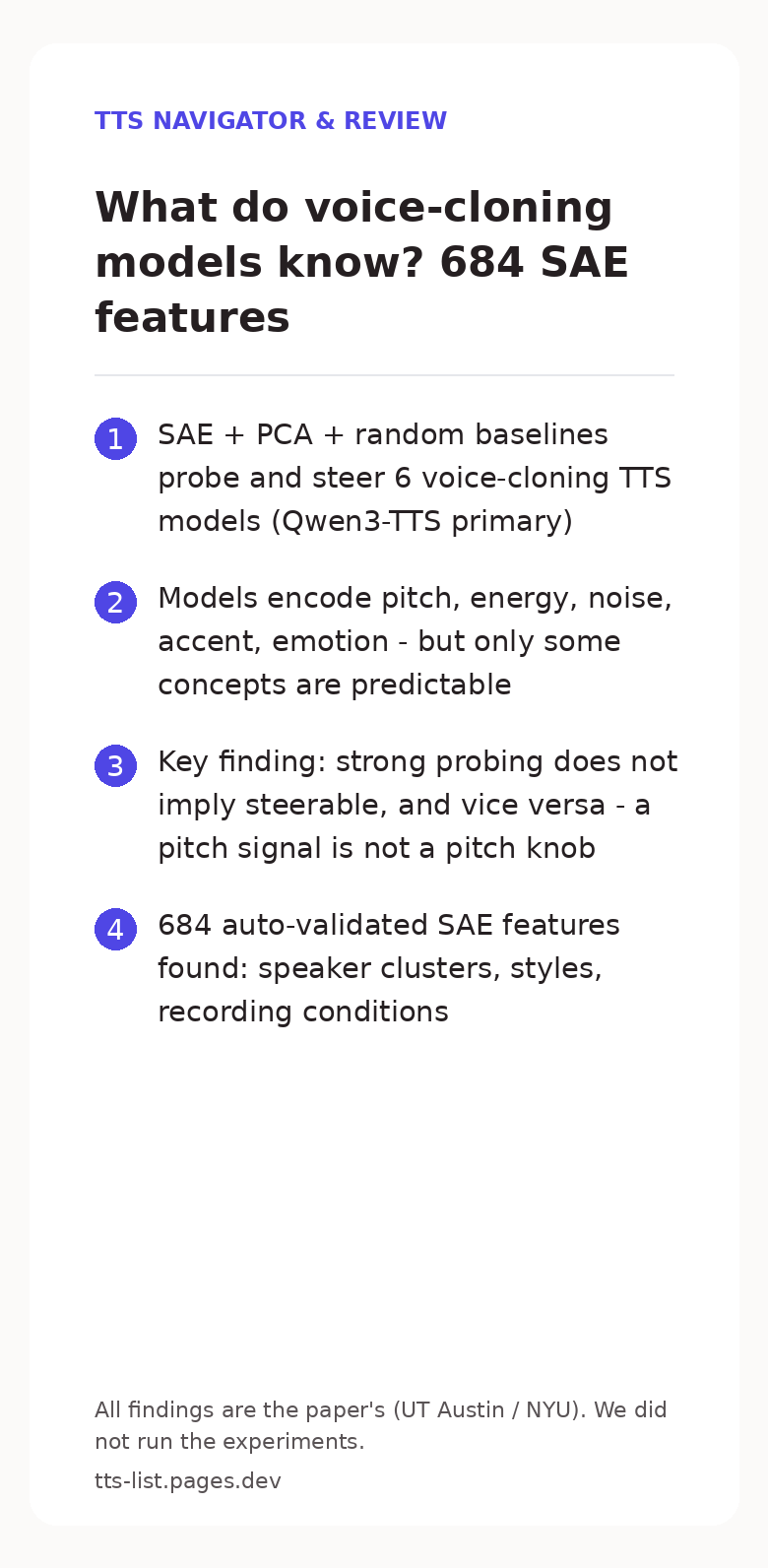
When a zero-shot voice-cloning TTS model copies a voice from a few seconds of audio, what did it actually extract - pitch? accent? the room's noise floor? A new paper from UT Austin and NYU (Diwan, Harwath, Choi) attacks that question systematically across six voice-cloning TTS models, with Qwen3-TTS as the primary subject and five Fish, Higgs and CosyVoice2 models testing whether the findings generalize. The toolkit: sparse autoencoders (SAEs), PCA, and random-direction baselines, evaluated three ways - sparse probing, generation-time steering, and quantitative auto-interpretability.
The findings that matter
- The concepts are in there. Models encode pitch, energy, noise, accent and emotion - but only some concepts are predictable from a few features.
- Probing ≠ steering. The paper's sobering headline for controllability work: strong sparse prediction of a concept does not imply you can steer it at generation time, and vice-versa. A direction that "knows" pitch is not necessarily a pitch knob.
- SAEs vs PCA is a split decision: SAEs win on sparse probing of human-labelled concepts and on novel-concept discovery; plain PCA is competitive for dense probing and for steering. Random directions are strong probing baselines - yet steer with near-zero effect, the probing-steering gap in miniature.
- 684 auto-validated SAE features in Qwen3-TTS beyond the labelled concepts: speaker clusters, speaking styles, and recording conditions - the model is internally organizing voices along axes nobody taught it.
Why the recording-condition features matter
The discovered features include recording conditions - which speaks directly to a known voice-cloning failure mode: unwanted transfer of background music or reverberation from the reference clip into generated speech. The authors flag their setup as a way to investigate exactly that leakage, and to track how representations shift during fine-tuning. For anyone building cloning products, "the model has a reverb feature you didn't ask for" is both a diagnosis tool and a future knob.
Caveats and availability
- Steering evaluation covers 55 extractor concepts on 100 examples; the 21 human-labelled concepts are probed only, since scoring them on fresh speech would need new human annotations. Effects "vary by model and concept," so no universal control recipe emerges yet.
- Steering demos and discovered features are on an anonymous demo page; code is promised at a named GitHub repo (ajd12342/voice-cloning-interp) - check availability before citing results as reproducible today.
- One contemporaneous CosyVoice3 SAE study is acknowledged; this is a fast-crowding subfield.
Why it matters
- Controllable TTS has been running on faith. Product UIs offer "emotion" and "style" sliders; this paper shows the underlying representations support control only unevenly - and that measuring the wrong thing (probing accuracy) can certify knobs that don't turn.
- Interpretability is becoming an eval discipline for audio. The same SAE methodology that mapped LLM internals now yields auditable feature inventories for voice models - useful for safety reviews (what else did the clone pick up?) as much as for control.
Source (read; link verified November 1, 2026)
- Discovering Interpretable Acoustic Features in Autoregressive Voice-Cloning TTS Models - arXiv:2610.40505 (October 29, 2026) - all findings, numbers and availability notes above.