Basque gets a cloning TTS from 9 hours of audio - and a card that prints its runaway rates
November 23, 2026 - TTS Navi. We read the model card in full, including its evaluation tables and failure-mode list. All figures are the authors' own measurements, not our tests.
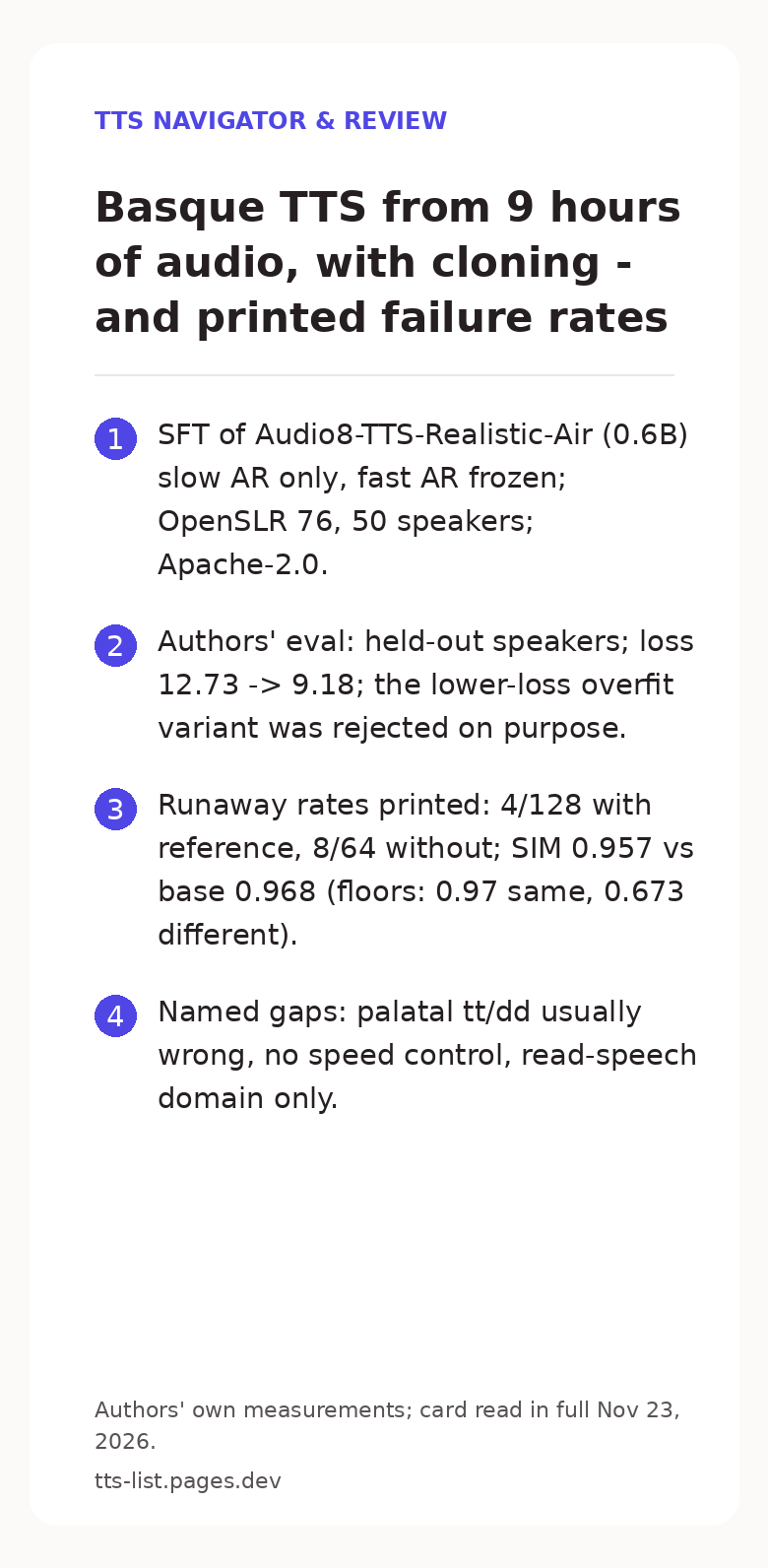
Basque (euskara) is a language isolate with no living relatives, and it was not among the 23 languages of Audio8-TTS-Realistic-Air, a 0.6B dual-autoregressive TTS with zero-shot voice cloning. On November 22, 2026, two Hugging Face accounts published what is, by the cards' identical method and numbers, the same adaptation: mikelalda/audio8-tts-eu and itzune/antzoki-mini-tts (the latter adds a llama.cpp GGUF build for CPU use; the mikelalda card credits the itzune recipe). The recipe: supervise only the slow AR branch on OpenSLR 76 crowdsourced Basque read speech - 6,811 utterances, 9.1 hours, 50 speakers after filtering - keep the fast AR frozen, 2 epochs, bf16, one RTX 5090. Apache-2.0; training data CC BY-SA 4.0 with a share-alike caveat the card tells you to check.
Evaluation done the careful way
Two speakers (euf_07505, eum_01523) were held out of training entirely. Teacher-forced loss on 200 of their utterances: base model 12.730, this release 9.183 - and the card reports an earlier, more aggressive run that reached 9.088 but overfit (OpenSLR 76 has many speakers reading the same sentences), so the authors shipped the slightly higher-loss version that "sounds and measures about the same and had fewer runaway generations when cloning". Choosing the less impressive number for a stated reason is the kind of detail that makes a card trustworthy.
The table most cards would hide
For cloning robustness: 8 new sentences across 2 held-out reference voices plus a no-reference condition, 8 seeds - 128 and 64 generations. Runaway rate (no end of speech, or speaking rate below 8 chars/s): 4/128 with a reference, 8/64 without, versus the base model's 8/128 and 5/64. Speaker similarity by WavLM cosine: 0.957, against the base's 0.968, with the calibration rows printed: 0.97 for real same-speaker pairs, 0.673 for different speakers. So the fine-tune trades a little similarity for a new language, and the failure rate is right there in the table.
Named limits, and one phoneme gap
The limitations section is specific: read-speech domain only (spontaneous speech, dialects and code-switching are out of distribution); acronyms and alphanumeric names get Basque digit readings; no speed parameter - pace follows the reference or the seed; and the palatal tt/dd sounds (Antton, pottoka) are almost absent from training data and usually come out wrong, with reference audio helping only sometimes. Text must go through the bundled Basque normalizer (numbers become inflected Basque words), and inputs should stay under about 150 characters. For Basque - a language where open tooling is thin - this is a real, runnable, honestly documented starting point, cloning included.