Can tiny-voca replace a hosted English TTS API? Small weights, fixed voices, clear limits
November 17, 2026 - TTS Navi. We read the model card in full. Performance and training claims are the project authors' reports, not our tests.
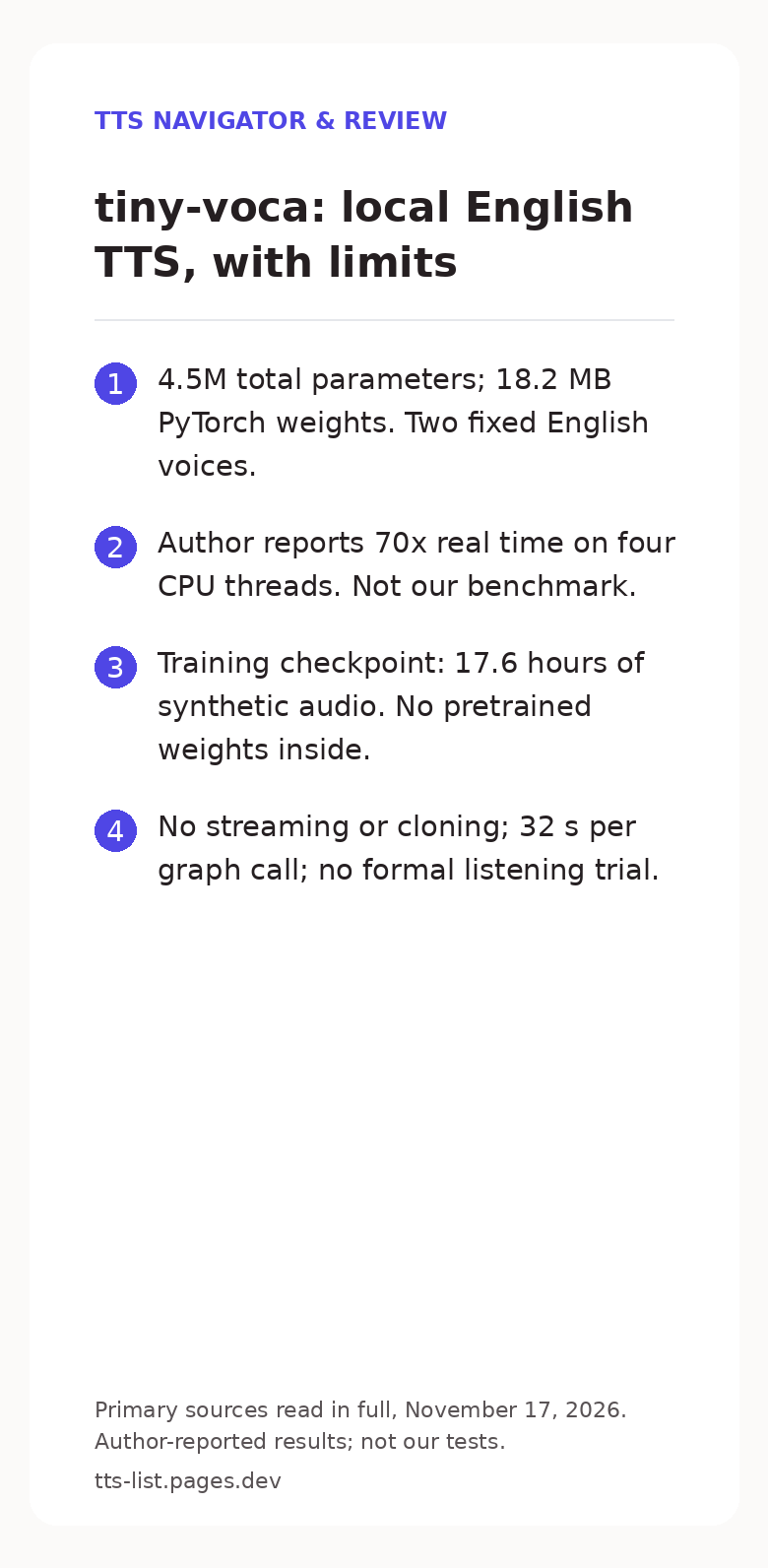
For local English read-aloud with two fixed voices, tiny-voca is worth testing. It is not a drop-in replacement for a multilingual, streaming or voice-cloning API. Its complete model has 4,537,291 parameters, including waveform generation; the published PyTorch weights are 18.2 MB. That makes it a different proposition from a hosted service, but does not prove comparable naturalness.
What is actually small?
The November 14 Hugging Face repository contains an 18.2 MB float32 PyTorch checkpoint and a 21.4 MB float32 ONNX graph. The phonemizer adds 5.4 MB of data. Model weight size is not total application memory or download size. Text becomes phonemes through dizione outside the ONNX graph; the model then generates 24 kHz mono audio. The author says the ONNX graph also works with onnxruntime-web using WebAssembly.
The training bill is not the cost of serving a product
Muhammed Nazeem reports $9.56 of rented RTX 4090 GPU time for dataset generation, failed attempts and the final run. This is an author-reported project GPU bill, not a verified total development budget, a hosting quote or a price per million characters. The training table specifies 16,018 clips and 17.6 hours, with 104,737 steps over 7.7 hours on one RTX 4090. Those are the checkpoint training figures, not a guarantee that a later dataset revision has the same size.
Synthetic voices, not pretrained model weights
The card says both voices were designed from text with Qwen3-TTS VoiceDesign and their training audio generated with Qwen3-TTS 1.7B Base. It says no recording of a real speaker was involved in this training audio. That statement concerns this dataset; it does not describe all data behind Qwen3-TTS. The tiny-voca network itself was trained from scratch. A pretrained wav2vec2 model provided alignment labels only, and is not shipped inside tiny-voca.
Speed is promising; quality evidence is narrower
The author reports about 70 times real-time generation on four CPU threads. We have not independently reproduced that result. The card labels its own eight-sentence validation and eight-sentence test sets as a sanity check, not a benchmark, and says no formal listening test has run. Its separate November 16 leaderboard snapshot ranks individual voices by average English word error rate. Word accuracy and a predicted quality score do not establish human preference, expressive range or production reliability.
Integration checks before replacing an API
Only American English F2 and M2 are supported, with no cloning and no streaming. One graph call accepts up to 512 tokens and 32 seconds; longer text must be split, even though the Python command handles sentence-by-sentence concatenation. The card warns that missing final punctuation can truncate the last word, foreign names may be mispronounced and occasional waveform peaks require scaling before 16-bit export. Code and weights are Apache-2.0; phonemizer data has its own notices. Test your actual names, numbers and long passages before replacing a paid API.