Maya 2 Native: Apache-2.0 streaming TTS for 11 Indic languages and English - open weights, three ASR judges, honest limits
Published October 28, 2026 · Built from the maya-research/maya2-native Hugging Face model card, read in full on October 28, 2026. Every benchmark number below is Maya Research's own - we say so each time it matters. We did not run the model.
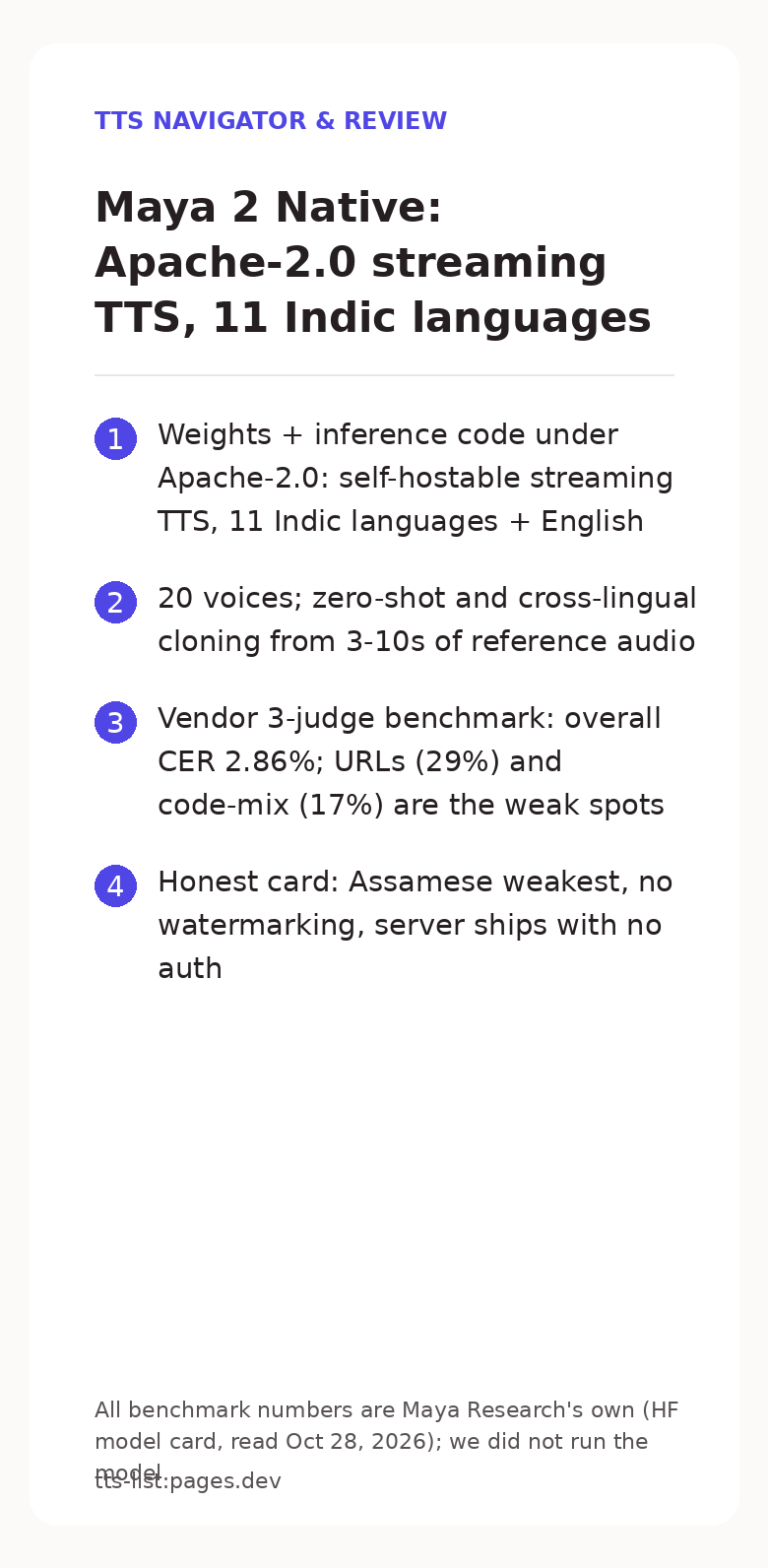
Two weeks after announcing Maya 2 as a hosted product, Maya Research has published the Maya 2 Native checkpoint (release 1.0, October 25): streaming text-to-speech for 11 Indic languages plus English, with weights and inference code under Apache-2.0. That makes it self-hostable end to end - a different proposition from the hosted-only launch, and from the CC-BY-NC weights we flagged in two other releases this week. It is also the base family behind Hurston-1, the accented-English model we covered yesterday, which was a fine-tune of the earlier Maya1.
What shipped
- 12 languages, 20 built-in voices. Assamese, Bengali, English, Gujarati, Hindi, Kannada, Malayalam, Marathi, Odia, Punjabi, Tamil and Telugu. The card stresses all 20 voice names "describe synthetic voice personas," not real people.
- Streaming output. 24 kHz mono audio in 80 ms frames, so playback starts while generation continues. Three interfaces: Python API, an OpenAI-compatible
/v1/audio/speechendpoint, and WebSocket streaming, with continuous batching and CUDA graphs for concurrency. - Zero-shot and cross-lingual cloning. Clone from 3-10 seconds of reference audio plus its exact transcript - and the reference can cross languages: in the card's words, "a Hindi reference can become Tamil speech."
- The stack. A backbone initialized from Qwen3-1.7B-Base predicts audio tokens step by step; a ~555M-parameter depth decoder fills codebooks 1-31 after the backbone's codebook 0; Kyutai's Mimi codec (32 codebooks at 12.5 fps) renders audio; a SpeechBrain ECAPA-TDNN handles speaker conditioning. 2.5B unique parameters, about 5 GB of BF16 weights. Training used licensed plus synthetic speech with transcripts, then DPO ranked by ASR agreement and speaker similarity - dataset names, hours and per-language composition are not disclosed.
The vendor benchmark - unusually informative, still vendor-run
Maya Research built a 6,000-text held-out benchmark (500 per language across 31 content types: names, numbers, dates, currency, addresses, URLs, code-mixed text), generated 20.3 hours of speech, and scored it with three separate ASR systems, reporting character error rate (CER, lower is better):
- Overall CER 2.86% with the held-out in-house judge (ASR-2) under the original scorer; 1.73% under "scorer v2" - and the card is explicit that the lower v2 numbers "reflect a scoring change," not different audio. English scores best (1.43%), Assamese worst (5.54%).
- Failure modes named with numbers. Web addresses: 29.06% CER (v1). Heavy code-mix: 16.74% (v1). The card also keeps a judge disagreement on the page: one judge (ASR-1) loops on spoken URLs like "W W W," inflating its English CER - all three judges' numbers are retained precisely so readers see the spread.
- VoiceArena. #2 for Hindi among real-time TTS models when checked October 27 (Elo 1049 ±10, 2,171 samples, rank interval 2-3, behind Cartesia Sonic-3.6). The card itself warns that ranks move as samples are added - and VoiceArena dates the entry to July, so treat any snapshot as a moment in time. A CEO claim on X that Maya 2 "outperforms ElevenLabs v3, Cartesia Sonic 3.5, and Bulbul v3" across Indian languages was noted by Digit as not showing how the test was conducted; the card itself reports no human naturalness study and no controlled comparison against other TTS models.
Running it - hardware, throughput, and two warnings
- Hardware. Linux, Python 3.10-3.12, NVIDIA GPU with CUDA 12.8 support. One concurrent stream ("seat") needs about 7.7 GB of GPU memory steady; a 12 GB card "provides more room." At 32 seats, 15.8 GB.
- Vendor serving numbers. One H100 NVL ran 224 concurrent WebSocket streams producing 323 seconds of audio per second, with a steady-state median of 111 ms to first audio - and the card adds these "do not establish public internet or telephone latency." A separate single-stream H100 measurement reports ~14 ms to first audio and 0.13 RTF. All vendor-measured.
- Warning one: the built-in server has no authentication. Add access controls before exposing it anywhere.
- Warning two: no audio watermark. The card puts consent, disclosure and abuse controls on the deployer, and asks users to clone only voices they own or have permission to use.
Limitations (the card's own list)
- Assamese is weakest: no built-in voice has even one hour of Assamese training data, and some outputs drift toward a Bengali-like timbre. Assamese is cross-lingual for every voice.
- Very short turns (one or two words) are less stable in voice identity.
- URLs, symbols, dates and long digit strings stay difficult even with text normalization on.
- Cloning is approximate; no dedicated cloning benchmark ships in this release. Emotion tags like
[laughs]are "best effort."
Why it matters
- A self-hostable option for a billion-plus speakers. Apache-2.0 weights plus code for 11 Indic languages is still rare; teams can test their own languages before committing to anything.
- A model card worth copying. Per-language breakdowns, three disagreeing judges kept visible, a scorer change flagged as a scorer change, hardware numbers, and a limitations section with specifics. This is what "vendor-run but honest" looks like.
- The open Indic stack is compounding. Hurston-1 (yesterday's coverage) fine-tuned Maya1 for accented English; Maya 2 Native now opens the multilingual base itself.
Sources (read in full; links verified October 28, 2026)
- maya-research/maya2-native - Hugging Face model card - all features, benchmark numbers, serving measurements, limitations and license statements above.
- LLMs Blog - Maya 2 Native (October 27, 2026) - release timeline (announced October 14 as hosted; weights October 25) and press context.