Chinese-English code-switch TTS without a GPU farm: Pocket-TTS zh-en ships weights, with a non-commercial catch
November 18, 2026 - TTS Navi. We read the model card in full. Performance and training claims are the project authors' reports, not our tests.
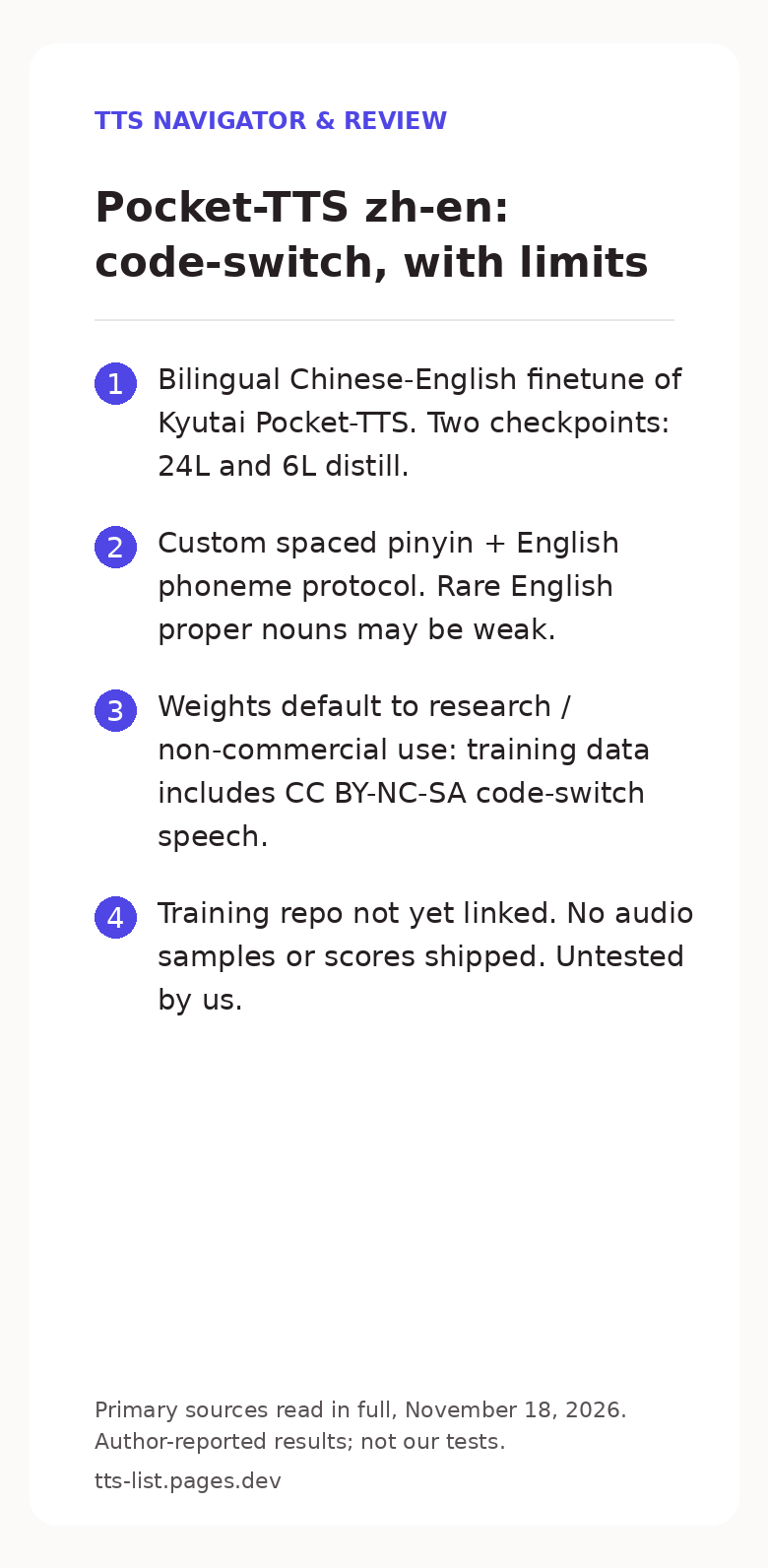
If your product mixes Chinese and English in the same sentence, most open TTS models stumble at the language boundary. pocket-tts-zh-en, published on Hugging Face on November 18, 2026 by Lautriv, is a bilingual finetune of Kyutai's Pocket-TTS aimed exactly at that code-switching case. It ships real weights and an inference script, but its training data includes a non-commercial dataset, and its training code repository is not linked yet.
What the release actually contains
The repository holds two checkpoints: a 24-layer model (v9_24l_15k.pt), which the author recommends, and a 6-layer distillation (v9_6l_80k.pt) trained from the 24-layer teacher. The 24L release checkpoint was selected at 15,000 training steps, not a full 250,000-step run; the 6L uses classifier-free guidance 1.0 at inference versus 2.0 for the 24L. You also get an atomic pinyin tokenizer, inference configs and infer.py. Voice is set by a short reference wave file, roughly four seconds in the example.
A different text protocol, on purpose
Instead of Kyutai's original English byte-pair encoding, this model uses a custom spaced bilingual protocol: tone-marked pinyin for Chinese, spaced en_* tokens and an <ew> marker for English, with an atomic pinyin tokenizer. That design choice is what makes in-sentence mixing like "今天我们去 Starbucks 开会" a first-class input rather than an accident. The tradeoff, stated on the card: rare English proper nouns may be weak because the English side is phoneme-protocol, not the original BPE.
The license is the headline for products
The code is MIT, inherited from Kyutai Pocket-TTS. The weights are not a single clean license: training data includes WenetSpeech for Chinese bulk, LibriTTS-R under CC BY 4.0 for English, AISHELL-3 patches, and CS-Dialogue under CC BY-NC-SA 4.0 for true code-switch sentences. Because of CS-Dialogue, the card says the weights default to research and non-commercial use. For a commercial product you would need to retrain without the NC data or obtain authorization. There is also a Chinese-only sibling, pocket-tts-zh, published the same day.
Training details and what is missing
The card summarizes the recipe: warm-start from the English 24L weights with a reset text embedding, cross-utterance voice probability 0.3, text dropout 0.2, learning rate 2e-4 and an effective batch of 64. However, the README's clone instruction still contains a placeholder for the training repository URL, so the full training code and recipe were not publicly linked when we read it. The repository also ships no audio samples and no evaluation scores. Quality, latency and hardware cost are all unverified by the author and untested by us.
Limits the card states itself
The 6L model drops or truncates more on long sentences, so the author recommends 24L for critical use. The training setup conditioned on a same-utterance prefix voice while inference uses an external voice plus full text, and the card warns very long openings may be unstable because of that mismatch. Prosody is described as not studio-grade and sensitive to reference audio quality and G2P errors. For a code-switch prototype under a non-commercial constraint this is a concrete starting point; for production, budget your own listening tests first.