Mithi v1 Flash: 11 Indian languages in 197 MB, Apache-2.0, CPU-friendly - with the missing benchmark said out loud
November 16, 2026 - by TTS Navi. We read the Oomni/mithi-v1-flash model card in full; the speed figures are the author's own CPU measurements.
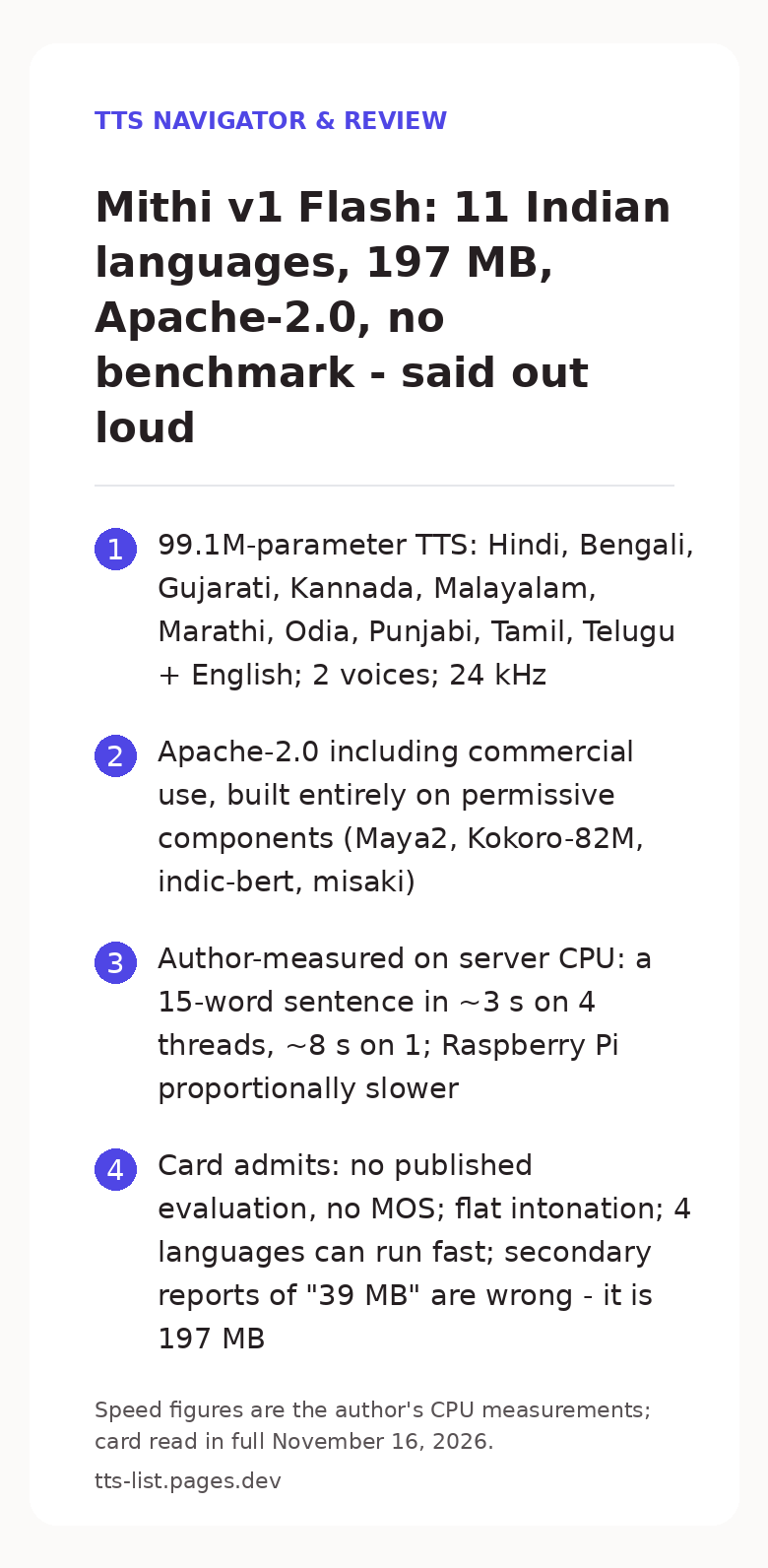
Mithi v1 Flash (Oomni, released November 7, updated November 11, 2026) is a 99.1M-parameter TTS model for eleven languages of the Indian subcontinent - Hindi, Bengali, Gujarati, Kannada, Malayalam, Marathi, Odia, Punjabi, Tamil, Telugu - plus English, with two voices (Satvik, male; Charvi, female) and 24 kHz output. The weights are bf16 safetensors, 197 MB, under Apache-2.0 with explicit commercial use allowed. One correction to the secondary coverage before anything else: it is being reported as a "39 MB" model - the actual download is 197 MB.
A clean license stack, top to bottom
The card's attribution table is the part most releases get wrong and this one gets right: the model is built entirely on permissively licensed components - Maya2-native (Apache-2.0), Kokoro-82M (Apache-2.0), AI4Bharat's indic-bert (MIT), misaki and espeak-ng - and the license section spells out that you can use, modify, redistribute and build products on it. For the "open alternative for Indian languages" question, there is no $1M clause, no registration, no revocation language. It reads like a deliberate contrast with how this week's other releases went.
CPU speed, measured on a real sentence
The author's own measurement: an average 15-word sentence (about 7 seconds of speech) takes ~8 seconds on one CPU thread and ~3 seconds on four threads on an AMD EPYC 9554 server CPU, with the honest note that slower CPUs like a Raspberry Pi take proportionally longer. That is roughly real-time on four threads - usable for batch narration and voice-assistant responses, not for snappy interactive dialogue. Long text is read sentence by sentence automatically, with the caveat that each sentence is spoken without seeing the others.
The limitation list includes the big one: no evaluation
The card's limitations section is unusually direct: intonation and emotion are flatter than natural speech; Kannada, Malayalam, Marathi and Odia can come out faster than natural; rare names and loanwords can be mispronounced; numbers and dates are only as good as the text normaliser. And then the line most cards avoid: "No published evaluation yet: no automated scores and no human listening study (MOS)." What you get instead is full transparency on samples - every sentence in both voices across all 11 languages, with the exact text in samples/sentences.tsv, so you can listen and judge rather than trust a number. For low-resource languages like Odia and Punjabi, even a listenable baseline under Apache-2.0 is news; just go in knowing quality is unmeasured, not proven.
Who should look
If you need Indic-language speech in a product without a GPU budget or a license lawyer, this is currently one of the cleanest packages: permissive stack, CPU-runnable, sentence-level chunking built in, and cards-on-the-table documentation. If you need measured quality, wait for the evaluation the card implicitly promises - or run your own listening pass on the published samples, which is exactly what they are there for.