Lure-TTS-0.6B: Apache-2.0 weights, engine and training code - a small voice-cloning model that takes stage directions
Published October 27, 2026 · Built from the Tesslate/Lure-TTS-0.6B Hugging Face model card, read in full on October 27, 2026, with release timing from Tensor Journal's coverage. Every benchmark number below is the authors' own - we say so each time it matters. We did not run the model.
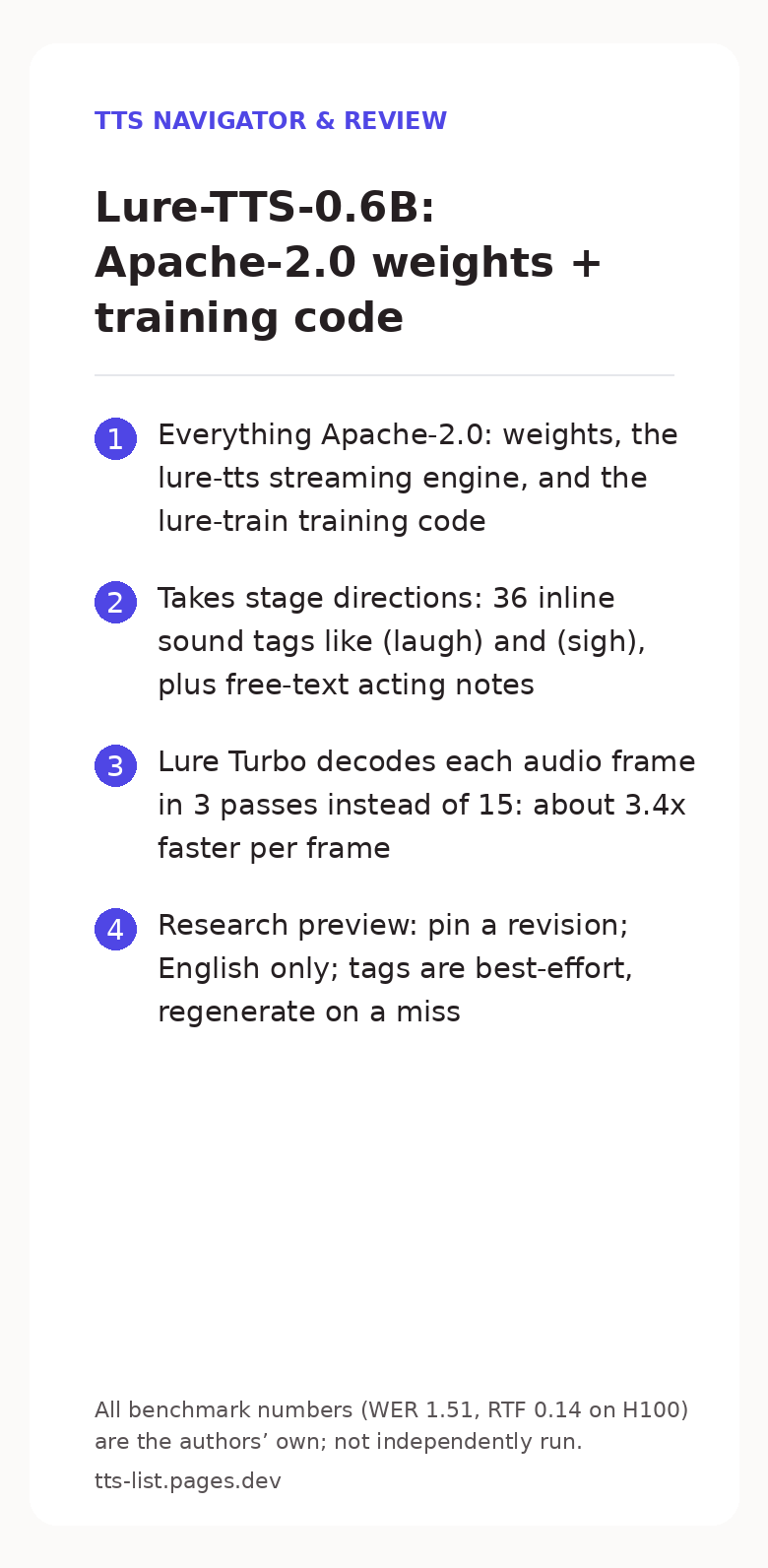
On October 24, Tesslate published Lure-TTS-0.6B, an English voice-cloning model, and put the whole stack under Apache-2.0: the weights, the lure-tts streaming engine, and the lure-train training code. That trifecta is rare - most recent open TTS releases (including two we covered this week) pair permissive code with noncommercial weights. The model's personality is expressiveness: inline sound tags like (laugh) or (sharp inhale) are performed where you write them, and an optional free-text "direction" note shapes the delivery like a note to a voice actor.
What shipped
- 0.6B-parameter English TTS, 24 kHz mono streaming output, built on the Qwen3-TTS 12Hz codec format (16 codebooks at 12.5 Hz) - which means the stock
qwen-ttspackage can load it directly, without the Turbo speed path. - Zero-shot voice cloning from a 3-12 second reference clip plus its exact transcript. The card is blunt that a wrong transcript causes skipped or repeated words.
- 36 inline sound tags in round brackets - six laughter variants, breaths, crying, throat and mouth sounds, spoken sounds, and
(pause). Square brackets are explicitly not supported. Laughs, sighs, gasps and sharp inhales are the most reliable; rarer tags like(ow)or(sob)land less often. - Acting directions. A free-text note - "Hushed and shaking, close to tears." - steers emotion, pace, pitch and breath. Without one, delivery follows the words and tags.
- Lure Turbo, a companion variant that decodes the 15 fine audio codes of each frame in 3 passes instead of 15, which the authors say makes per-frame decoding about 3.4x faster at matching benchmark scores.
The benchmark table - the authors' own runs
The card's comparison table mixes the authors' fresh runs (Lure, Lure Turbo, each with official scripts and default sampling) with numbers other developers published for their own models. Selected rows:
| Model | Size | Seed-TTS WER ↓ | LibriSpeech-PC UTMOS ↑ | RTF ↓ |
|---|---|---|---|---|
| Lure | 0.6B | 1.51 | 4.43 | 0.230 |
| Lure Turbo | 0.6B | 1.59 | 4.38 | 0.140 |
| Qwen3-TTS 0.6B | 0.6B | 1.32 | 4.41 (0.6B-1.7B row) | - |
| Fish S2 Pro | 5B | 0.99 | - | 0.195 |
| Real recordings | - | - | 4.10 | - |
Two honest readings of this table. First, Lure's word accuracy is competitive with models several times its size but not the best in it - Fish S2 Pro and Qwen3-TTS 0.6B post lower WER. Second, the UTMOS column needs care: Lure's 4.43 sits above the 4.10 of real recordings in the same set, which says more about UTMOS as a proxy metric than about Lure sounding more natural than humans. The speed figures (Turbo at 11.4 ms per frame, RTF 0.14 single-stream on an H100, 8 streams on a 24 GB card, faster-than-real-time on a MacBook) are all from the authors' own engine on their own hardware.
Why it matters
- The license is the story. Apache-2.0 weights plus engine plus training code means a commercial product can ship Lure today and retrain it tomorrow - no CC-BY-NC wall, no separate commercial license negotiation.
- Directed speech without a giant model. Tags plus acting directions cover much of what instruction-tuned 7B+ models do for expressive reads, at 0.6B - cheap enough to run beside a local LLM.
- A realistic release posture. The card calls itself a research preview, tells you to pin a revision, lists its own failure modes, and includes YODAS v3 in its training data disclosure. This is what honest model cards look like.
Caveats
- Every performance number is the authors' own; we did not run the model. The release is days old (82 downloads in its first month counter at read time) with no independent evaluations yet.
- English only - other languages are untested, and the card says to always set
language="english"becauseautosilently hurts quality. - Directions shape emotion and pace, but Lure is weaker than large instruction-tuned models at changing who is speaking (accent, age, gender) on request.
- Very long single calls can stop early or drift in voice; split text into sentences. Tags are best-effort - a take sometimes skips one, and the fix is to regenerate with a new seed.
- Research preview: weights, behavior and the card itself can change between releases. Pin a revision before building on it. Imitating a real person without consent is a prohibited use.
Sources (read in full; links verified October 27, 2026)
- Tesslate/Lure-TTS-0.6B - Hugging Face model card - all features, benchmark numbers, settings, limitations and the Apache-2.0 licensing statement above.
- Tensor Journal - Tesslate publishes Lure-TTS-0.6B (October 25, 2026) - release timing (October 24) and independent write-up.