Audio8-TTS-Realistic: 0.6B open-weights voice cloning in 23 languages, trained with a realism critic
Published October 30, 2026 · Built from the Hugging Face model card (primary source, read in full October 30, 2026) and MarkTechPost's write-up. All benchmark numbers are the authors' self-reported "reference comparison" - we did not run the model.
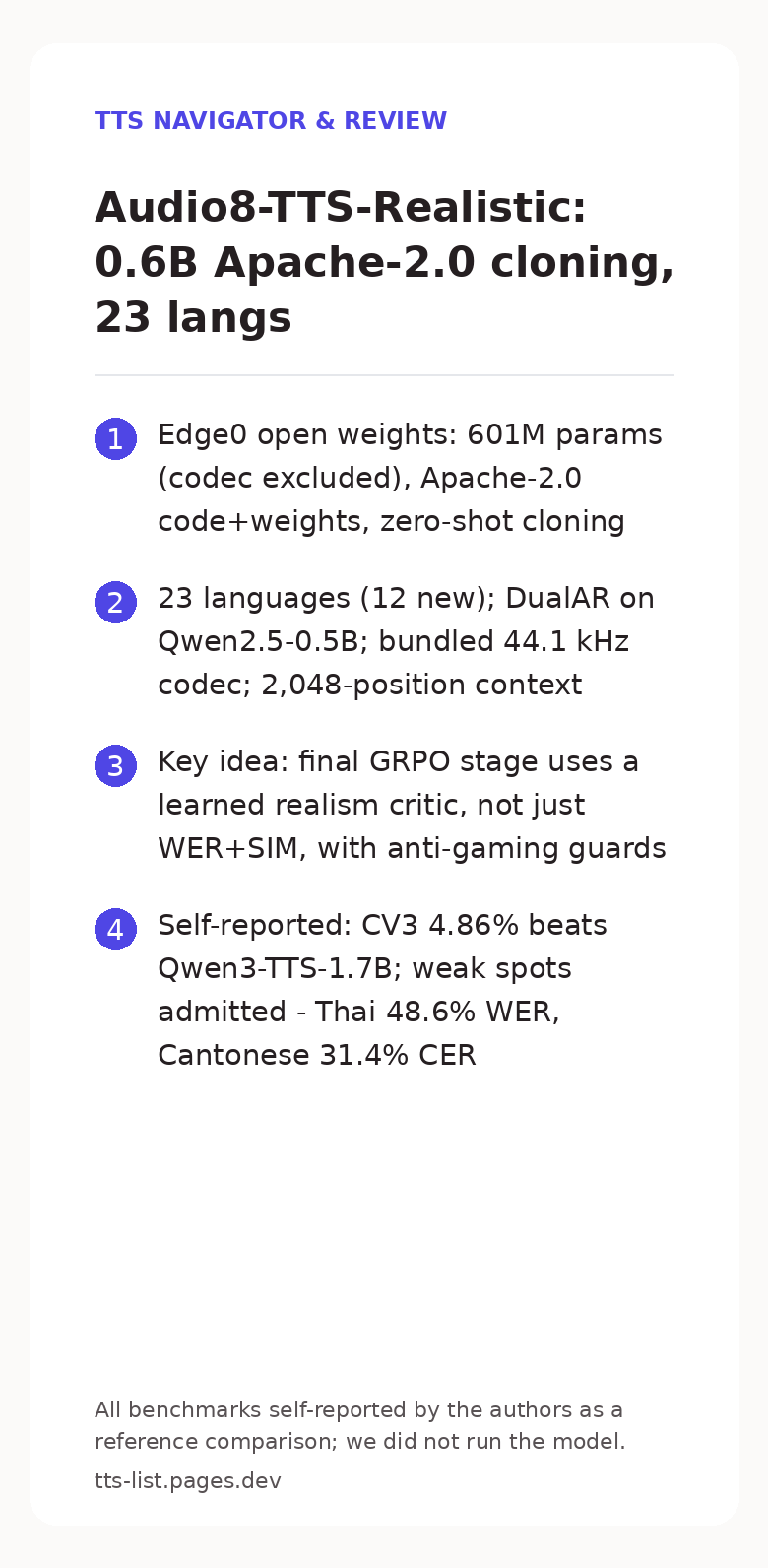
Edge0 has released Audio8-TTS-Realistic, the second 0.6B model in its Audio8 family: 601M main-model parameters, Apache-2.0 weights and code, zero-shot voice cloning from one reference clip plus its transcript, in 23 languages (12 more than the Preview). The interesting part is not the size - it is the argument that WER and speaker similarity are the wrong finish line, and the training recipe built around that argument.
Architecture in one paragraph
DualAR, inspired by Fish Audio S2 Pro: a slow autoregressive transformer built on Qwen2.5 0.5B (24 layers, width 896, ~21.5 frames/s) predicts text tokens plus the first audio codebook per frame; a shallow 4-layer fast branch predicts the remaining 9 codebooks in parallel, so sequential compute only happens at frame level. The bundled 44.1 kHz neural codec handles reference encoding and waveform decoding - no separate checkpoint. Context: up to 2,048 packed text/audio positions. Loads through the standard Transformers interface (trust_remote_code=True).
The realism critic - the actual contribution
- The claim: a model can win WER and SIM and still sound synthetic - those metrics miss rhythm, pauses and timing.
- Stage 1-2: multilingual supervised fine-tuning, then GRPO with a 0.7-WER / 0.3-SIM reward.
- Stage 3: GRPO guided by a learned realism critic - a ~3M-parameter head on a frozen WavLM-large encoder that scores each output against a matched human recording. The critic's quality ladder was built from six open-source TTS systems ranked in a private blind listening study, with human recordings at the top and synthetic pause compression adding finer rungs.
- Anti-gaming guards: an identity-erasure loss stops the critic rewarding generator fingerprints; a duration penalty beyond 1.35x reference length stops the policy buying realism with slower speech.
- The surprising bit: the final stage used only Chinese and English prompts, yet the 13 lower-resource languages still improved - error 22.53% → 20.77%, SIM 0.637 → 0.679.
Benchmarks - self-reported, with the honest lines kept in
- Seed-TTS (EN/ZH): 1.25% average error, SIM 0.704. CV3 (9 languages): 4.86% average error, SIM 0.661 - ahead of VoxCPM2 (5.35%), CosyVoice3-1.5B (6.89%) and Qwen3-TTS-1.7B (7.73%). MiniMax (24 languages): 5.89%, SIM 0.754.
- Where bigger models still win: Higgs TTS 3 (~4B) reports 4.41% on CV3 and 2.74% on MiniMax; Qwen3-TTS-1.7B averages 1.01% on Seed-TTS. Small and cheap is the point; state of the art is not.
- The weak spots, from the same table: 48.57% WER on Thai (CV3) and 31.35% CER on Cantonese (MiniMax) - multilingual coverage is wide but very uneven.
- The authors' own caveat: they call their table a "reference comparison" because evaluation pipelines and text normalization differ across projects. All numbers above are self-reported.
Deployment reality
- PyTorch 2.5+ / Transformers 4.57+; smoke-tested on an NVIDIA H20 in BF16. The paper reports 1.1-1.2 GiB peak memory on an Apple M2 CPU in INT4 ONNX - but no public Realistic ONNX export exists yet, so treat CPU deployment as a paper claim for now.
- GPU serving via an SGLang Omni adapter (paged attention, dynamic batching, OpenAI-compatible
/v1/audio/speech) - with throughput and streaming explicitly not benchmarked. - Free playground on Hugging Face ZeroGPU; the model is also entered in TTS Arena. The repo adds CLI, batching and fine-tuning scripts.
Why it matters
- Preference-model training arrives in open TTS. A learned realism critic with anti-gaming guards is the RLHF playbook applied to how speech feels, not just what it says - and it is reproducible: weights, code and training scripts are all Apache-2.0.
- 0.6B is the fine-tune-and-ship tier. At this size, a single consumer GPU can serve it and a small team can adapt it - the competitive surface is exactly where hosted APIs can't follow.
- Honesty as documentation. A card that prints its Thai and Cantonese failures next to its wins, and labels its own table a reference comparison, is doing model cards right.
Sources (read in full; links verified October 30, 2026)
- Edge0/Audio8-TTS-Realistic-0.6b - Hugging Face model card (primary) - architecture, languages, training recipe, deployment details.
- Edge0 Releases Audio8-TTS-Realistic, a 0.6B Voice Cloning TTS Model - MarkTechPost (October 29, 2026) - benchmark tables and comparison figures above.