BA: Egyptian Arabic voice cloning that ships the weights untouched and the engineering on top - with a watermark on every second of output
November 15, 2026 - by TTS Navi. We read the model card in full; all results below are the author's own measurements, and the author states they are all automatic - no native-listener review of BA's own outputs yet.
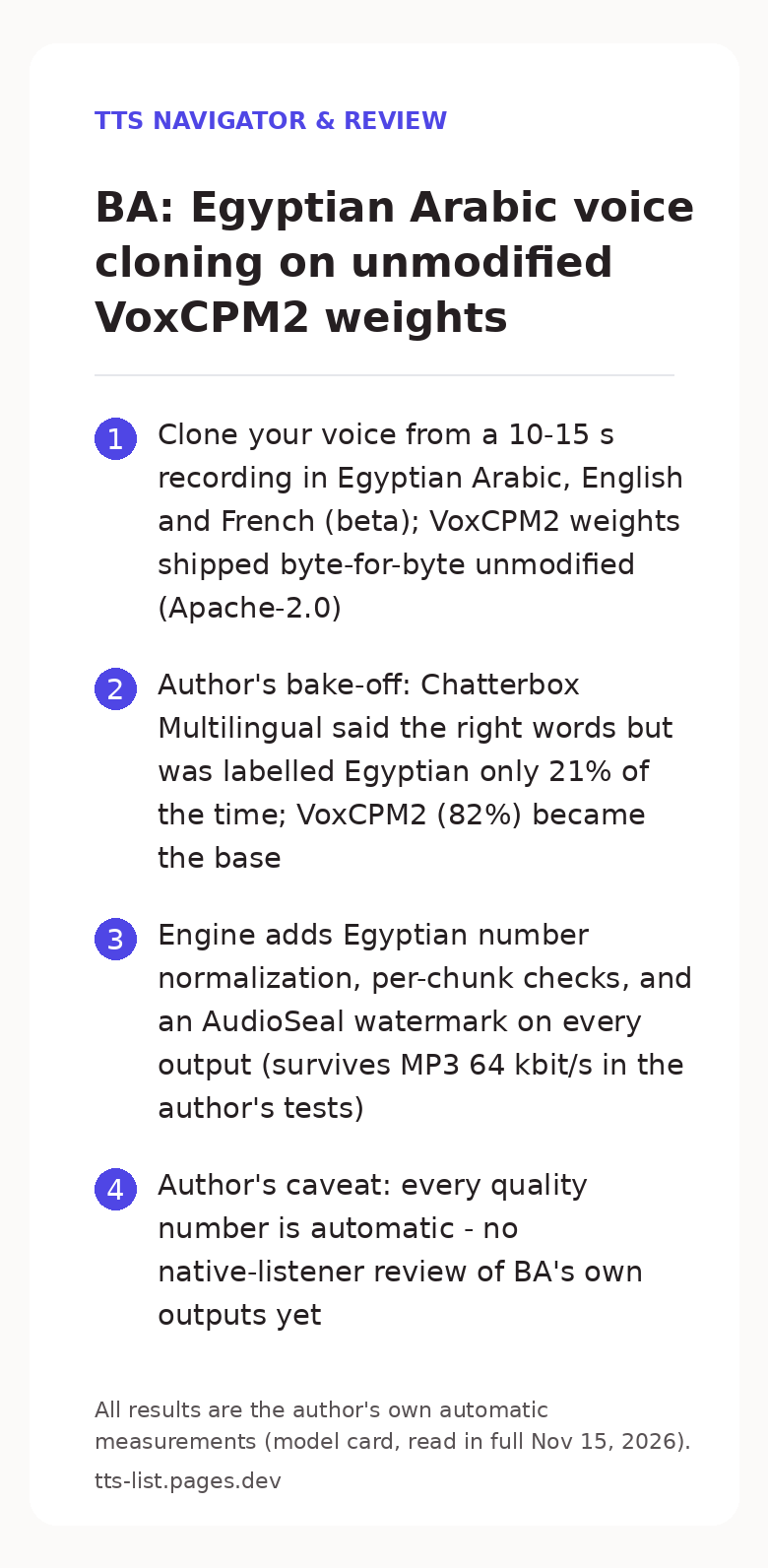
BA (mahmoudalyosify/BA, v0.1.0, updated November 15) clones your voice from a 10-15 second recording and speaks Egyptian Arabic, English and French (beta). The unusual part is what it does not do: it does not fine-tune anything. The repository ships OpenBMB's VoxCPM2 weights byte-for-byte unmodified (a pinned commit, with NOTICE), and puts all the work in an engine around them: reference-audio preparation that refuses noisy or clipped recordings, Whisper large-v3-turbo transcription when you give none, an Egyptian text normaliser that writes digits, prices and loanwords the Egyptian way, per-chunk validation with regeneration on failure, loudness normalisation - and an AudioSeal watermark embedded in every output, detectable after MP3 at 64 kbit/s and resampling to 16 kHz (60/60 detected in the author's tests; untested against deliberate removal).
Choosing the base by dialect, not by leaderboard
The card's bake-off is the instructive part. Eight voice-cloning systems were screened on Egyptian Arabic; only permissively licensed weights with documented training data were eligible as a base. On 3 voices x 32 Egyptian sentences, Chatterbox Multilingual V3 said the right words (CER 0.035, better than VoxCPM2's 0.065) but a dialect classifier labelled its output Egyptian only 20.8% of the time - mostly it landed on Levantine, Gulf or Modern Standard Arabic. VoxCPM2 was labelled Egyptian 82.3% of the time, so VoxCPM2 became the base. A blind listening check (one native-Egyptian rater, 6 sentences per system) agreed: both Chatterbox bases were rated "not Egyptian" on 6 of 6, VoxCPM2 never was. The author's summary is quotable: Chatterbox says the right words with the wrong dialect.
The held-out numbers
Evaluation uses 12 FLEURS reference voices (6 Egyptian, 3 English, 3 French) and held-out texts, with every metric calibrated against real speech - the card prints what the same ASR scores on real colloquial Egyptian (CER 0.071) so you can see the floor. Against raw VoxCPM2 on identical texts, voices and seeds, the BA engine improves the Egyptian conditions it targets: CER 0.030 vs 0.069 on ordinary sentences, 0.073 vs 0.122 on sentences with digits, dialect-classifier Egyptian share 0.889 vs 0.819, speaker similarity (ECAPA) 0.769 vs 0.713, and zero failures in any condition versus two empty English outputs from the raw model. On English the engine's gain is similarity (0.779 vs 0.655) rather than words (WER 0.003 vs 0.000). A language is only "listed" if the full system passes a fixed gate: failure rate at most 5%, intelligibility within bound, similarity at least 80% of the same-speaker real-audio ceiling, and for Egyptian a dialect share at least 60% of real colloquial speech. French passes the same gate but ships as beta - three reference voices, untuned generation settings, newest language.
The stated limits
The card's limitations section does the work most cards skip. BA's own outputs have not been rated by ear at all - every number is automatic, and the author says which meters are weak: one dialect classifier decides "Egyptian" (it labels Egyptians reading MSA as Egyptian only 34% of the time), DNSMOS was trained on English, similarity is one embedding model. Digit handling is measured by ASR, which writes spoken numbers back as digits, so the digit CER shows the right number was said, not that it was said the Egyptian way. Test sets are small (18 digit sentences, 18 code-switched utterances, 2 passages per language). Cross-language cloning loses similarity (Egyptian voice speaking French: 0.696 against the 0.870 same-speaker ceiling). And since nothing is fine-tuned, anything VoxCPM2 cannot say well, BA cannot either. The engine needs a GPU for practical use (about 8 GB peak; CPU runs at roughly 30x real time for the raw model). Licence: BA's own code and assets are under a community license - free for non-commercial use, commercial use needs the owner's written permission - while the VoxCPM2 weights stay Apache-2.0 and usable independently.
Our analysis
BA is a reminder that for dialect work the scarce resource is not a better checkpoint but selection and plumbing: pick the base whose dialect identity survives (measured, not assumed), then normalise text the way the dialect is actually spoken. The Egyptian number normaliser is a small thing that directly addresses the failure the native rater noticed - raw systems saying numbers the non-Egyptian way. The "weights unmodified, engine on top" architecture also has a governance upside: the watermark, consent checkbox and upload-deletion policy live in code the author controls, and the Apache-2.0 weights remain cleanly attributable upstream. The honest reading of the evidence: the automatic metrics are calibrated and the bake-off logic is sound, but the headline claim (BA sounds Egyptian in your voice) currently rests on classifiers and one rater's pre-engine listen, so treat the quality numbers as pending a proper listening test. If the author adds native-listener ratings of BA's own outputs, this becomes one of the best-documented dialect releases of the year; even now, the card itself is the artifact to copy.
Sources
- BA model card (read in full, November 15, 2026)
- BA demo Space
- VoxCPM2 (OpenBMB, Apache-2.0)