mova-tts: Ukrainian voice cloning in 0.7B, streaming from CPU or GPU, watermarked by default
November 22, 2026 - TTS Navi. We read the mova-tts model card in full. All evaluation and speed figures are the author's own measurements on their own harness, not our tests and not a third-party evaluation.
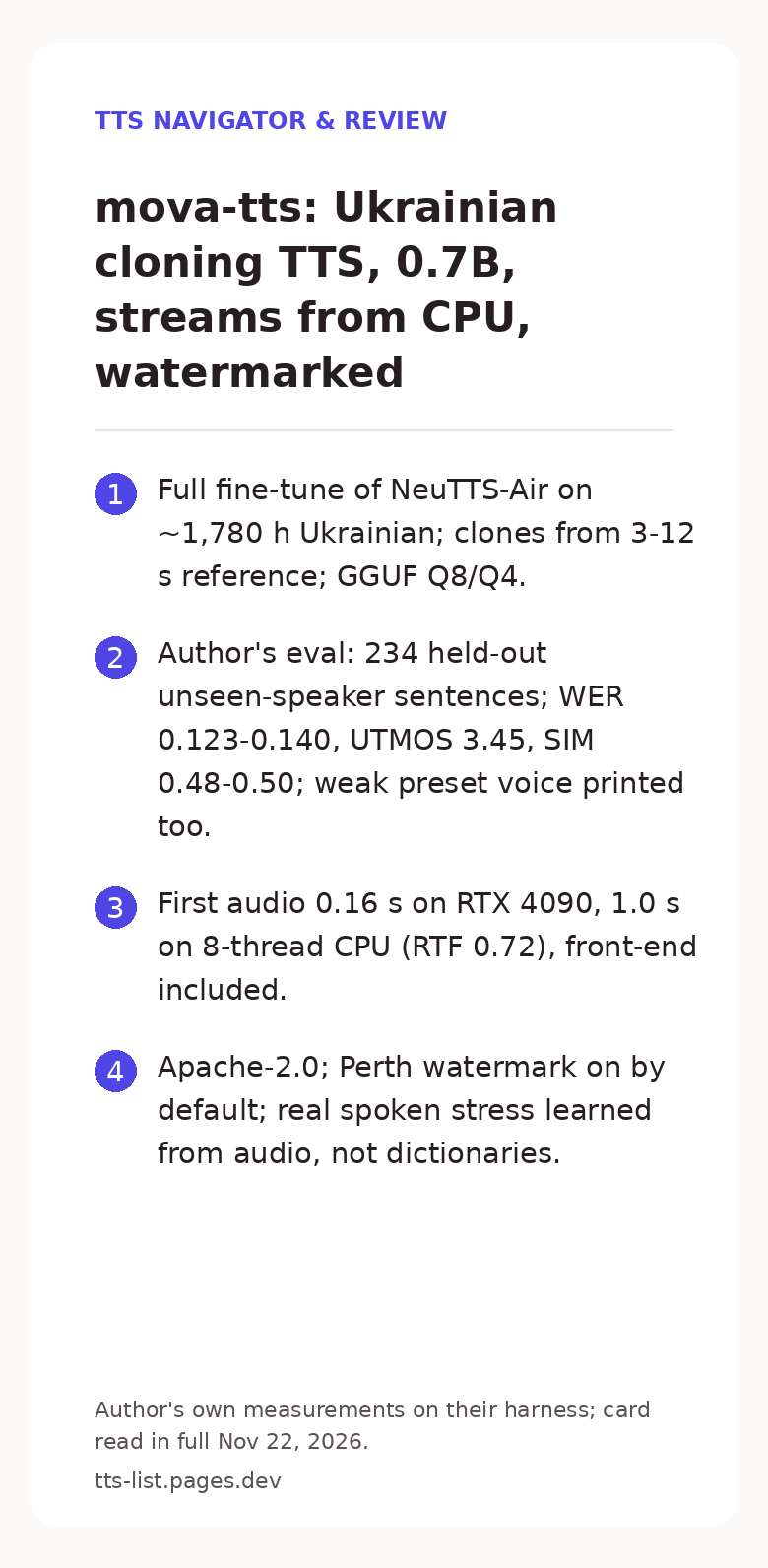
mova-tts (Mikhailo, released November 21, 2026) is a Ukrainian text-to-speech model with voice cloning: a full fine-tune - no adapter - of neuphonic's NeuTTS-Air (a 0.7B Qwen-based speech LM) on roughly 1,780 hours of Ukrainian audiobooks, podcasts, Common Voice and studio recordings, in two stages (12k steps on a 740-hour subset, then 20k on everything). It speaks from IPA phonemes produced by its own front-end (numbers to words, real stress learned from the audio via forced alignment rather than dictionary stress), clones a voice from a 3-12 second reference with its exact transcript, and runs as GGUF under llama.cpp (Q8_0 at 0.8 GB default, Q4_K_M at 0.6 GB) on CUDA, Apple GPU or CPU. Apache-2.0 throughout.
Evaluation, with the range and the weak spot printed
On 234 held-out sentences from Common Voice and audiobooks, cloning unseen speakers from a different sentence of theirs: WER 0.123-0.140 and CER 0.035-0.041 for whole-utterance Q8_0 (ranges over 3 sampling seeds), UTMOS 3.45, speaker similarity 0.48-0.50 ECAPA cosine against real recordings. Streaming costs a little (WER 0.135-0.140, UTMOS 3.37) and Q4_K_M a little more (3.33). WER/CER come from Whisper large-v3 transcripts; UTMOS is a predicted naturalness score, which the card labels as such. The preset-voice table prints four voices with individual scores - including lada at UTMOS 2.55, well below the others. Publishing the weak voice in the same table as the good ones is how this should be done.
Streaming and speed, author-measured
First audio after 0.16 s on an RTX 4090 (RTF 0.14); after 1.0 s on an i9-13900KF CPU with 8 threads (RTF 0.72), front-end included - usable for interactive apps on a desktop CPU. The package handles chunked decoding with left context and a crossfade, so long text streams without seams.
Limits and the responsible-use detail
Ukrainian only - Latin words are transliterated. Sampling means occasional stretched words or odd pauses; the card's advice is simply to regenerate with another seed. Cloning quality follows the reference recording. The NeuCodec dependency is gated, so you accept its terms on Hugging Face once. And every synthesized file carries an imperceptible Perth watermark by default - a concrete anti-misuse choice, stated plainly next to "clone only voices you have permission to use". For Ukrainian - a language with real, current demand for local speech tooling - this is a complete, self-hostable package: front-end, weights, streaming runtime, presets, and numbers you can actually read.