Running Haru-4B yourself: Apache-2.0 weights, a 12 GB GPU, and what the 65 ms claim measures
November 18, 2026 - TTS Navi. We read the model card, GitHub repository and technical blog in full. Hardware and latency figures are the developers' own reports, except the First hands-on test section, which is our own measurement on free-tier hardware.
A post circulating on X today (November 18, 2026, by @fishjar) describes higurashi-ai's Haru-4B as an end-to-end full-duplex model that removes the ASR-LLM-TTS cascade and its stacked latency, and claims first audio in under 250 ms. We covered Haru-4B's architecture and its 65 ms latency claim yesterday. This follow-up answers the practical question: what does it take to actually run it? Everything below comes from the official model card, GitHub repository and technical blog, all read in full on November 18. Hardware figures and latency numbers are the developers' own reports, not our tests.
What the release gives you
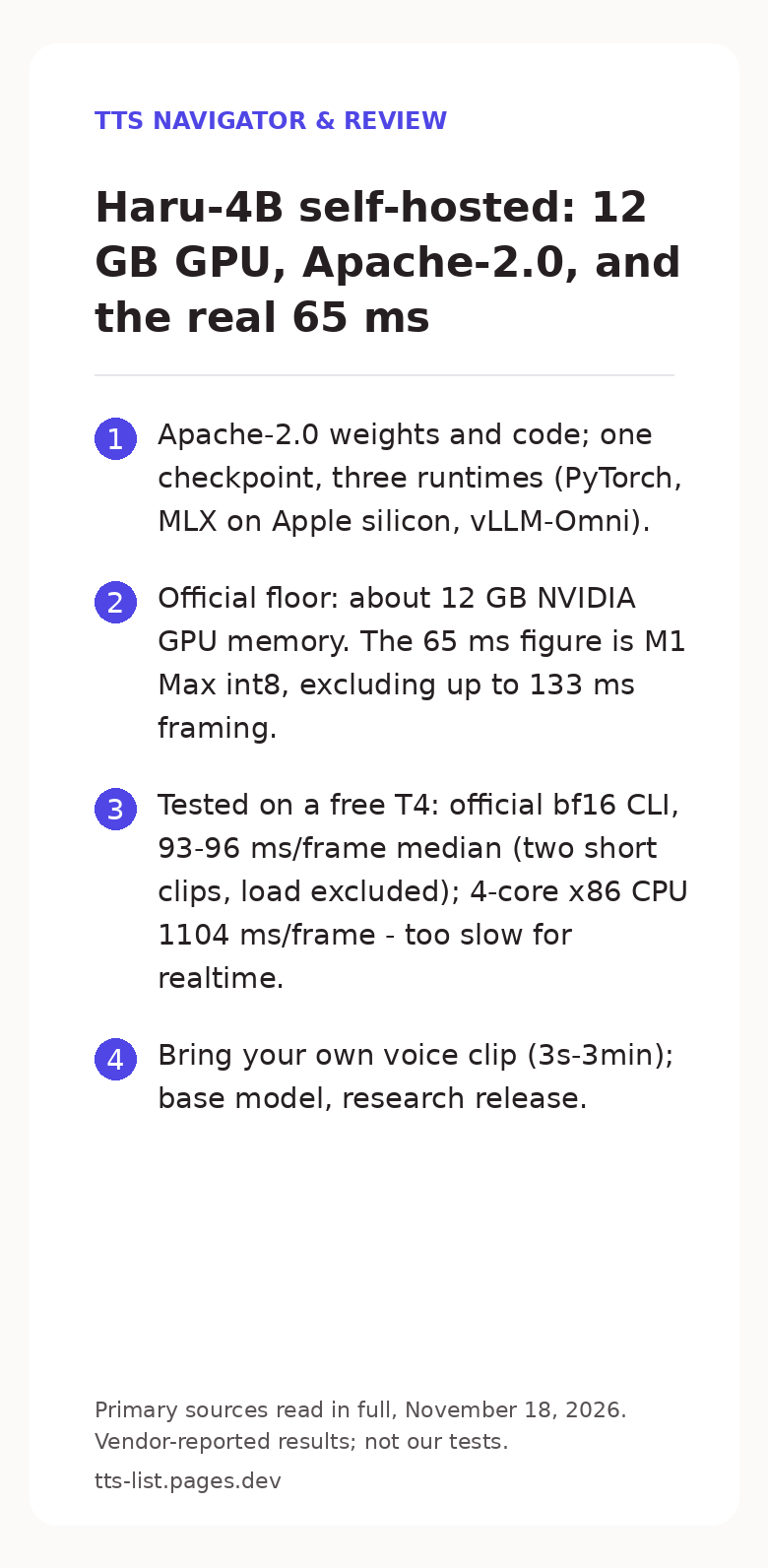
Haru-4B ships as a single bfloat16 safetensors checkpoint (language model, audio input projections, MeanFlow audio head, codec) plus a text tokenizer, under the Apache License 2.0 - both weights and code. That is a permissive, commercial-use license, which sets it apart from the community licenses many recent open voice models carry. The repository offers three ways to run the same checkpoint: a PyTorch implementation with a web demo and offline file inference, an MLX implementation with a native macOS app for Apple silicon, and a plugin that serves it with vLLM-Omni for multi-conversation GPU serving. It is a 4B-parameter model (Qwen3.5-4B backbone, 32 layers, hidden size 2560) with a VibeVoice-derived causal codec at 24 kHz, pretrained - the developers report - on over 40 million hours of real speech across 160+ languages, using 256 NVIDIA B200 GPUs for about 8 days. Nine primary languages: English, Spanish, Portuguese, German, French, Chinese, Japanese, Russian, Korean.
The hardware floor: about 12 GB of GPU memory
The official quick start asks for "an NVIDIA GPU (about 12 GB of memory)" for the PyTorch path: clone, pip install, run the server, open localhost:8998, pick a character, supply a voice, talk. The macOS path is MLX on Apple silicon; the 65 ms demo figure comes from a MacBook with an M1 Max running int8 weights. For GPU servers, the vLLM-Omni plugin is the recommended engine, and the blog reports that on an NVIDIA B300, audio encode plus decode plus one language-model step take about 15 ms. Hand-written Triton kernels (replayed from CUDA graphs) are opt-in on NVIDIA and cut the codec from about 6 ms to about 0.7 ms per frame; plain implementations produce the same results more slowly.
The 65 ms claim, unpacked
The headline number has a precise scope. On the M1 Max with int8 weights, the developers report an end-to-end p50 of 65.2 ms, broken down as: microphone-to-app input 5.3 ms, one model step 34.2 ms, socket and handoff 4.1 ms, output wait 13.3 ms, app-to-headphones output 8.1 ms. This explicitly excludes audio framing, which at the 7.5 Hz frame rate adds up to 133 ms of algorithmic latency, and it assumes wired microphone and headphones - the README warns Bluetooth adds 100 ms or more. The X post's "first audio packet under 250 ms" is the poster's own phrasing, not a vendor figure, and it measures something the vendor's published numbers do not: the vendor reports a 65 ms processing pipeline (framing excluded) plus up to 133 ms of framing, while the post describes first-audio-packet latency, a different quantity. Neither figure verifies the other, and we have not tested either. All of these numbers come from specific hardware; a different GPU, driver or audio stack will land elsewhere.
First hands-on test: a free T4 runs it near the realtime budget, a 4-core x86 CPU does not (our measurements)
After publication we ran the official release ourselves on free tiers, with nothing modified. On a Kaggle notebook with two NVIDIA T4s (python 3.13.16, torch 2.11.0+cu130), the official haru-inference CLI ran the unmodified bfloat16 checkpoint (9.82 GiB, publicly downloadable without login) in two independent batches: a 6-second input (44 timed frames, median 93.3 ms per frame) and a 14-second input (105 frames, median 95.8 ms). Each timed frame covers the full chain - codec encode, one language-model step, MeanFlow sampling, codec decode - on the plain torch backend, not the Triton kernels, and excludes model load and prefill. That median sits about 28 percent under the 133.3 ms per-frame realtime budget, but two short clips prove nothing about long-session stability, and these numbers cannot be ranked against the vendor's 65 ms (M1 Max, int8, framing excluded) or 15 ms (B300, single step) figures: all three measure different things on different hardware. The code routes to a single cuda:0 with no parallelism, and 9.82 GiB fits in one T4's usable memory, so the second card was idle by code inspection - we did not sample runtime VRAM. Setup was quick: pip install about 7-10 seconds, checkpoint download about 55 seconds. The 14-second run produced audible, in-character speech - transcribed as "Sure. I'm Haru, Sam's assistant. What's your question?" - but it did not answer the question in the synthetic input, which fits the base-model positioning: responsive conversation, not a reliable assistant. Voice cloning via --reference was not tested; the run used no reference voice, which the README allows. On the CPU path, a Kaggle 4-vCPU x86 instance in float32 managed a median of 1103.9 ms per frame over 8 frames, 8.3 times the realtime budget - one x86 cloud instance, not a measurement of any ARM machine.
Bring your own voice, and your own character
Haru ships without any voice clips. To make it speak you supply a reference recording - one speaker, 3 seconds to 3 minutes, clean speech - and the developers state plainly: only use voices you have the right to use. The persona comes from a character card with a fixed layout (persona, name, relationship, situation) passed as the system prompt. In Python, a DuplexSession takes the card and the prepared reference, then steps frame by frame: 3200 samples of user audio in, 3200 samples of model audio out, with the model always one frame ahead. An offline command (haru-inference user.wav reply.wav) turns an input recording into a reply file without a microphone, which is the practical test route on a headless server.
Where it will struggle, on the current evidence
First, CPU-only servers: the README's quick start assumes a GPU, but the official code does have a CPU path - the loader (haru/haru/models/loaders.py) falls back to CPU when CUDA is absent and its docstring says to pass torch.float32 to run on CPU, and both the server and the offline inference CLI take a --device flag. Speed on one x86 instance is now measured: 1103.9 ms per frame median (float32, 8 frames, see the test section above), far too slow for live conversation but workable for patient offline file inference. No ARM machine has been measured, so whether a small ARM VPS behaves the same remains an open inference, not a fact. Second, older GPUs: the checkpoint is bfloat16, and Turing-generation cards such as the T4 have no native bf16 support (hardware spec, not a vendor statement). Empirically the unmodified bf16 checkpoint executed successfully on a T4 in our test - return code 0 and audible output - but whether PyTorch ran bf16 through emulation or another mechanism is something we did not determine, and the per-frame times there should not be ranked against the vendor's numbers. Finally, even where the model runs, the demo's microphone capture only works on localhost or over HTTPS, and the realtime experience is meaningless without local audio I/O; a remote headless box can only prove offline file inference unless you tunnel audio.
Base model, research release - the standing caveat
As we noted yesterday, Haru-4B is a pretrained base model released for research. The card itself warns it is not a reliable source of facts and does not follow instructions like an assistant. For a voice-agent product it is a foundation to fine-tune, not a drop-in conversationalist - but as an Apache-2.0, single-checkpoint, three-runtime release with a documented 12 GB entry point, it is one of the more approachable full-duplex models to experiment with today.
Sources
- https://huggingface.co/higurashi-ai/Haru-4B
- https://github.com/higurashi-ai/Haru
- https://blog.higurashi.ai/melte/haru4b/
- https://x.com/fishjar/status/2122902117258310032