Linnet en-35M: Streaming TTS at 9% of Real Time on a Phone CPU
November 5, 2026 - by TTS Navi. We read the model card in full; every speed and quality figure below is the vendor's own measurement unless marked otherwise.
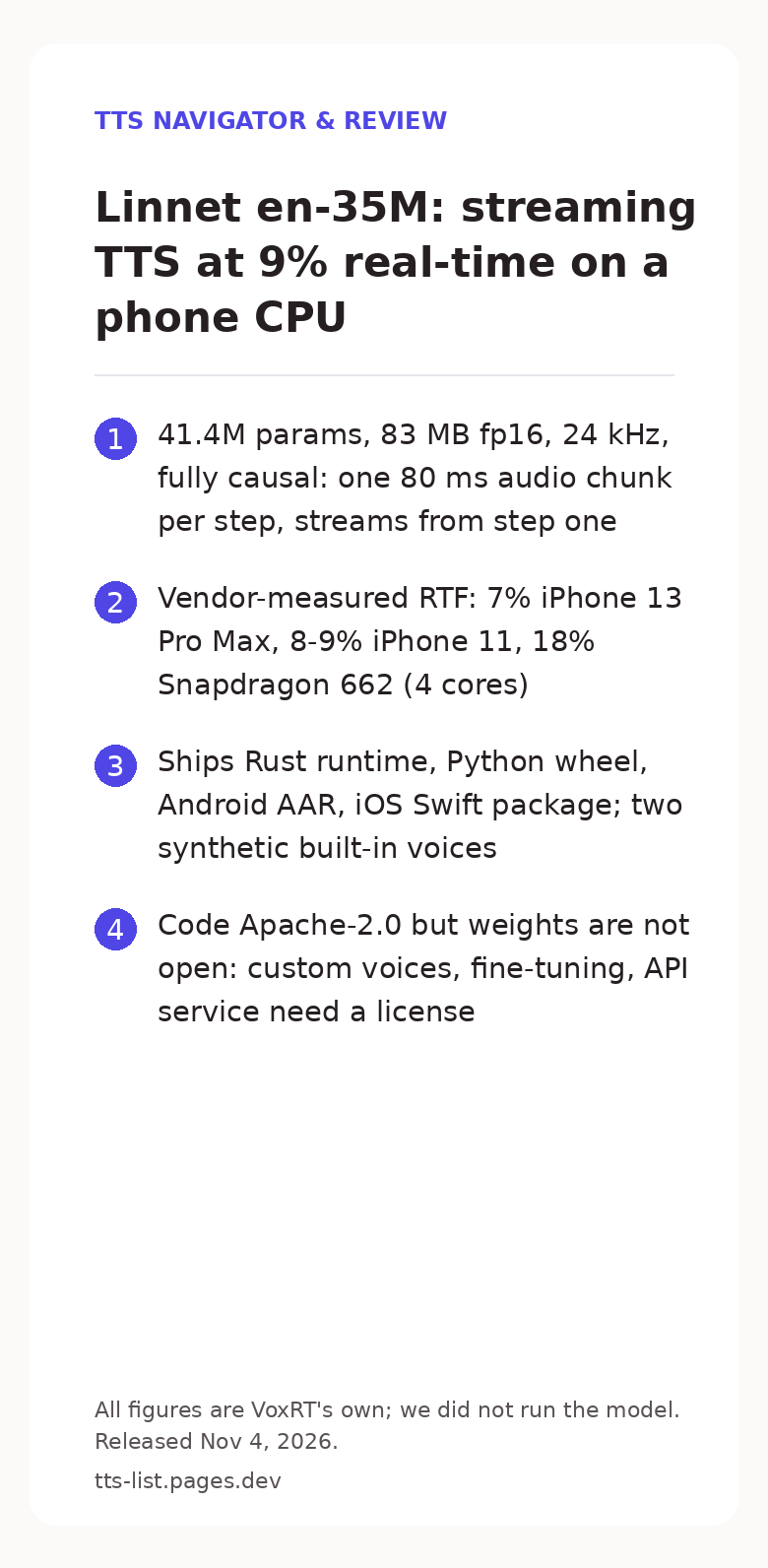
On-device TTS keeps shrinking. Linnet linnet-en-35m, released November 4 by VoxRT (GitHub VoxRT/LinnetTTS, mirrored on Hugging Face), is a 41.4M-parameter English model - the name says 35M, the card's own table totals 41.4M (31.5M flow LM plus a 9.9M codec decoder) - that synthesizes 24 kHz speech fully causally: every operator in the chain is causal, each step produces one 80 ms audio chunk, audio streams from the first step, and chunks concatenate bit-for-bit. The fp16 weights are 83 MB, and the release ships a Rust runtime plus Linux C, a Python wheel, an Android AAR and an iOS Swift package. That last part is the rarity: most "on-device" claims stop at a PyTorch script.
Vendor-measured speed
VoxRT's card publishes a per-device table (Rust runtime, fp16 weights, real-time factor = step time / 80 ms):
- iPhone 13 Pro Max (A15): 7% RTF on one core, first audio in 85 ms
- iPhone 11 (A13): 8-9% RTF, first audio in ~110 ms
- Core i9-13900K desktop: 9% on one thread, 3% on four
- Snapdragon 662 (budget Android): 53% on one core, 18% on four big cores
- Raspberry Pi Zero 2 W: 198% single-core (not real time), 75% on four cores
- Apple M5: 4%
The card also benchmarks against other CPU TTS models on the same desktop (speed only - the card itself says quality is not measured there): Linnet 10.6% RTF on one thread, pocket-tts 23.8%, Kokoro-82M 51.7%, Piper medium 5.8%. So Piper is still faster at the small end, but Linnet claims the combination of streaming-from-first-frame, voice conditioning, and phone-class footprint in one package. One honest footnote from the card: when synthesis is paced to playback, mobile power management raises step time 3-4x, so the idle-burst numbers flatter sustained playback.
The license is the catch
This is a split release. The code (runtime, bindings) is Apache-2.0. The weights are under a custom "Linnet Weights License 1.0" that is not open source: you may use the unmodified weights with the two built-in voices inside your own products, including commercial and closed-source ones, for free - but custom voices, fine-tuning, modified or quantized copies, and offering general-purpose TTS as an API or service all require a separate written license from VoxRT. The model is architecturally voice-conditioned (a latent from ~5-6 s of clean speech), yet the encoder that produces voice latents from recordings is not part of this release, so in practice you get exactly the two built-in voices unless you talk to VoxRT. Both built-in voices are synthetic, designed via Qwen3-TTS VoiceDesign, not clones of real people.
Honesty notes from the card itself
The card is more candid than most about limits: English only ("other languages produce garbage"); no text normalization, so "1359" or "$19.99" are often misread and digits should be written out first (they trained 74 hours of synthetic number/date speech with Qwen3-TTS to patch this); intelligibility testing by an independent ASR shows 15-30% WER on short sentences, which the card attributes mostly to tokenization differences; and a "slight roughness" is audible on headphones in some utterances - judged acceptable for release, and listed as a known limitation rather than hidden.
Our analysis
Linnet is the clearest signal this week that on-device TTS is moving from demos to shipped SDKs: real iOS and Android artifacts, a documented streaming contract, and bit-exact chunk concatenation are production concerns, not research ones. The training-data provenance table (5,612 codec hours in 8 languages, 6,012 LM hours of English, all license-audited, Common Voice used for validation only) is also best-in-class disclosure for a commercial-weight release. The trade to weigh is control: you get a fast, free-to-ship engine, but the voice catalog is locked behind the vendor. If your product needs a custom voice or an API, the free tier ends quickly. Compared with yesterday's TiHon (a 100K-parameter Vietnamese model on a simulated MCU), Linnet sits at the opposite pole: 400x the parameters, one language, but running on real shipping phones with binaries you can download today.
Sources
- VoxRT/linnet-en-35m model card (read in full, November 5, 2026)
- VoxRT/LinnetTTS on GitHub (weights-v1 release, November 4, 2026)
- Demo Space (CPU, vendor-hosted)