ProTTS: a TTS that discovers which words to stress by itself, then lets you override it
November 20, 2026 - TTS Navi. We read the paper in full. All results are the authors' experiments, including their 35-listener study, not our tests.
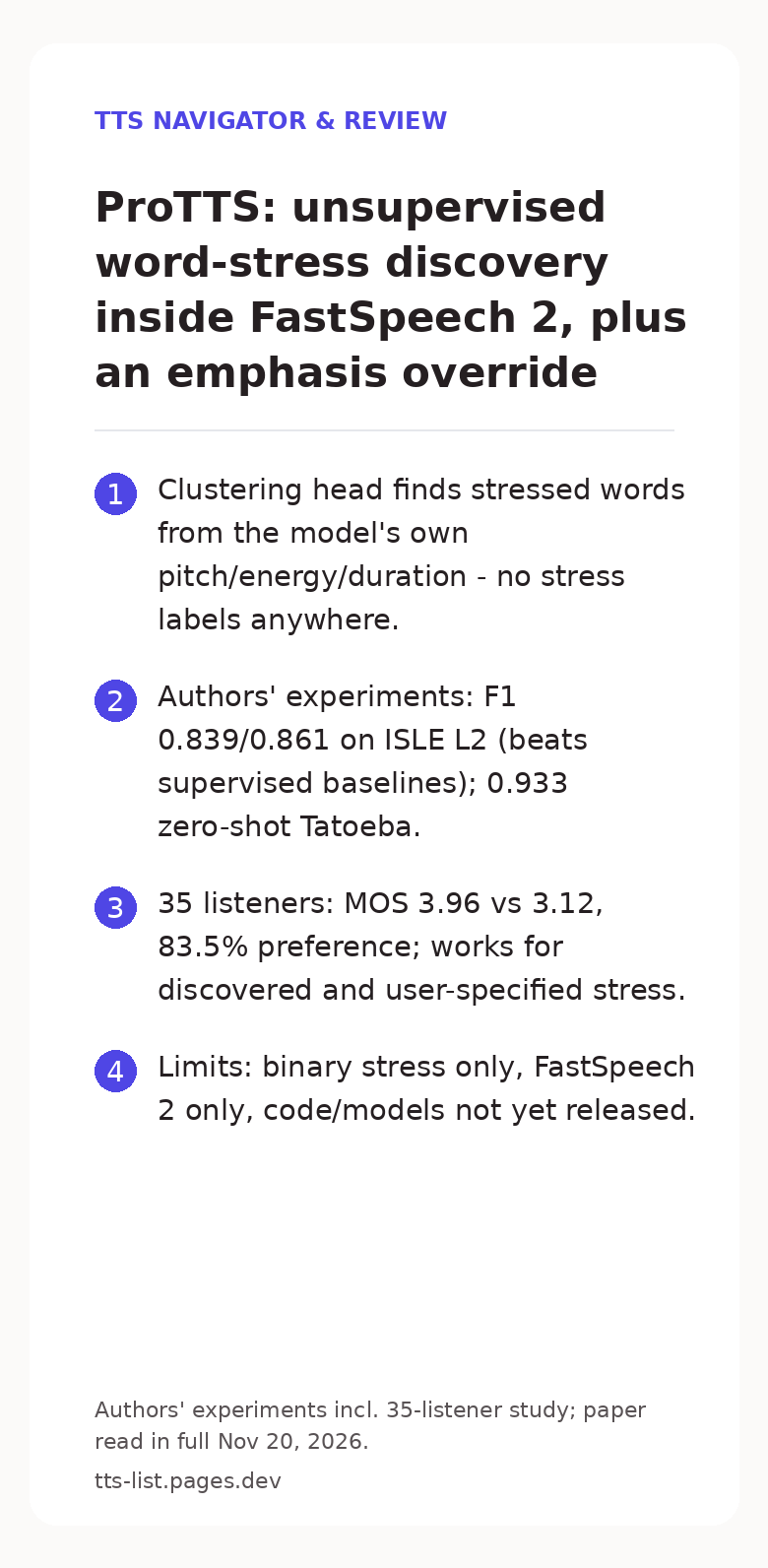
Say "I never said she stole my money" seven times, stressing a different word each time - seven different meanings. Most TTS systems have no idea where that stress should go: emphasis-controllable models need you to supply stress labels, and stress detectors exist only as separate tools that never talk to a synthesizer. ProTTS (arXiv 2611.19832, November 15, 2026, IIIT Hyderabad) closes that loop inside one model: a clustering head inside FastSpeech 2's variance adaptor discovers stressed words from the model's own prosodic predictions (pitch, energy, duration), emphasis variance predictors then modify those three contours only for stressed words, and at inference you can replace the discovered mask with your own to control emphasis directly. No stress labels are used at any training stage.
Detection results, in the authors' experiments
Evaluated as a stress detector against word-level ground truth, ProTTS reaches F1 0.839 (German L2) and 0.861 (Italian L2) on the ISLE non-native corpus - above both the unsupervised K-Means baseline (0.76/0.71) and the supervised baselines it was compared against (DNN 0.83/0.74, SupraDoRAL 0.78/0.87, WhiStress 0.80/0.87). Trained on LibriTTS it transfers zero-shot to Tatoeba at 0.933 F1, ahead of a supervised DNN (0.891), and scores 0.911 on TinyStress-15k and 0.923 on EmphAssess. A supervised upper bound trained on ground-truth labels reaches 0.901/0.932 on ISLE, so a 0.06-0.07 gap remains for cases where stress depends on discourse context rather than acoustics. Evidence the representation genuinely changed: K-Means clustering accuracy on the prosody embeddings rose from 67.0% before to 87.2% after joint training.
Does it sound better? A human study, not a predictor
Thirty-five listeners (balanced across gender, native language, and speech-research familiarity) rated the output. Naturalness MOS: 3.96 (±0.11) for ProTTS vs 3.12 (±0.14) for base FastSpeech 2, with 83.5% preference. In the stress-preference test (target words highlighted, both automatic and user-specified masks), ProTTS was preferred 78.3% with only 4.1% preferring the baseline. In ABX similarity against real recordings, ProTTS was chosen as closer 71.8% of the time. The authors argue the emphasis predictors are not merely exaggerating prosody but aligning with how speakers realize prominence - and the three test designs together support that reading.
Where it fails, per the authors
Two error patterns are named: over-predicting stress on contextually unstressed content words (which carry strong prosodic profiles anyway), and missing stress on short monosyllables like "pub" or "bus" where acoustic cues are weakest. The limitations section adds: the binary stressed/unstressed assumption cannot express gradient prominence; only German and Italian L2 backgrounds were evaluated (tonal-language L1s like Mandarin may behave differently); and the whole framework is demonstrated on FastSpeech 2 - a 2019-era non-autoregressive architecture - so how the idea ports to modern LLM-based TTS is untested.
Why it matters to builders
"Emphasize this word" is one of the oldest feature requests in TTS, usually answered with SSML markup that sounds bolted on. ProTTS shows a route where emphasis placement is learned, natural-sounding by human judgment, and user-overridable in the same architecture, at FastSpeech-scale cost. The caveat for anyone planning to use it: code and trained models are not released yet - the paper states they will be released upon acceptance. Until then this is a recipe (and a reproducible-looking one: 100k steps from a pretrained FS2 checkpoint, full hyperparameters in the appendix), not a download. Together with this week's DPO-GSPO-OPSD post-training paper on text-adaptive prosody, it marks a visible turn: expressiveness work is moving from prompt tricks into the model itself.