EmpDPO: teaching a TTS model to stress the right word with 5,171 preference pairs (Adobe Research + Brown)
Published November 3, 2026 · Built from the arXiv paper (2610.39427, October 29, 2026; HTML full text read November 3, 2026). All experiments and numbers are the paper authors' (Haonan Chen, Yunyun Wang, Megan Wei, Zeyu Jin - Adobe Research and Brown University); we did not run anything. The base model is internal and no code or weights are released.
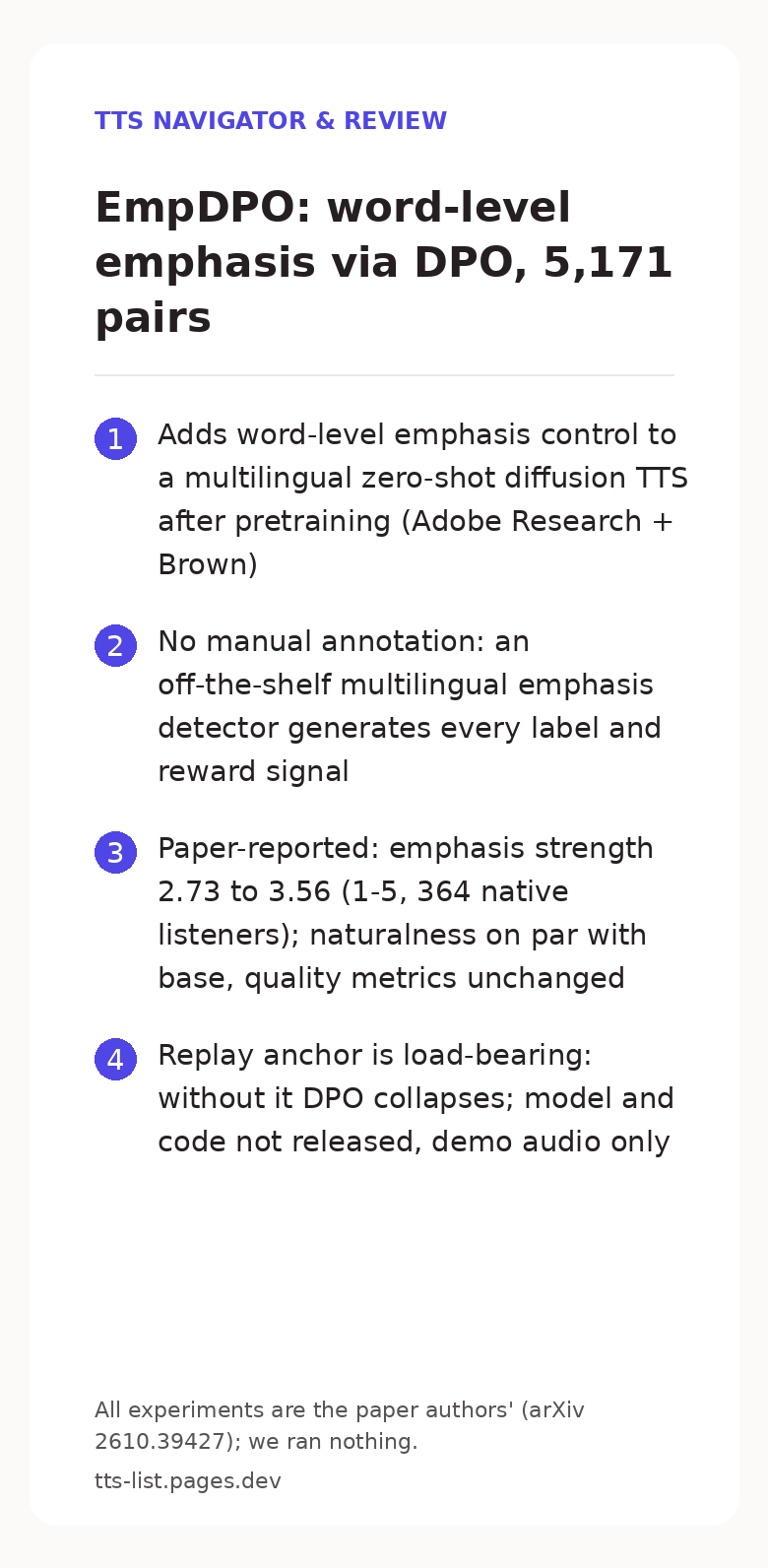
Emphasis is one of the last controls TTS handles badly: mark a word as important and most systems either ignore the markup or make the whole sentence sound off. EmpDPO takes a pretrained multilingual zero-shot diffusion TTS (flow-matching over DAC latents, T5 text + IPA phonemes) and adds word-level emphasis control after pretraining - with no manual emphasis annotation anywhere in the pipeline. An off-the-shelf multilingual emphasis detector (trained on 7 languages, applied zero-shot elsewhere) supplies every training label.
How it works
- Stage 1 - SFT: sentences where the detector finds emphasis get special begin/end markers around the emphasized words; the base model is fine-tuned on 711 hours (45% marked) so it learns the marker syntax.
- Stage 2 - Diffusion-DPO: for each sentence, 5 candidates are sampled with different emphasized positions; the detector scores each, and winner/loser pairs are built only from candidates that pass quality filters (CER, NISQA, speaker similarity, clipping, minimum emphasis gap). Result: 5,171 pairs across 6 languages (en, de, es, fr, ja, zh), 10k training steps.
- The load-bearing detail - the replay anchor. Paper-reported ablation: DPO without replay collapses (denoising errors explode after ~2k steps, output becomes unintelligible). Replaying the model's own chosen samples works for emphasis but makes output 5.7 dB louder and drops NISQA from 4.4 to 3.7; replaying the real SFT corpus avoids both. Also: 10k more SFT steps alone yield no gain - the improvement is the preference optimization, not extra updates.
Paper-reported results
- Objective (210 sentences x 8 voices): mean emphasis strength delta rises from 0.069 (SFT) to 0.136 (DPO), slightly above Fish-S2's 0.129; WordVoice 0.074; Qwen3-TTS 0.017 (near zero - emphasis control is rare in public systems). The paper reports CER, speaker similarity, UTMOS and NISQA unchanged.
- Subjective (364 native listeners via Prolific, 1-5 scale): emphasis strength Base 2.73 → SFT 3.15 → DPO 3.56 vs Fish-S2 3.25; naturalness statistically on par with Base and SFT at ~3.47 per the paper (Fish-S2 2.90, WordVoice 3.13, both significantly lower). Mis-emphasis rate: 32% DPO vs 29% Fish-S2 - slightly worse, per the paper.
- An honest per-language wrinkle: Fish-S2 beats DPO on English but loses on the other five languages; the authors suspect Fish-S2 carries over the accent of its English reference audio (they heard a foreign accent on Chinese samples).
Why it matters
- Preference optimization is quietly colonizing speech. DPO came from text LLMs, then diffusion images; EmpDPO shows it transfers to diffusion TTS with a few thousand pairs - provided a replay term anchors the model to real speech. That replay finding is the most reusable lesson in the paper.
- Zero new annotation as a recipe. Using an off-the-shelf detector as both data labeler and reward signal means any prosodic attribute with a decent classifier could get the same treatment.
- Availability caveat: this is a research recipe, not a product. The base model trained on 300k hours of internal data; no code or weights are released - only a demo page with audio samples. If you need emphasis control today in an open model, this paper tells you how to build it, not where to download it.
Source (read in full; links verified November 3, 2026)
- EmpDPO: Word-Level Emphasis Control in Multilingual Zero-Shot TTS using Direct Preference Optimization - arXiv 2610.39427 (October 29, 2026) - method, training details, all evaluations and the replay ablation above.