When zero-shot TTS meets gender-expansive voices: human listeners and automated metrics disagree
November 18, 2026 - TTS Navi. We read all 6 pages of the paper in full. Results below are reported by the paper authors.
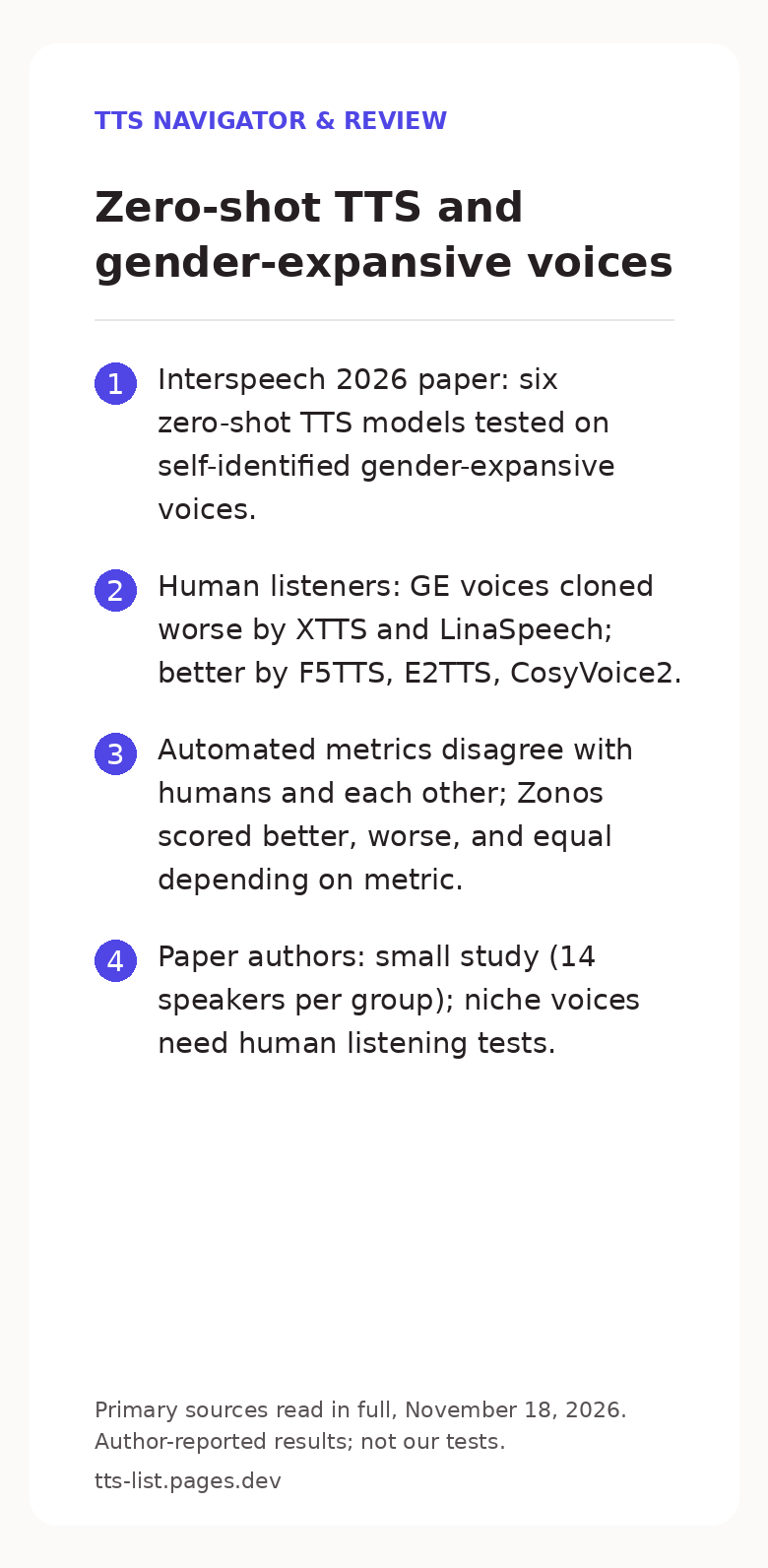
If you evaluate voice cloning only with automated speaker-similarity and predicted-MOS scores, a new Interspeech 2026 paper says you may be drawing the wrong conclusions for voices outside the training mainstream. Researchers at KTH Royal Institute of Technology and UC Berkeley tested six zero-shot TTS models on gender-expansive (GE) voices - speakers who self-identify as not cisgender - and found that automated metrics conflict with human listeners and with each other.
The setup, and its scale limits
The authors synthesized 15 Harvard sentences per speaker with CosyVoice2, E2TTS, F5TTS, XTTS, Zonos and LinaSpeech, using about ten seconds of reference audio per speaker. Gender-expansive references came from the MAGES dataset of self-identified speakers; cisgender references from GLOBE, whose authors note some gender labels were classifier-assigned. Sixteen listeners rated similarity in a MUSHRA-like protocol on eight speakers. This is a small study - 14 speakers per dataset group - so treat direction and conflict as the finding, not exact percentages.
What human listeners heard
Paper authors report that listeners rated GE voices significantly less similar to the reference for XTTS and LinaSpeech, but significantly more similar for E2TTS, F5TTS and CosyVoice2, with no significant difference for Zonos. The effect sizes were largest where GE voices did worse: Cohen's d of .704 for LinaSpeech and .419 for XTTS, versus -.311, -.283 and -.226 where GE voices did better. In other words, when cloning fails for these voices, it fails harder than it succeeds elsewhere.
Where the automated metrics break
Three speaker-embedding metrics (ECAPA-TDNN, TitaNet-L, ReDimNet-M) and two MOS predictors (UTMOS, a fine-tuned wav2vec2) often pointed in opposite directions. For Zonos, ECAPA-TDNN predicted GE voices score better, TitaNet-L predicted worse, and ReDimNet-M found no difference. UTMOS predicted non-GE voices score higher for all six models, while the fine-tuned wav2vec2 found significant differences for only two. Only LinaSpeech was consistent: worse for GE voices across all three embeddings and in WER, matching the human ratings.
The authors' explanation is a hypothesis
The paper suggests the two models listeners judged worse were trained on read speech, while two that did better (F5TTS, E2TTS) were trained on the in-the-wild Emilia corpus, whose spontaneous speech likely covers more diverse speakers. The authors are explicit that this is speculative, and note a subtler risk: if synthesis and metric models both flatten the queer aspects of a voice, automated scores can look deceptively consistent - agreement between metrics was higher on GE voices for most models, which may reflect erasure rather than accuracy.
Why practitioners should care even outside this use case
The broader lesson transfers to any niche voice population: accented speakers, the elderly, children. An evaluation pipeline validated on mainstream voices does not automatically transfer. The authors also document the data bottleneck - they found only two speech datasets with explicit queer representation, and only 14 usable voices in one - and argue new datasets must be built with the represented communities, under the principle "nothing about us without us." Until then, the paper's practical advice is implicit but clear: for underrepresented voices, budget human listening tests, because the automated shortcuts disagree with people.