NepTTS-Bench: when native listeners disagree with the metrics - Piper beats ElevenLabs on Nepali
Published November 4, 2026 · Built from the arXiv paper (2611.03718, v1 submitted October 31, 2026; HTML full text read November 4, 2026). All experiments and numbers are the paper authors' (Ashish Thapa - Ampixa Labs; Rupak Ghimire - Kathmandu University; Lekhnath Sharma Pathak - Tribhuvan University); we did not run anything.
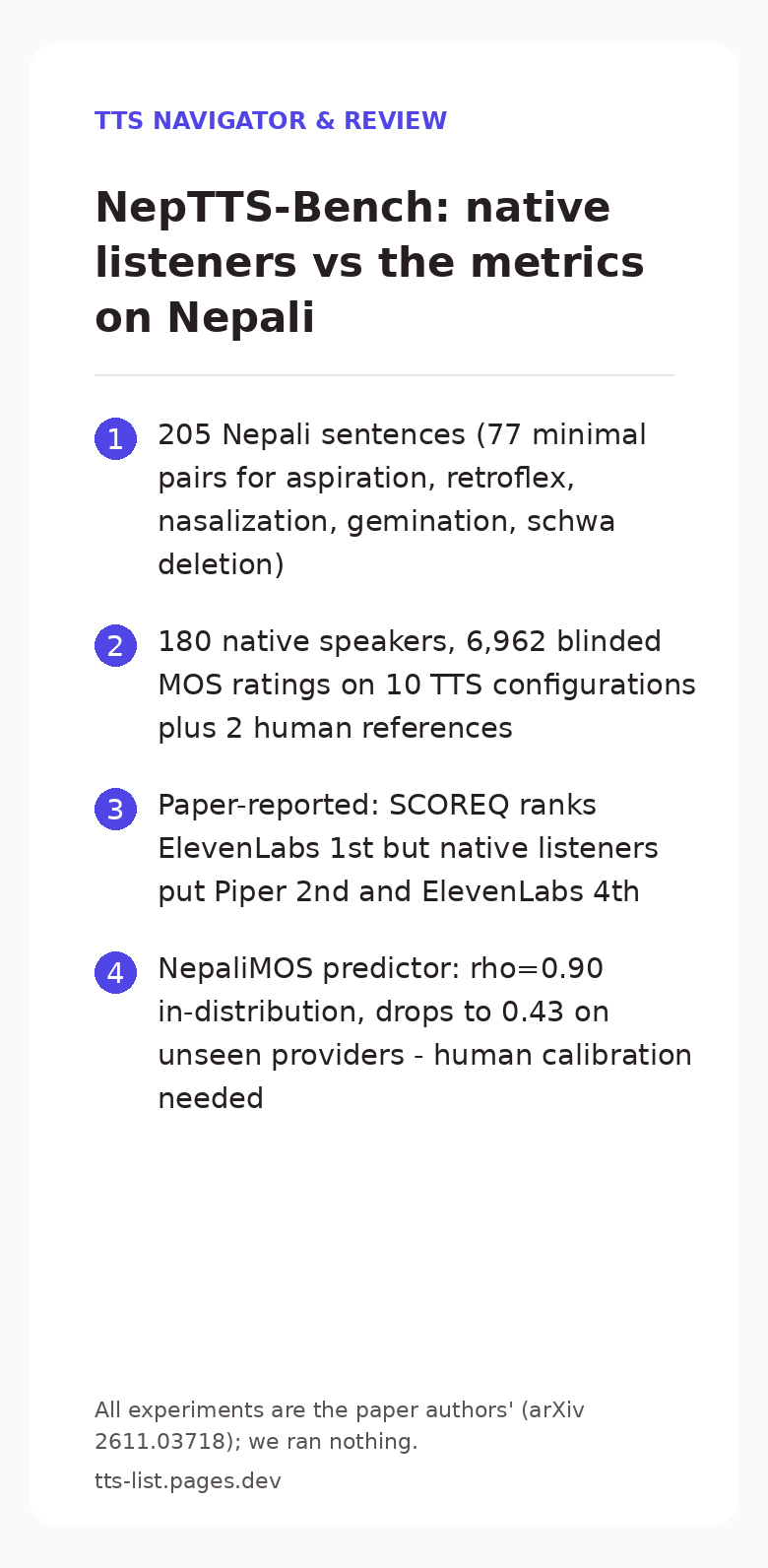
Every low-resource language hits the same wall: several TTS systems claim to support it, their papers report incomparable numbers, and nobody has run one controlled listening test. NepTTS-Bench does that unglamorous work for Nepali: 205 sentences, 77 of them minimal pairs targeting the contrasts that decide whether synthesized Nepali sounds right - aspiration, retroflex vs dental stops, nasalization, gemination, schwa deletion - rated by 180 native Nepali speakers under one blinded protocol (6,962 ratings, 1-5 MOS, 95% cluster-bootstrap CIs).
Paper-reported results
- The headline divergence: SCOREQ (a general no-reference quality metric) ranks ElevenLabs v3 first - but native listeners rate ElevenLabs fourth (MOS 3.47) and put open/local Piper second (3.50), behind only the Nepali-specific TingTing Asmita voice (3.55). The paper's explanation: systems not tuned for Nepali drift into Hindi phonological behavior, which clean-signal metrics cannot hear and the minimal pairs are designed to expose.
- ASR round-trip has the same blind spot. Gemini Flash posts the best Whisper-small CER yet lands mid-pack on human MOS - easy to transcribe is not the same as sounds right. Of 7 ASR models tested for round-trip ranking, Chirp 2 and MMS agree best with human scores. Whisper large-v3-turbo is documented as a negative finding: up to 10% of files per system produced fluent hallucinated Nepali "transcripts" (CER up to 1,115), so it is unusable without hallucination filtering.
- Even the purpose-built metric does not transfer. NepaliMOS (IndicWav2Vec fine-tuned on the collected ratings) reaches Spearman rho=0.90 at system level in-distribution - the only metric surviving multiple-testing correction - but under leave-one-system-out evaluation utterance-level correlation drops to rho=0.43 and held-out providers cannot be ranked reliably. The authors' own conclusion: calibrate with a small human panel before trusting it on any new system.
- The top of the table is a tie, honestly reported. Inter-rater agreement is low (Krippendorff alpha=0.17) and most top-cluster CIs overlap, so the paper refuses to name a single winner; only gTTS (2.60) is clearly separated at the bottom. The wider release covers 40 named systems/voices, with the sparse-rated ones explicitly excluded from statistical claims.
Why it matters
- This is the missing layer for the low-resource TTS wave. We keep covering new models for under-served languages (14 Indic languages from Arrowhead, Vietnamese from TiHon this week); benchmarks like this are how claims about such languages get checked. The same minimal-pair method transfers to any language where "close neighbor accent" is the dominant failure mode.
- A caution for how we read every model card. Cards - including ones we covered this week - lean on UTMOS/SCOREQ-style predicted quality. Here is direct evidence that for a low-resource language those scores can invert the human ranking. Predicted metrics are triage, not verdict.
- Availability caveat: the benchmark package (prompts, ratings, audio, evaluation CLI) is promised "upon acceptance" - it is not downloadable yet, so the results cannot be independently re-run today.
Source (read in full; link verified November 4, 2026)
- NepTTS-Bench: Native-Speaker Benchmarking and NepaliMOS for Nepali Text-to-Speech - arXiv 2611.03718 (v1, October 31, 2026) - dataset design, rating protocol, all metric-vs-human tables and the LOSO transfer analysis above.