Your cloned voice reads every text in the same flat style. This paper attacks that with post-training.
November 19, 2026 - TTS Navi. We read the paper in full. All results are the authors' experiments on LLM-judged benchmarks plus their human ABX study, not our tests.
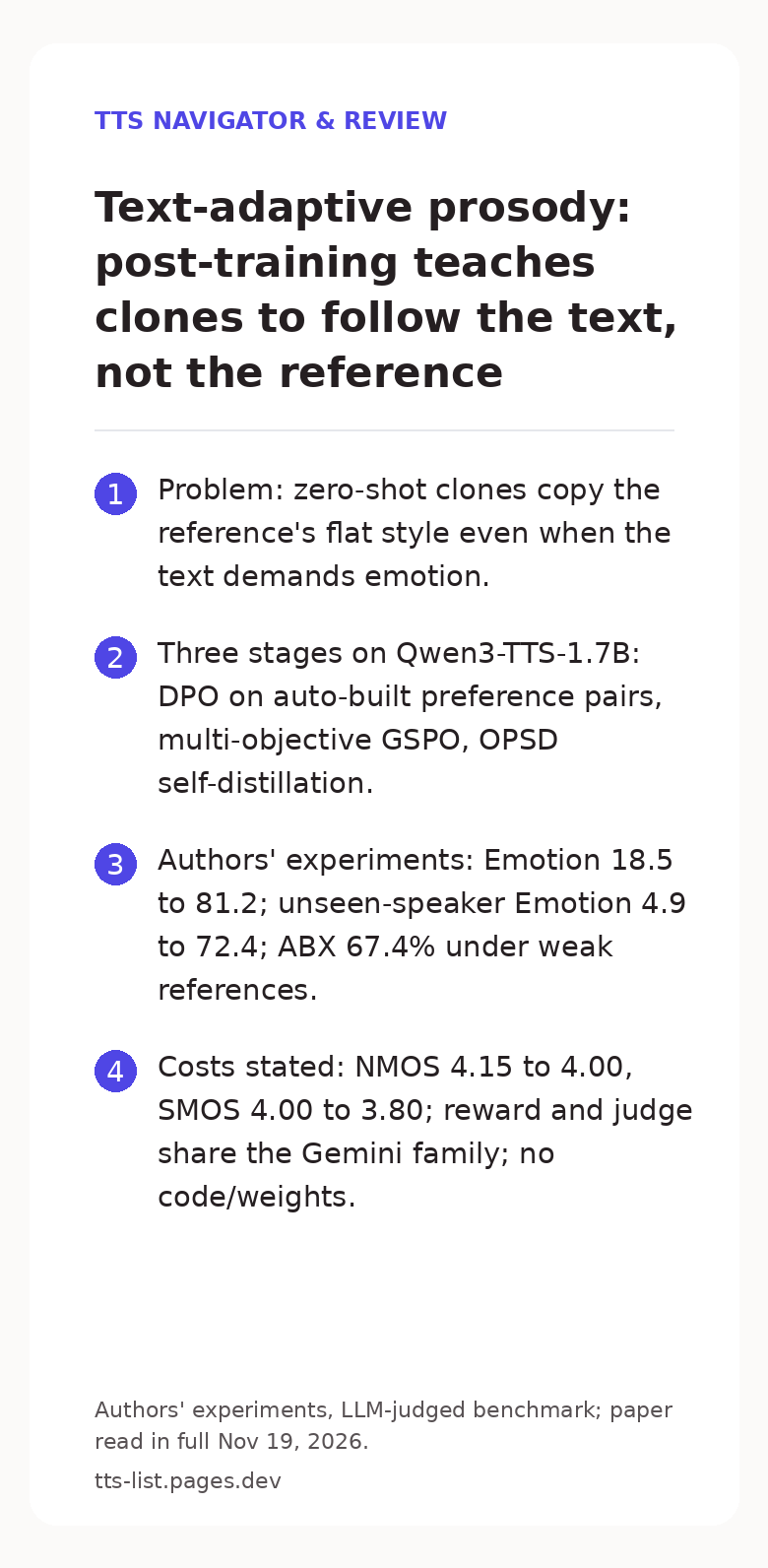
Zero-shot voice cloning copies everything from the reference clip, including its speaking style. If your reference is a calm, flat sentence, every output sounds calm and flat, even when the target text is excited, questioning or sarcastic. A paper from Alibaba Token Hub and Nanjing University (arXiv 2611.19787, November 15, 2026) names this text-adaptive prosody synthesis: keep the speaker's timbre, but let the target text, not the reference recording, decide the delivery. Their answer needs no architecture change and no explicit style controls. It is pure post-training, in three stages, applied to Qwen3-TTS-12Hz-1.7B-Base.
Stage 1: DPO cold start on automatically built preference pairs
Preference pairs are constructed without human annotation: Gemini 3.1 Flash TTS generates a teacher sample for each text, the student model rolls out ten candidates conditioned on the target speaker's reference, and Gemini 2.5 Pro verifies that the teacher's prosody actually fits the text better before a pair is kept. SeedVC voice conversion then expands coverage from 30 seed speakers to 500 speakers sampled from Emilia, and UTMOS, WER and speaker-similarity filters clean the result. DPO on these pairs aligns the model toward text-appropriate expressiveness. An ablation worth knowing: plain SFT on the same teacher data boosts Emotion but degrades complex pronunciation (65.3 to 53.3), while DPO avoids that degradation.
Stage 2: multi-objective GSPO
Group Sequence Policy Optimization then jointly rewards four things: prosodic expressiveness (judged by Gemini 2.5 Pro), acoustic quality (UTMOS), intelligibility (WER) and speaker similarity. The ablation shows the prosody reward does the heavy lifting: removing it drops the Emotion score from 92.3 to 62.9, while removing the UTMOS reward drops UTMOS from 3.32 to 2.74. The default configuration (4 rollouts, batch 64) beat a 64-rollout, batch-4 variant on every reported metric.
Stage 3: OPSD, learning to need less from the reference
Context-conditioned On-Policy Self-Distillation trains the model under weak, flat references to match its own output distributions when given strong, expressive references, using full-vocabulary JSD (which edged out a cheaper sampled-token variant in their ablation). At inference, no expressive reference is needed - the expressive behavior has been internalized.
Results, with the judge caveat attached
In the authors' experiments, overall Emotion on Emergent TTS-Eval rises from 18.5 to 81.2 and Paralinguistics from 38.4 to 73.9. The unseen-speaker gain is the striking one: Out-Set Emotion goes from 4.9 to 72.4. A human ABX study supports the mechanism: listeners preferred high-expressiveness references over low ones 75.7% to 19.2% for the baseline, confirming reference dependence, and preferred the OPSD model over the baseline 67.4% to 25.7% when both used the same weak reference.
Two caveats belong next to those numbers
First, both the training reward and the Emergent TTS-Eval judge lean on Gemini models. The authors report 80.1% agreement between the Gemini judge and human preferences, which helps, but reward and evaluator sharing a model family is structurally favorable ground; treat the 18.5-to-81.2 jump as the authors' experiments on an LLM-judged benchmark, not an independent measurement. Second, the costs are real and stated: naturalness MOS slips 4.15 to 4.00, speaker-similarity MOS 4.00 to 3.80, and automatic SIM also drops. Expressiveness and identity preservation still trade off, and the authors name stronger identity preservation as future work.
Why it matters to builders
If you ship voice cloning, "the clone sounds flat" is one of the most common complaints, and today the only fixes are prompt-engineering the reference clip or hoping for hidden style controls. This paper shows a reproducible recipe - DPO, then multi-objective RL, then self-distillation across reference strengths - that works on an existing open base model. It is a recipe, not a product: no code or weights accompany the paper, only a demo page with audio samples. But every component (DPO, GSPO, OPSD, automated preference-pair construction) is standard and documented, so a team with Qwen3-TTS fine-tuning capacity could replicate it.