Why few-step TTS loses the speaker: guidance at pure noise shifts every trajectory the same way
November 12, 2026 - by TTS Navi. We read the full paper; all results below are the authors' own experiments, not ours.
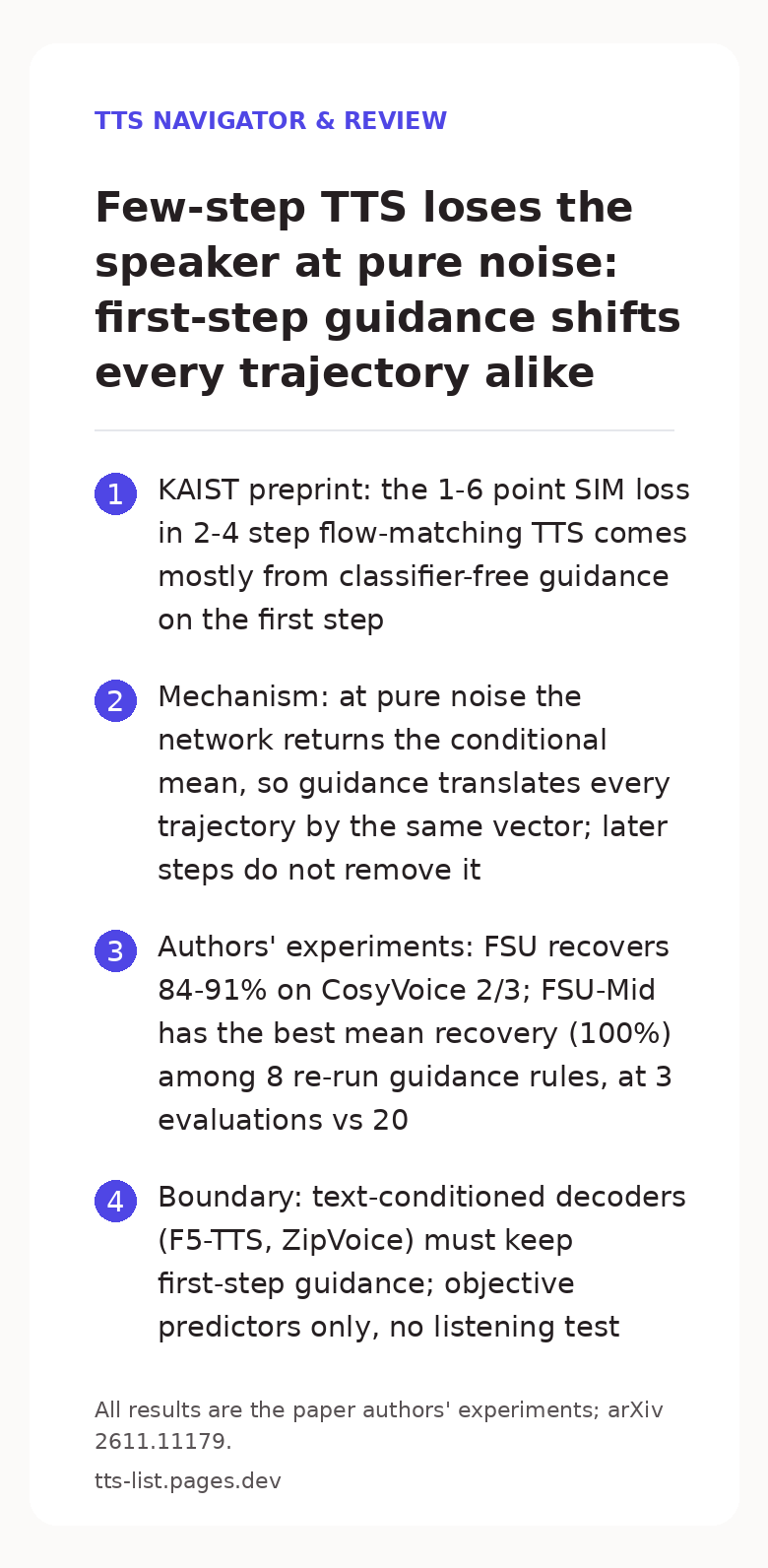
Zero-shot TTS systems that pair a language model with a flow-matching mel decoder increasingly run that decoder at two to four Euler steps instead of the official ten or more, to cut first-packet latency. Every few-step system reports the same cost: word error rate stays flat but speaker similarity drops by one to six points, and nobody had pinned down why. A KAIST preprint (arXiv 2611.11179) answers it: the loss comes mostly from classifier-free guidance applied on the very first step - the step that starts at pure noise - and two training-free samplers derived from that analysis, FSU and FSU-Mid, recover most or all of the loss while using one network evaluation fewer than the official two-step sampler.
The mechanism, in plain terms
At t = 0 the sampler's state is pure Gaussian noise and carries no information about the output, so the network can only return the conditional mean for the given tokens and prompt. The paper's Proposition 1 shows that guidance at that moment adds the same vector - the first-step length times the guidance weight times the guidance direction - to every trajectory, whatever the noise seed. That is a translation of the whole output distribution, not a blur, and its size grows with the length of the first step. On the cosine grid used by CosyVoice the first step spans 0.29 of the trajectory at two steps but 0.01 at ten, so the same guidance weight displaces the state roughly 25 times farther at two steps, which is why the loss only appears in the few-step regime. The tokens already fix content and rhythm, so the speaker is the one free attribute the shift can damage. On CosyVoice 2 the authors measure the two-step output cloud sitting 1.3-1.8 teacher spreads away from the teacher's center, in a direction that points toward another voice; with the noise seed fixed, up to 15 identical later steps do not remove the shift.
What the authors' experiments show
Controls that switch guidance on and off step by step attribute the loss cleanly: guiding only the first step is worse than no guidance at all on all four token-conditioned decoders tested (CosyVoice 2/3, IndexTTS-2, GLM-TTS), in each of eight seeds. FSU - leave the first step (start time below t* = 0.1) unguided, guide the rest - recovers 84-91% of the two-step SIM loss on CosyVoice 2 and 3 with no significant WER change. FSU-Mid, which replaces the two Euler steps with one midpoint step whose first evaluation is unguided, recovers 77-85% on IndexTTS-2 and matches or exceeds the ten-step teacher on CosyVoice 2 and GLM-TTS - at three network evaluations against twenty. Re-running eight published guidance rules at two steps on the same decoders, the authors find each rule recovers SIM in proportion to how much first-step guidance it removes; FSU-Mid gives the highest mean recovery (100%), and the only cell it loses goes to a corrected TV-CFG variant that also zeroes the first step. Gains hold across the hard set, LibriSpeech-PC, multilingual prompts, noisy prompts and long inputs, with no significant WER increase in any of sixteen robustness conditions.
Where the rule does not apply
The same analysis predicts its own boundary, and the authors test it. In text-conditioned decoders (F5-TTS, ZipVoice) the unconditional branch erases the text, the averaging term dominates, and first-step guidance is what establishes the text-audio alignment: removing it raises WER from 2.33 to 6.37 on F5-TTS at eight steps. There, first-step guidance should be kept - though a long guided first step from pure noise hurts those decoders too, and FSU repairs most of a collapsed uniform-grid baseline (WER 80.6% to 18.9%). The choice of unconditional branch matters as well: an all-null branch that also erases the tokens enlarges the guidance vector by 1.6-2.2x, and on CosyVoice 2 it loses 5.8 SIM at two steps against 0.9 for a speaker-null branch. Caveats the authors state: no distilled token-conditioned decoder has public weights, so all experiments run the public teachers with few Euler steps and distilled students are future work; quality is assessed with five objective predictors, not a listening test; and because official implementations batch the two guidance branches, removing one saves computation but leaves wall-clock time nearly unchanged - FSU improves quality at the same latency rather than speeding anything up. Code and samples are on GitHub.
Our analysis
This is a tidy piece of sampler forensics with an unusually complete chain: a closed-form prediction (displacement proportional to first-step length), a direct mel-space test of the closed form (slope 0.99 of prediction), attribution controls, and a remedy that falls out of the diagnosis. The practical upshot for anyone serving a token-conditioned flow-matching TTS decoder is almost free to adopt: if you run two to four steps, stop guiding the first step - and if your grid is uniform (IndexTTS-2 style, where the first step spans half the trajectory), use the midpoint variant instead. It also explains a pattern practitioners have been patching around: distillation papers kept reporting the similarity loss as an unavoidable cost of acceleration, when most of it was one misapplied guidance term. The honest limits are that everything here is SIM-and-predictor evidence without human listening, the distilled-decoder case is untested, and "matches the teacher" is measured against the teacher's own distribution, so a sampler that exceeds the teacher's SIM is not necessarily producing better speech - just speech closer to (or beyond, in the same direction) the reference point.
Sources
- Paper: Guidance at Pure Noise Erodes Speaker Similarity in Few-Step Token-Conditioned Flow-Matching TTS (arXiv 2611.11179) (read in full, November 12, 2026)
- Code and audio samples (GitHub: 16jhlee/FSU)