ZEN-TTS 1.2: Japanese TTS Entirely in the Browser, Emotions Included
November 6, 2026 - by TTS Navi. We read the model card and GitHub README in full; every performance figure below is the vendor's own measurement unless marked otherwise.
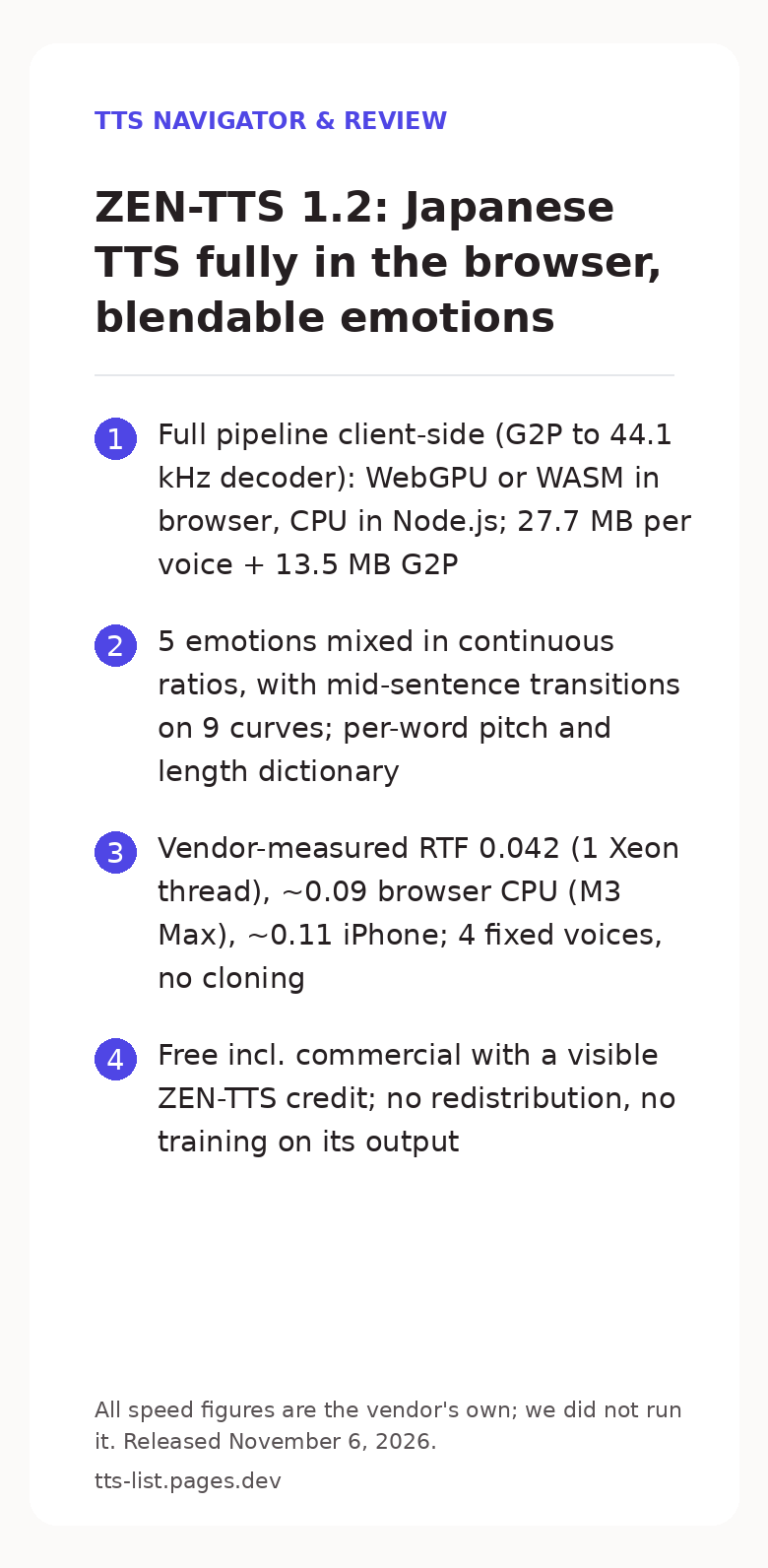
Most browser TTS demos stop at "a model runs in a tab." ZEN-TTS, from Japanese studio Zenryokukikai (全力機械), ships the whole pipeline client-side: text normalization and G2P, prosody prediction, the generator, and the NSF decoder that produces 44.1 kHz audio - all in the browser via WebGPU (WASM SIMD fallback in a Web Worker) or in Node.js on CPU. Version 1.2.0 landed November 6 with model files on Hugging Face (Zenryokukikai/zen-tts) and the runtime on GitHub. Four voices are available (two female, two male: marine, hashiro, kai, kikka), each a single 27.7 MB .ztm file with int8 prosody/generator and fp16 decoder, plus a shared 13.5 MB G2P model and a 60 KB WASM CPU kernel.
Emotion as a continuous, time-varying control
The distinctive feature is not just five emotion styles (neutral, happy, sad, angry, apologetic) but how you control them: emotions are mixed in arbitrary continuous ratios (e.g. {happy: 70, neutral: 30}) and can transition mid-sentence along nine curve types with explicit start and end positions - so a single sentence can move from calm to angry on an ease curve between its 20% and 80% marks. Pitch (-6 to +12 semitones), speed (0.5-1.5x) and intonation strength are separate controls, and a per-word dictionary stores reading, accent type, relative pitch contour and length - relative values, so registered shapes survive any emotion mix. The demo even includes a per-mora intonation editor (F0, length, accent core) that persists across emotion changes.
Vendor-measured speed and the comparison table
Zenryokukikai's README publishes a self-run benchmark on a fixed single Xeon Silver 4316 thread: RTF 0.041-0.045 across short/medium/long sentences, versus Supertonic 3 fp32 (0.28-0.37), VOICEVOX CORE (0.61-0.67), Kokoro-82M (0.66-0.78) and AivisSpeech (3.24, single-run with HTTP overhead). Piper's Japanese voice (0.066-0.070) was measured but excluded from the ranking because its voice data is CC BY-NC-SA; ZEN-TTS was still faster. In browser: roughly RTF 0.09 on an Apple M3 Max (CPU) and 0.11 on iPhone. Model-size comparison: 31.1 MB total for ZEN-TTS versus ~185 MB (VOICEVOX) to ~1.25 GB (AivisSpeech). The vendor also tested per-note pitch control (+3 semitones requested): ZEN-TTS produced +2.8 to +3.5, VOICEVOX +2.0 to +3.0, AivisSpeech ignored the instruction entirely. These are the vendor's own measurements on their chosen setup - treat them as directional, not independent. The README publishes same-sentence audio comparisons, level-matched to -20 LUFS and otherwise unprocessed.
Reading Japanese text correctly
Version 1.2.0's other headline is a new G2P model: it reads numerals with correct counter inflection (10分 = ジュップン, 3本 = サンボン) and English loanwords (Unity, Anthropic) without any built-in reading dictionary; romaji and short uppercase abbreviations are handled by rules. The G2P was trained on Japanese Wikipedia, Aozora Bunko, Tatoeba, Wikinews and National Diet Library data (all documented in the third-party notices). The 1.2.0 voice models also rework noise generation in the synthesizer, reducing consonant/breath roughness and a high "pyun" artifact that appeared on morae like く.
The license: free, with a credit line
ZEN-TTS License 1.0 allows use inside your own apps, sites, services and works - commercial included - with one condition: a visible credit "音声合成:ZEN-TTS" with a link. Modification and redistribution of the weights are not allowed, and the software, weights and generated audio may not be used to train, distill or evaluate other ML models. There is no voice cloning; custom voices are a paid service from the company. Browser support: WebGPU on Chrome/Edge 113+, Safari 26+ and Android Chrome; everything else falls back to WASM.
Our analysis
ZEN-TTS lands in the middle of this week's on-device wave (Linnet, Klein-TTS, Phonon) with a different bet: instead of chasing parameter counts down, it productizes the control surface - continuous emotion mixing, mid-sentence transitions, per-mora pitch editing - as a small, fast, browser-native package. That is exactly the feature set game developers and interactive-fiction builders actually need, and Japanese is a sensible beachhead: VOICEVOX proved the demand but never went browser-native. The honest gaps: only four fixed voices, Japanese only, quality judgment rests on the vendor's own level-matched samples (we did not run it), and the no-training-on-outputs clause will matter to teams who hoped to distill it. Still, a 31 MB footprint with documented per-word pitch control and a credit-only commercial license is a genuinely useful release.
Sources
- Zenryokukikai/zen-tts model card (read in full, November 6, 2026)
- zenryokukikai/zen-tts on GitHub (v1.2.0 README, read in full)
- Zenryokukikai (全力機械)