Sony's Walrus: an 8B unified speech model that bets on data, not architecture
November 11, 2026 - by TTS Navi. We read the full technical report; all results below are the authors' own experiments, not ours.
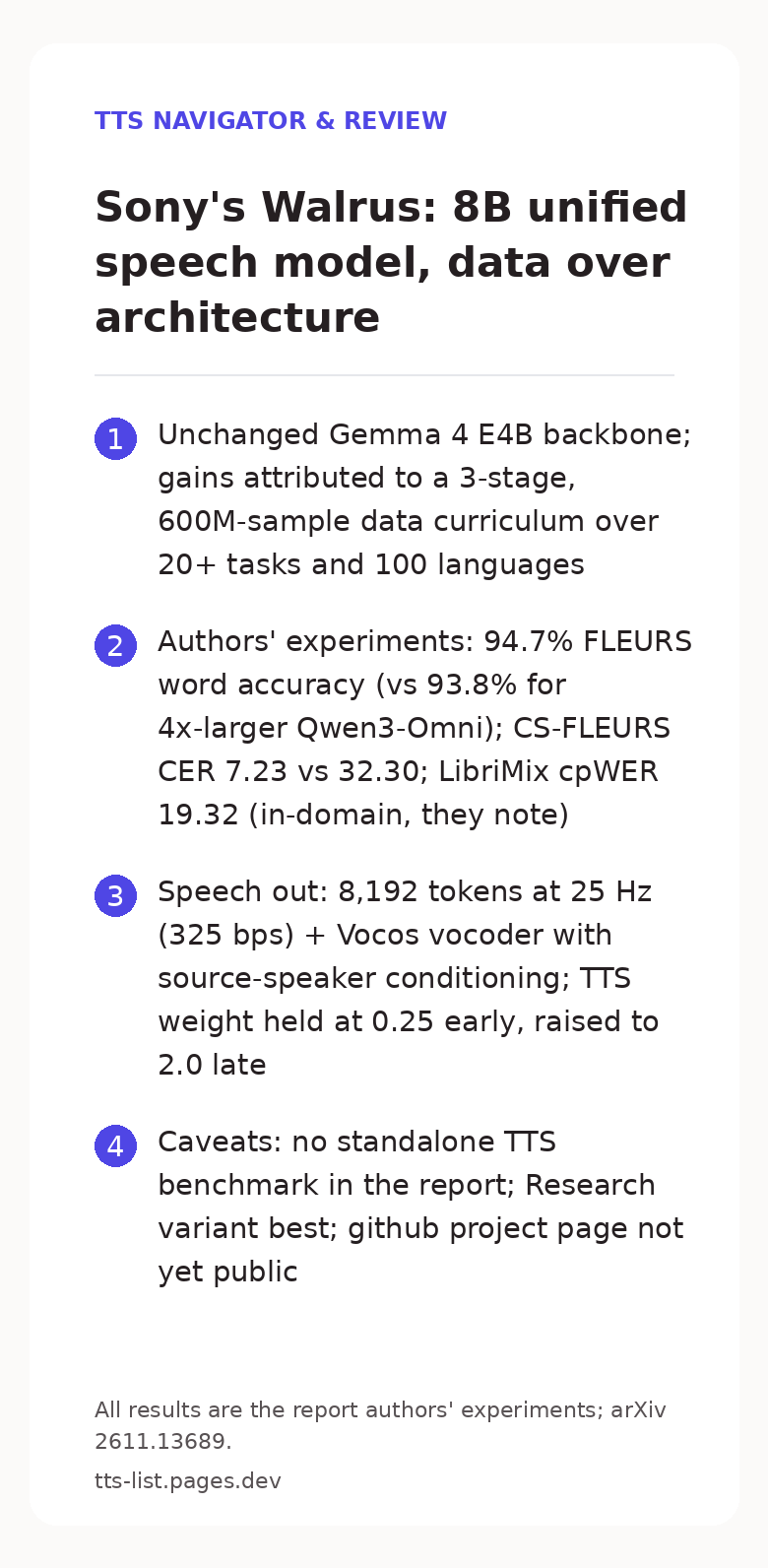
Sony's Speech & Language AI Lab has published the Walrus Technical Report (arXiv 2611.13689): a unified 8B speech-and-audio foundation model covering recognition (including code-switching and multi-talker ASR), translation (text, speech-to-text, speech-to-speech), text-to-speech, emotion recognition, captioning, and audio understanding. The authors' central claim is methodological: the architecture is deliberately ordinary - a Gemma 4 E4B decoder-only backbone, unchanged - so that the gains can be traced to a three-stage data curriculum trained on over 600 million samples across more than 20 tasks and 100 languages, at a cost of about 92,000 H100 GPU-hours.
How the speech side works
For TTS and speech-to-speech translation, Walrus extends the backbone vocabulary with 8,192 discrete speech tokens produced at 25 Hz - 325 bits per second, a very low bitrate. A single-layer VQ tokenizer quantizes features from the 20th layer of W2v-BERT 2.0, and a GAN-based Vocos vocoder renders the waveform in one non-autoregressive step, conditioned on lower-layer features of the source speech so speaker identity and prosody transfer without needing speaker-matched training pairs. The data curriculum is the real contribution: recognition is kept dominant (45% of the mix, with ASR holding the highest task weight in every stage) while generative tasks are deliberately starved early - TTS carries a weight of just 0.25 in stages 1-2 so its long token sequences cannot dominate the loss, then raised to 2.0 in the specialization stage. Two variants ship conceptually: a Commercial-Ready model (stage 2, commercially usable data only) and a Research model (stage 3, all data, best quality).
The authors' numbers - and the TTS caveat
The report's headline results are on recognition, translation, and understanding. The authors report 94.7% word accuracy on FLEURS (ahead of the 4x larger Qwen3-Omni-30B at 93.8% and Whisper Large-v3 at 92.0%), code-switching CER of 7.23 on CS-FLEURS read speech against 32.30 for the best comparable prior system, multi-talker cpWER of 19.32 on LibriMix 2-mix versus 37.04 for Qwen3-Omni-30B (with the authors themselves noting LibriMix is in Walrus's training data), the strongest S2ST scores among compared systems (43.63 ASR-BLEU on CVSS-C X to En), and 71.92% on MMAU-Pro audio understanding. For TTS specifically, the report trains on LibriTTS, VCTK and AISHELL-3 and defines the generation pathway - but the main results table contains no standalone TTS naturalness or similarity benchmark; speech generation quality is only evaluated through S2ST. One ecosystem footnote TTS readers will enjoy: the code-switching training audio was itself synthesized with Qwen3-TTS and an in-house Chatterbox variant, then filtered by NISQA naturalness (3.50 threshold) and Whisper round-trip WER (5% threshold).
Limits, as stated
The authors are candid: multi-talker evaluation uses 30-second segments that do not match long-form rivals' design, and the Japanese Daily Talk cpCER of 56.29 "is still high"; emotion recognition (49.55% on IEMOCAP vs 63.80% for Audio-Flamingo-3) and audio captioning trail specialized baselines; Stage-3 gains cannot be fully separated from the weight rebalancing; and the Commercial-Ready model is measurably behind the Research one. Also practical: the report cites github.com/sony-speech/walrus as the project page, but as of our reading on November 11 that repository is not yet public - there is no code or weights release to try today.
Our analysis
For this site's audience the report is two things at once. As a TTS artifact it is a tease: an 8B model that can speak 100 languages' worth of text at 325 bits per second with prosody transfer, benchmarked only inside translation, with no public weights. As a methods artifact it is one of the year's more useful training documents - the explicit task-weight schedule (starve generation early, feed it late), the two-variant licensing split (a commercially clean checkpoint vs a best-quality research one), and the synthetic-data pipelines with quality filters are all directly copyable ideas, and Sony is unusually transparent about where the model still loses. The claim to watch is whether the Research variant's weights ever ship; until then, Walrus is a benchmark table, not a model you can run.
Sources
- Walrus Technical Report (arXiv 2611.13689) (read in full, November 11, 2026)
- Project page cited by the report: github.com/sony-speech/walrus (link unavailable) (not yet public as of November 11, 2026)