Alania-2 and Antalia-2 Mini: Turkish TTS trained almost entirely on synthetic speech
November 12, 2026 - by TTS Navi. We read both papers in full; all results below are the authors' own experiments, not ours.
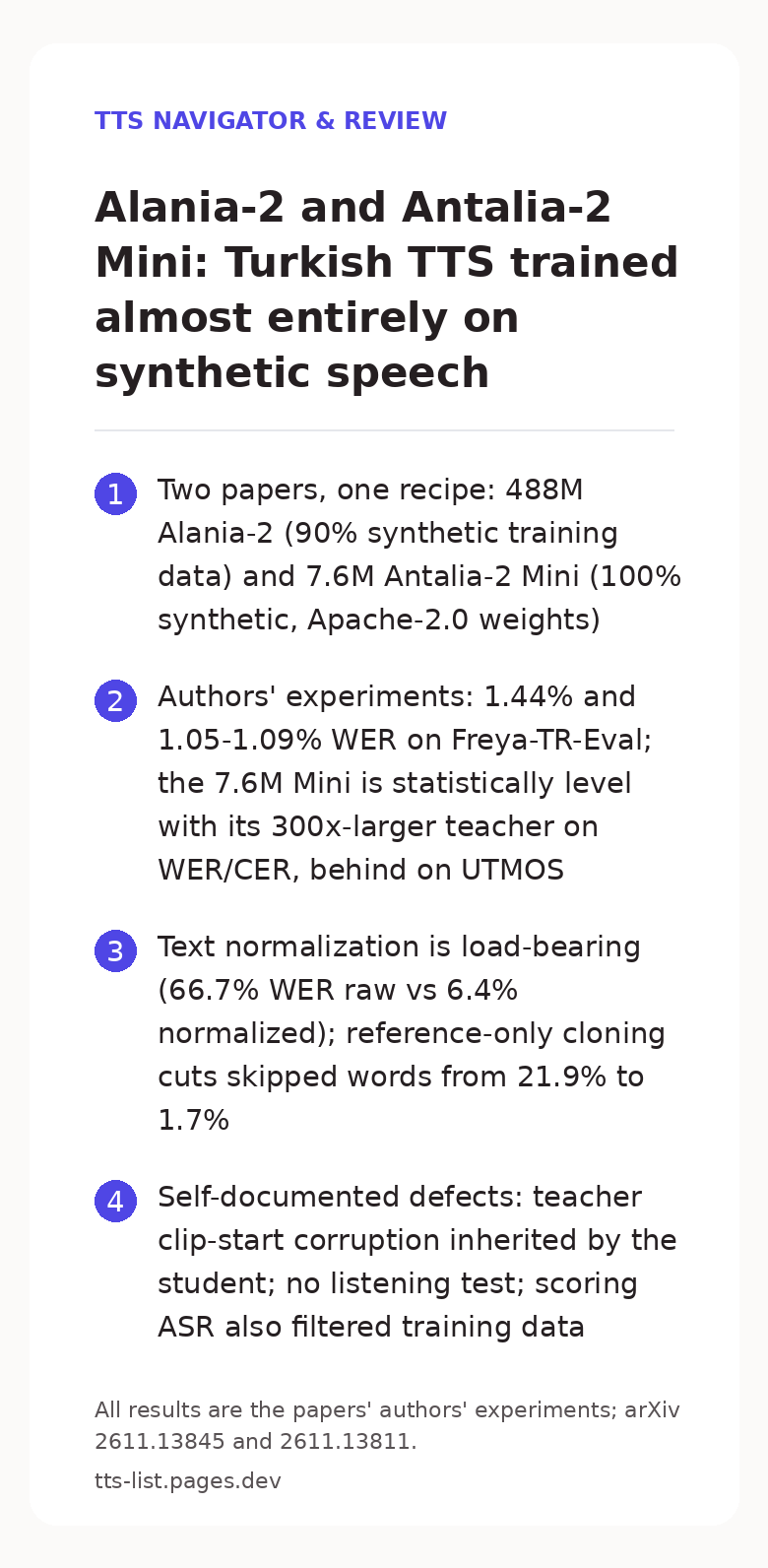
PatientDesk AI has published a pair of papers that read like one story told at two scales. Alania-2 (arXiv 2611.13845) is a 488M-parameter Turkish TTS system with voice design and two kinds of voice cloning, trained from scratch on 18,195 hours of Turkish speech - 90% of it synthetic, generated by the much larger VoxCPM2 and filtered automatically. Antalia-2 Mini (arXiv 2611.13811) pushes the same recipe to the floor: a 7,620,931-parameter single-voice model whose training audio came entirely from one teacher reading one synthetic reference clip, with open Apache-2.0 weights, a browser page, and a signed Android engine. Turkish is a mid-resource language spoken by more than eighty million people, and the pair's shared claim is that data recipe, not parameter count, is what separates intelligible systems from the rest.
What the authors built
Alania-2 keeps VoxCPM2's architecture, tokenizer and frozen audio VAE (16 kHz encode, 48 kHz decode) but trains its own weights from random initialization: a 268M backbone LM, a 72M residual LM, a 69M feature encoder and a 72M diffusion decoder. The data pipeline is the paper. The real portion starts from 9,216 hours of Turkish YODAS audio, treated as untrusted and filtered by language ID, an audio tagger, DNSMOS and re-transcription down to 2,398 hours (1,772 after stricter training filters). The synthetic portion - 16,423 hours - comes from VoxCPM2 reading FineWeb2, Wikipedia, LLM-written domain sentences and YODAS transcripts in two built-in voices plus a bank of 2,752 designed voices, kept only if each clip passes CER, speaking-rate, speaker-match, UTMOS and pitch checks (79.2% pass rate in a manual audit of 681 clips). A rule-based text normalizer rewrites numbers, money, dates, initialisms and foreign brand names into spoken Turkish, with vowel-harmony suffix handling and a native-speaker-reviewed lexicon. Training took on the order of 210 H200 GPU-hours, not counting data generation.
The authors' numbers
On Freya-TR-Eval, a public 495-sentence Turkish benchmark scored by Whisper, Alania-2 reaches 1.44% WER through its API - seventh of 15 systems the authors re-ran under one protocol, against 5.99% for their own previous 3.3B system. The two best systems are tiny: EMA Lightning (8.6M) at 1.04% and their own Antalia-2 Mini at 1.05-1.09%. Normalization is load-bearing: with raw written text the model's WER is 66.7% on constructed clinic-style sentences, against 6.4% normalized, and none of 96 digit-containing sentences kept its critical spans without it. On model size, the authors continued training the full 2.3B VoxCPM2 on their data and gained only 0.3-0.5 CER points on built-in voices over the 488M model, while the 488M model serves 12 requests per second per H200 against about 8. Voice-cloning findings are practical: conditioning on the reference audio alone instead of continuing it cut skipped words from 21.9% to 1.7% over 200 streams; similarity peaks with 20-30 seconds of reference and the model breaks down at 60-120 s (CER 0.47-0.90); a rank-32 LoRA adapter trains in 84-126 seconds on one A100 and beats instant cloning, and is only served if it passes a held-out gate. Engine work (batched VAE decoding, CUDA-graph prefill, kernel warm-up) brings single-stream first audio to 32 ms, and 94 ms at 96 concurrent streams. The Mini adds its own findings: fine-tuning the vocoder on the acoustic model's own mels cut WER from a mean of 3.89% to 1.75% across seven adjacent-checkpoint pairs; it runs at 41x real time on two threads of an Apple M5 CPU and 35x on one L4; and a paired bootstrap cannot distinguish its benchmark WER/CER from EMA Lightning's or from its 300x-larger teacher - while it is clearly behind on full-band UTMOS, an English-trained naturalness proxy.
The defects they document themselves
Both papers are unusually candid. The teacher corrupts the start of a clip when the first word begins with the vowel ö - only 26% of 12,554 kept ö-initial training lines have a correct first word by Whisper - and the student learned the defect; a hidden spoken prefix ("ee, ") is rendered and cut away to hide it, which the authors stress hides rather than removes the problem. A bf16 autocast cache silently gave the Mini's generator no gradients for its first 6,000 training steps. A Turkish casing bug misspelled most ı-initial short-set lines, and they stayed in the data. Whisper checked only 7,500 of 444,437 short clips. And the scoring recognizer also filtered the training data, so WER may flatter the models by an amount the authors say they have not measured. Neither model has had a human listening test; naturalness rests on UTMOS, which was trained on English. Alania-2's weights are not released (the eval harness and three datasets are); the Mini's weights and inference code are, but its training code and data are not.
Our analysis
The pair's most useful contribution is a clean size-versus-data data point: on one public benchmark, under one protocol, the systems span 7.6M to 2.38B parameters and size simply does not predict intelligibility - the 3.3B Alania-1 misreads four times as many words as the 488M Alania-2 trained on better data. The second contribution is methodological honesty as a feature: the teacher-defect inheritance chain (VoxCPM2 corrupts ö-initial clip starts, the 10% whole-line CER gate passes 82% of the affected lines, the student learns the defect, a hidden prefix masks it) is exactly the kind of failure that synthetic-data pipelines usually hide, and here it is documented with counts. The caveats are real: every quality number is an automatic metric, several tuned directly on the benchmark being reported (the authors flag this selection bias themselves), UTMOS is an English proxy applied to Turkish voices, and Alania-2 is closed - only the Mini is reproducible end to end. For teams building mid-resource-language TTS, the actionable lessons are concrete: normalize text before you touch the model, budget GPU time for QC inside the generation plan, fine-tune the vocoder on generated mels early, and check clip starts separately from whole-line CER.
Sources
- Alania-2 paper (arXiv 2611.13845) (read in full, November 12, 2026)
- Antalia-2 Mini paper (arXiv 2611.13811) (read in full, November 12, 2026)
- Freya-TR-Eval re-run harness and results (Hugging Face); released datasets: alania-speech-captions-tr, alania-synthetic-speech-tr, alania-domain-text-tr